For a single-celled organism drifting in the primordial soup, the environment was not a liquid playground but a viscous prison. At the scale of a few microns, the physics of fluid dynamics shift dramatically. Water, which flows effortlessly around a human swimmer, behaves like thick tar or cooling lava for a microbe. In this regime, inertia is irrelevant; the moment an organism stops applying force, it ceases to move. Understanding how early life overcame this constraint is one of the more quietly consequential questions in biophysics — one that sits at the intersection of evolutionary biology, fluid mechanics, and molecular engineering.
The core of the problem is captured by a dimensionless quantity known as the Reynolds number, which expresses the ratio of inertial forces to viscous forces acting on a body moving through a fluid. For a human swimming in a pool, the Reynolds number is on the order of millions — inertia dominates, and a swimmer can push off the water and glide. For a bacterium a few microns long, the Reynolds number drops to something near 0.00001. At that scale, viscous forces overwhelm inertia so completely that the moment propulsive effort ceases, motion stops almost instantaneously. There is no coasting, no momentum to exploit.
The Scallop Theorem and the Limits of Reciprocal Motion
The implications of low Reynolds number physics were formalized in a landmark 1977 lecture by the physicist Edward Purcell, who articulated what became known as the "scallop theorem." Purcell observed that any organism relying on a simple reciprocal motion — opening and closing, rowing back and forth along the same path — would achieve zero net displacement in a low Reynolds number environment. The reason is symmetry: in a world without inertia, a stroke and its reverse cancel each other out perfectly. A scallop, which propels itself in the ocean by clapping its shell open and shut, would go nowhere if shrunk to the size of a bacterium.
This physical constraint imposed a severe design requirement on early life. Random thrashing or simple back-and-forth appendage movement could not produce locomotion. Any viable propulsion mechanism had to break the symmetry of reciprocal motion — it had to involve a stroke cycle whose forward phase is geometrically distinct from its return phase. The challenge was not merely biological but fundamentally mathematical.
The Rotary Solution
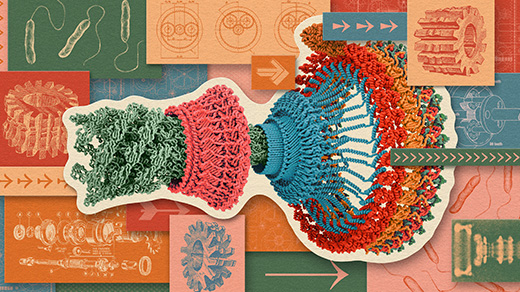
The answer that evolution arrived at — the bacterial flagellar motor — remains one of the most remarkable molecular machines known. Rather than beating or rowing, the flagellum rotates. A helical filament, shaped like a corkscrew, is spun by a protein motor embedded in the cell membrane, powered by the flow of protons or sodium ions across a gradient. Because a rotating helix is inherently non-reciprocal — its geometry breaks the time-reversal symmetry that the scallop theorem demands — it generates net thrust even in the most viscous conditions.
The flagellar motor is not the only solution life discovered. Eukaryotic cilia, for instance, employ a flexible whip-like beat with a distinct power stroke and recovery stroke, each following a different geometric path. Spirochetes, the corkscrew-shaped bacteria responsible for Lyme disease and syphilis, rotate their entire bodies. Each strategy represents a different engineering answer to the same underlying physical constraint: the need to produce asymmetric motion in a world where symmetry means stasis.
What makes the problem enduringly interesting is not just the elegance of the solutions but what they reveal about the relationship between physics and evolution. Natural selection does not operate in a vacuum of possibility — it operates within the boundaries set by physical law. The low Reynolds number regime did not merely influence the shape of early motile organisms; it dictated the narrow class of mechanisms that could work at all. Biology, in this sense, did not invent locomotion so much as discover the small set of locomotion strategies that physics permits at the microscale.
The tension between physical constraint and biological innovation runs through the entire history of life. Whether the flagellar motor arose once and was inherited broadly, or whether rotary and non-reciprocal solutions emerged independently in multiple lineages, remains a subject of active investigation. Either way, the first stroke — the first successful, directed movement of a living cell through its viscous world — was less a triumph of biology alone than a negotiation with the deepest structure of fluid mechanics.
With reporting from Quanta Magazine.
Source · Quanta Magazine