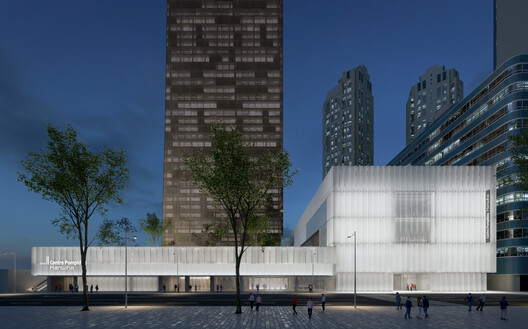
The Centre Pompidou, the French institution that redefined museum architecture with its Renzo Piano and Richard Rogers-designed "inside-out" flagship in 1977, is further decoupling its brand from its Parisian roots. Its latest venture, the Hanwha Seoul Pompidou Center, is slated to open in 2026 within the base of the iconic 63 Tower on Yeouido Island, Seoul's financial district along the Han River. The project, a partnership with the Hanwha Foundation of Culture, adds a 12,000-square-meter cultural hub to a growing constellation of international outposts that already spans cities from Shanghai to Málaga.
The timing is deliberate. The original Paris building — a landmark of high-tech architecture that exposed its structural skeleton, color-coded mechanical systems, and escalator tubes to the outside — remains closed for extensive renovations. Rather than retreat during this period of physical absence in France, the institution has accelerated its international program, treating the closure less as an interruption and more as a catalyst for geographic diversification.
Adaptive Reuse Over Architectural Spectacle
The Seoul project, led by French firm Wilmotte & Associés, departs from the model that made the Pompidou famous. Where the Paris original was a provocation — a building that deliberately challenged the Beaux-Arts fabric of the Marais — the Hanwha Seoul Pompidou Center opts for integration. The center will occupy the lower levels of an existing skyscraper rather than stand as a freestanding monument. Adaptive reuse of this kind reflects a broader shift in institutional architecture: the era of the signature "starchitect" museum, exemplified by Frank Gehry's Guggenheim Bilbao in 1997, has given way to a more pragmatic approach where cultural spaces are woven into existing urban structures.
The design aims to create fluid environments where exhibition galleries intersect with educational facilities, positioning the venue as a civic meeting point rather than a static repository for art. Embedding a cultural institution inside a commercial tower in a financial district also carries symbolic weight. It signals that the Pompidou brand sees itself as compatible with — not opposed to — the rhythms of business and commerce, a posture that aligns with Seoul's own identity as a city where corporate patronage and cultural ambition frequently overlap.
The Logic of Cultural Franchising
The Seoul outpost fits a pattern that has become increasingly common among major Western cultural institutions. The Louvre opened a satellite in Abu Dhabi in 2017. The Guggenheim has pursued franchise agreements across multiple continents for decades. The British Museum and the Hermitage have explored similar models. For the host city, such partnerships offer instant cultural credibility and a recognized global brand. For the institution, they generate revenue, extend influence, and keep the brand visible even when the home venue is unavailable.
But the model carries risks that merit attention. Cultural franchises depend on the sustained prestige of the parent brand, which in turn depends on curatorial independence and intellectual authority. The more an institution disperses its name, the greater the pressure to maintain consistent quality across sites with different governance structures, funding sources, and political contexts. The Guggenheim's experience — where some proposed satellites never materialized and others drew criticism for labor conditions at construction sites — illustrates how expansion can generate reputational exposure alongside cultural reach.
Seoul, for its part, is no passive recipient. The city has built a substantial contemporary art infrastructure of its own over the past two decades, anchored by institutions, commercial galleries, and an art fair circuit that has drawn increasing international attention. The Pompidou arrives not in a cultural vacuum but in a competitive ecosystem where it will need to demonstrate relevance beyond the weight of its name.
The question that hangs over the Hanwha Seoul Pompidou Center — and over the franchise model more broadly — is whether a cultural institution can maintain coherence as it multiplies. A museum is not a hotel chain; its value derives from curatorial vision, not standardized service. Whether the Pompidou's expanding network strengthens that vision or gradually dilutes it remains a tension the institution has yet to resolve, and one that Seoul will now help test.
With reporting from ArchDaily.
Source · ArchDaily