NASA's Curiosity rover has identified a diverse suite of organic molecules within the Gale Crater, providing a significant piece of the puzzle regarding Mars' ancient habitability. Through a first-of-its-kind chemical experiment, the rover detected more than 20 organic compounds in 3.5-billion-year-old clay-rich sandstones. Among these findings are nitrogen heterocycles — complex ring-shaped structures containing nitrogen atoms that serve as the fundamental bases for nucleic acids like DNA and RNA.
The presence of these molecular building blocks does not confirm the existence of past life, but it does establish that the essential chemical ingredients were once present on Mars and, perhaps more critically, have been preserved despite billions of years of harsh radiation and geological activity. For a field that has spent decades searching for organic chemistry beyond Earth, the detection of nitrogen-bearing compounds in ancient sedimentary rock represents a qualitative shift in what can be said about the Red Planet's chemical history.
From water to chemistry: building the habitability case
Curiosity has operated inside Gale Crater since 2012, and the site was chosen precisely because orbital data suggested it once held a lake fed by rivers — an environment where sediments could accumulate and, potentially, preserve organic material. Over the years, the rover has confirmed the presence of ancient liquid water, sulfur-bearing compounds, and simpler organic molecules such as thiophenes and chlorobenzene. Each finding added a layer to the habitability argument, but none carried the biochemical specificity of nitrogen heterocycles.
Nitrogen heterocycles matter because they are not merely organic; they are the structural core of nucleobases — adenine, guanine, cytosine, thymine, and uracil — without which no known genetic system functions. Their detection in Martian clay-rich sandstone narrows the gap between "Mars once had water" and "Mars once had the chemical toolkit that, on Earth, led to biology." That gap remains wide, but it is measurably smaller than it was before this finding.
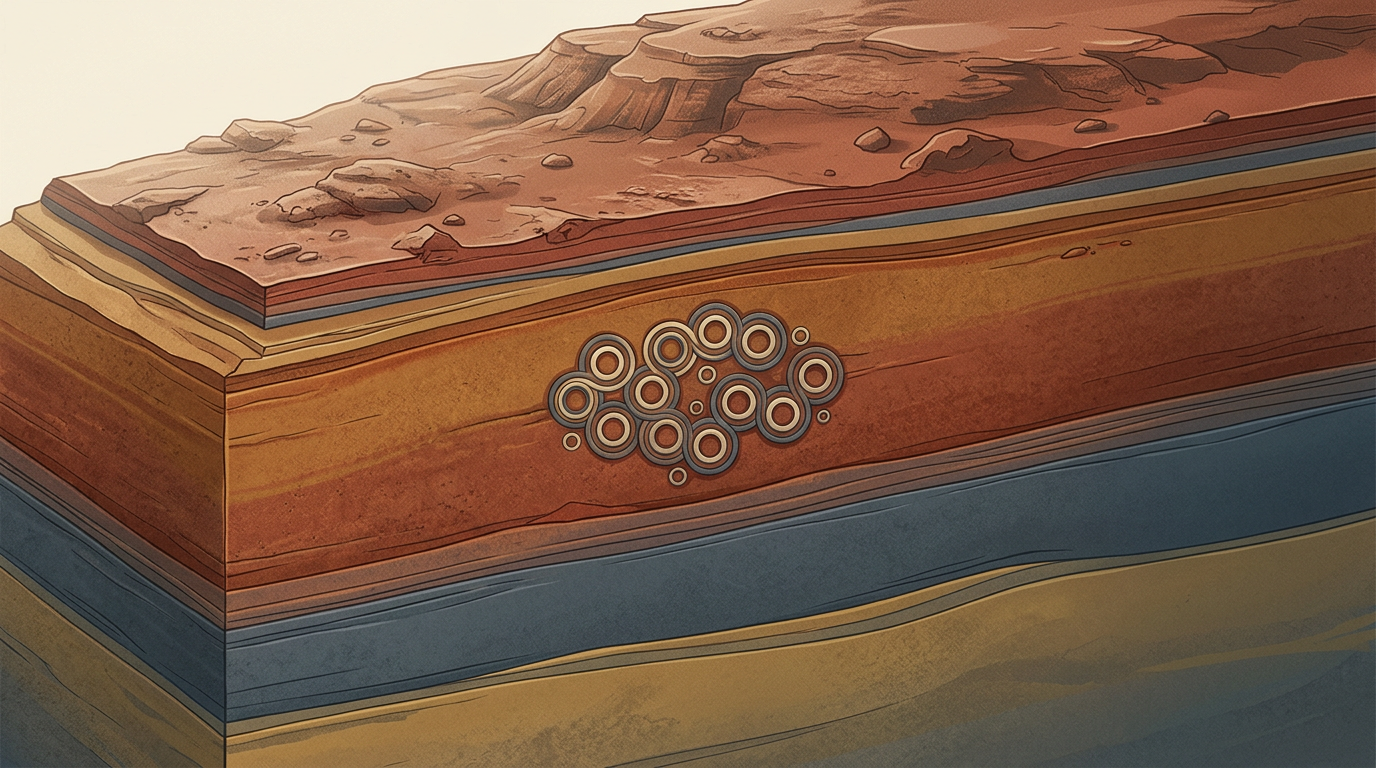
The clay matrix itself is relevant. Clay minerals form in the presence of water and are known to adsorb and shield organic molecules from degradation. On Earth, clay-rich sediments have preserved molecular fossils for hundreds of millions of years. The Martian equivalent appears to have performed a similar protective function across a far longer timescale, suggesting that the geological conditions in Gale Crater were unusually favorable for molecular preservation.
The origin question remains open
Researchers remain cautious about the source of these molecules. The current instrumentation aboard Curiosity cannot distinguish whether the compounds were produced by ancient biological processes, synthesized through internal geological mechanisms such as hydrothermal reactions, or delivered externally via meteorites and interplanetary dust. All three pathways are plausible, and each carries different implications for the broader question of life beyond Earth.
Abiotic synthesis of nitrogen heterocycles has been demonstrated in laboratory settings that simulate volcanic and hydrothermal environments. Carbonaceous chondrite meteorites — some of which have been found to contain nucleobases — regularly deliver organic material to planetary surfaces. Biology, meanwhile, remains the most efficient known producer of such compounds but is also the hardest hypothesis to test at interplanetary distance.
The distinction matters because confirming a biological origin would constitute one of the most consequential scientific findings in history, while a geological or meteoritic origin would still reshape understanding of how prebiotic chemistry distributes itself across the solar system. Future missions, particularly NASA's Mars Sample Return program and the European Space Agency's Rosalind Franklin rover, are designed with instruments better suited to parsing these origins — assuming the samples can be retrieved and analyzed on Earth or with next-generation in-situ tools.
What the Gale Crater finding ultimately places in tension is a familiar scientific asymmetry: the chemical evidence grows steadily more suggestive, while the analytical tools available on Mars remain a generation behind what any terrestrial laboratory could deploy. Whether the molecules sitting in Martian clay are remnants of a living world or artifacts of a sterile but chemically active one is a question that the data, for now, declines to answer.
With reporting from InfoMoney.
Source · InfoMoney