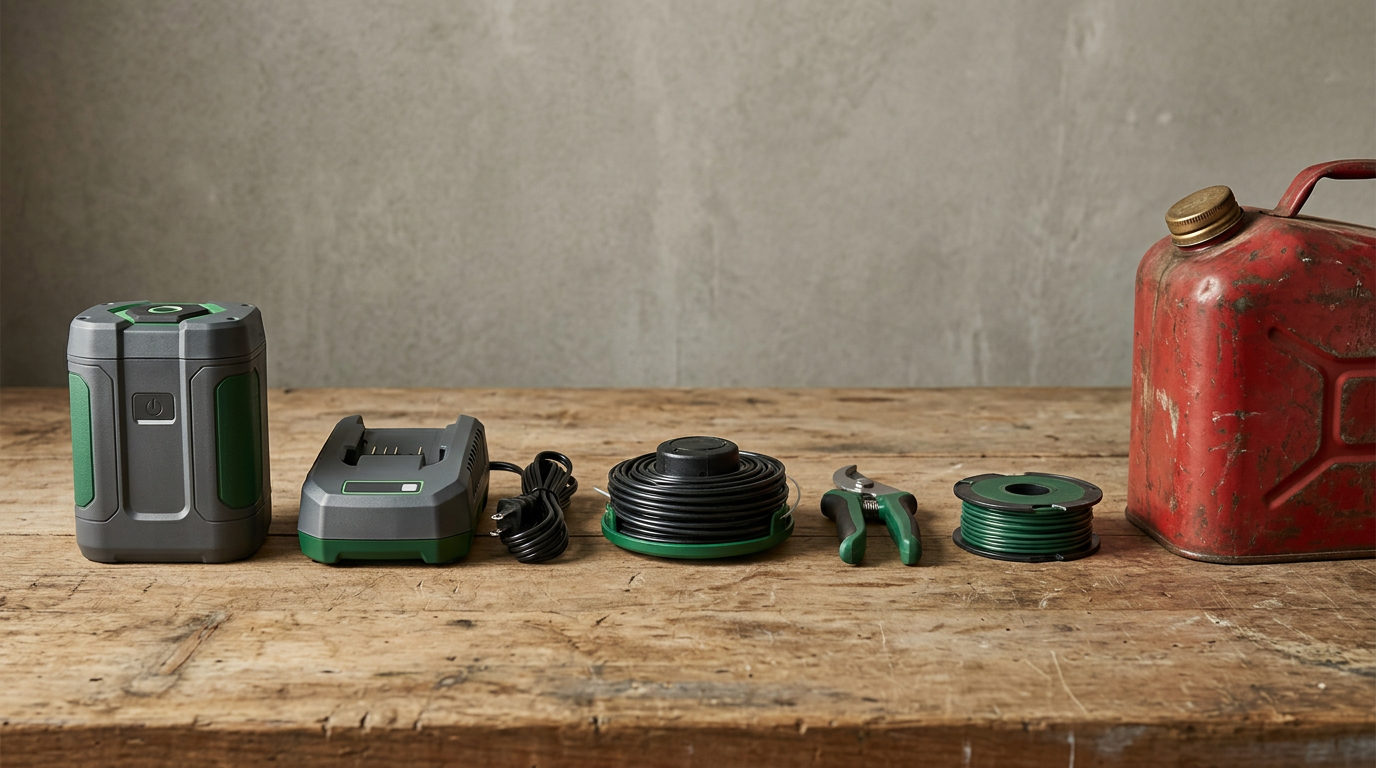
The combustion engine's long-standing hold on the American lawn is beginning to loosen. What was once a landscape defined by pull-starts and gasoline cans is increasingly being reshaped by lithium-ion cells and brushless motors. Recent market shifts — including significant markdowns on self-propelled cordless mowers from brands like Worx and expanding product lines from Greenworks and Jackery — suggest that the so-called "green premium" on electric outdoor equipment is eroding faster than many in the industry anticipated. The shift is not driven by a single breakthrough but by the steady, compounding effects of battery manufacturing scale, falling cell costs, and consumer expectations that have quietly pivoted toward quieter, lower-maintenance alternatives.
The transition has been years in the making. Early cordless mowers and trimmers, introduced in volume roughly a decade ago, suffered from short runtimes, underwhelming power, and price tags that made them hard to justify against a reliable gas-powered equivalent. The intervening years brought improvements in lithium-ion energy density — the same trajectory that reshaped consumer electronics and electric vehicles — and those gains have now cascaded into the comparatively modest power demands of lawn care. A brushless motor paired with a modern battery pack can deliver sustained torque without the maintenance burden of spark plugs, oil changes, or carburetor cleaning. For a growing segment of homeowners, the calculus has shifted from aspiration to pragmatism.
From Lawns to High-Torque Applications
The electrification pattern is not confined to mowing. Pressure washers, leaf blowers, and chainsaws — tools that historically required the energy density only gasoline could provide — are crossing performance thresholds that matter to consumers. Electric pressure washers now reaching output levels around 2,700 PSI place them in territory that was, until recently, the exclusive domain of gas-powered machines. The significance extends beyond convenience. Each tool that moves off gasoline removes the need for onsite fuel storage, eliminates direct tailpipe emissions at the point of use, and reduces noise pollution — a factor that has drawn increasing regulatory attention in municipalities across the United States.
California's ban on the sale of new gas-powered small off-road engines, which took effect in 2024, served as an early regulatory catalyst, but the market dynamics now appear to be outrunning the mandate. Manufacturers are competing on price and performance rather than merely responding to compliance requirements. When mainstream retailers begin discounting cordless mowers and electric pressure washers alongside their gas counterparts during seasonal sales, it signals that the supply chain views these products as volume categories, not specialty niches.
Portable Storage and the Decentralization of Resilience
Perhaps the most structurally significant development is the falling cost of high-capacity portable power stations. Units offering upwards of 1,500 watt-hours of storage — enough to run essential household appliances for hours — are appearing at price points that would have been unthinkable three years ago. The category originated in overlanding and outdoor recreation, but its relevance has expanded as grid reliability concerns grow in regions prone to extreme weather events. A portable lithium-iron-phosphate unit does not replace a whole-home backup generator, but it offers a layer of decentralized resilience that requires no fuel, no permanent installation, and minimal technical knowledge to operate.
The convergence is worth noting: the same battery chemistry improvements that make a cordless mower viable also make a portable power station affordable. Economies of scale in cell production ripple outward across product categories, compressing margins and expanding addressable markets simultaneously. What looks like a collection of unrelated consumer deals — a discounted mower here, a marked-down power station there — is better understood as the surface expression of a deeper industrial shift.
The question that remains open is whether this momentum sustains itself without continued cost declines, or whether the current wave of adoption is partly a function of promotional pricing that masks still-fragile unit economics for manufacturers. The tension between volume growth and margin pressure will shape how quickly electrified outdoor equipment moves from early-majority adoption to true market default. For now, the pull-start is losing ground — not with a dramatic rupture, but with the slow, steady logic of a better cost curve.
With reporting from Electrek.
Source · Electrek