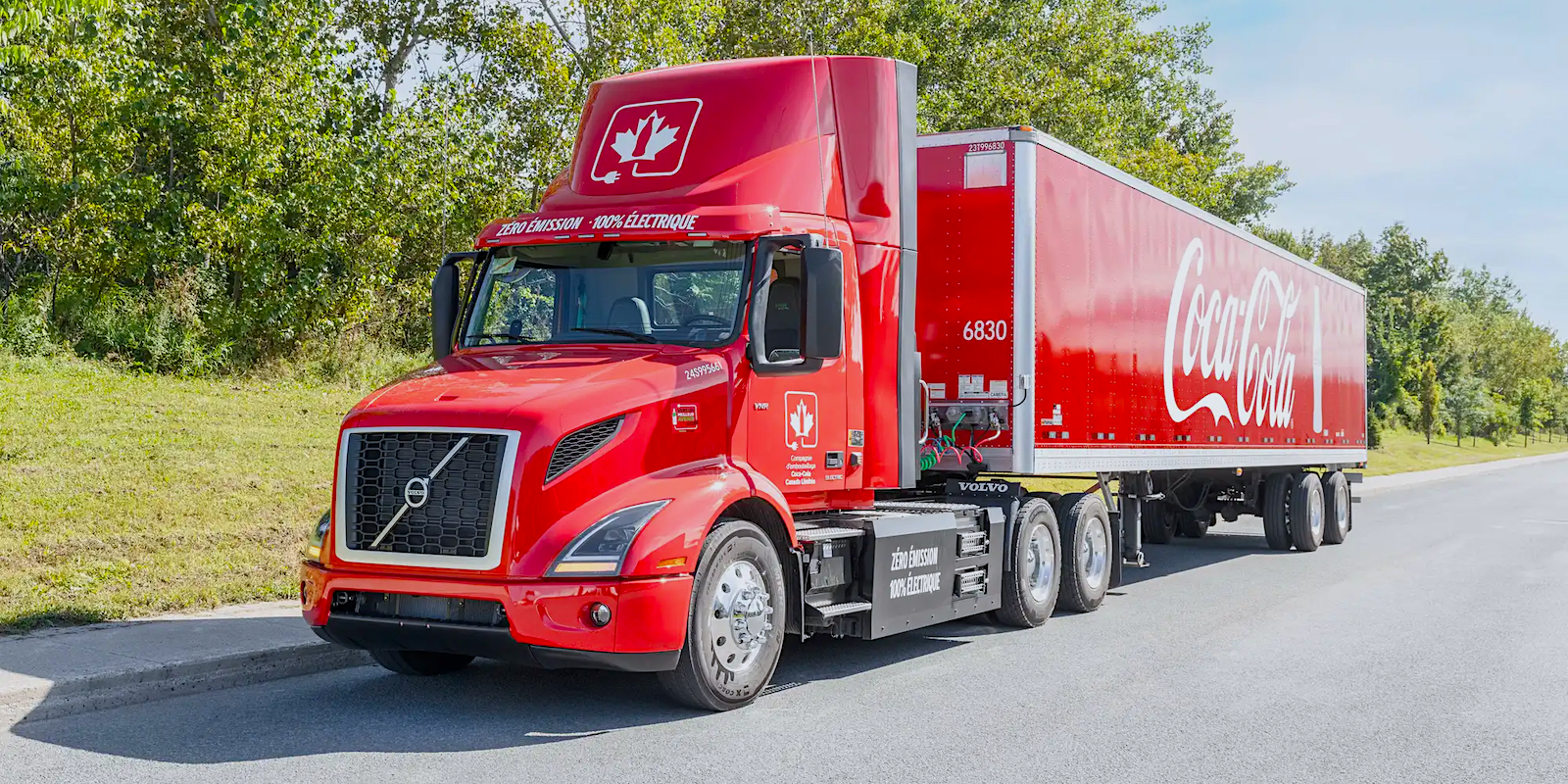
In the high-stakes theater of corporate sustainability, the rivalry between beverage giants often plays out in the logistics of distribution. While PepsiCo's deployment of the Tesla Semi has garnered significant media attention, Coca-Cola is taking a quieter, arguably more pragmatic approach to decarbonizing its heavy-duty fleet — one built on incumbent manufacturing expertise rather than Silicon Valley spectacle.
Coca-Cola Canada Bottling Limited recently expanded its roster of Volvo VNR Electric trucks, bringing its total count to more than 40 units. Operating primarily in the demanding Canadian climate, these bright red semis represent a significant commitment to battery-electric technology from a legacy truck manufacturer. Unlike the bespoke, tech-first architecture of Tesla's offering, the Volvo VNR Electric is built on a proven chassis, leveraging the Swedish automaker's deep roots in industrial reliability and existing dealer and service networks.
The Case for Incumbent Platforms
The strategic logic behind Coca-Cola Canada's choice of Volvo over newer entrants reflects a broader pattern in fleet electrification. Large beverage distributors operate under tight delivery windows, high uptime requirements, and zero tolerance for service disruptions. For fleet managers, the question is rarely which truck is most technologically ambitious — it is which truck can be maintained, repaired, and redeployed with minimal friction.
Volvo Trucks has spent decades building a global service infrastructure designed for exactly this kind of operational continuity. The VNR Electric shares components and architecture with its diesel counterpart, which means technicians already familiar with the platform can service it without wholesale retraining. That interoperability between electric and conventional fleets is a practical advantage that purpose-built electric trucks, however innovative, cannot easily replicate at scale.
The approach also carries lower adoption risk. A fleet operator adding Volvo electric units alongside existing Volvo diesel trucks faces a shallower learning curve than one integrating an entirely new manufacturer into its operations. Parts procurement, warranty management, and driver familiarity all benefit from platform continuity — factors that rarely make headlines but consistently determine whether pilot programs graduate into permanent deployments.
Heavy-Duty Electrification Beyond the Pilot Phase
The transition to electric heavy hauling remains one of the most difficult segments of the broader energy transition. Battery weight competes directly with cargo capacity, and the charging infrastructure required for a fleet of this scale is substantial. Range limitations further constrain route planning, particularly in a country as geographically vast as Canada, where winter temperatures can degrade battery performance.
Yet the steady expansion of the Volvo-Coca-Cola partnership — from initial trial units to more than 40 trucks — suggests that at least for certain use cases, the economics and logistics are beginning to close. Beverage distribution, with its relatively predictable urban and regional routes, fixed depot locations suitable for overnight charging, and high public visibility, represents a near-ideal early application for battery-electric Class 8 trucks.
The broader competitive landscape adds context. PepsiCo's Tesla Semi deployments have served as high-profile proof points for electric trucking, but Tesla has faced persistent questions about production volume and delivery timelines. Volvo, by contrast, has positioned itself as a volume supplier capable of fulfilling fleet-scale orders from an established manufacturing base. Daimler Truck, through its Freightliner eCascadia, occupies similar territory. The emerging pattern is one in which traditional truck manufacturers may ultimately capture the bulk of fleet electrification demand, even if newer entrants set the narrative.
What remains unresolved is whether the economics hold beyond favorable route profiles. Urban and regional distribution — the kind Coca-Cola Canada runs — offers the shortest path to electric viability. Long-haul corridors, with their heavier payloads and sparse charging infrastructure, present a fundamentally different challenge. The question facing the industry is not whether electric trucks can work in controlled, high-visibility deployments, but whether the operational model scales to the full diversity of freight logistics. The answer will likely depend less on any single truck platform than on the pace of charging infrastructure buildout and the evolution of battery energy density — forces that remain in tension with the urgency of corporate decarbonization timelines.
With reporting from Electrek.
Source · Electrek