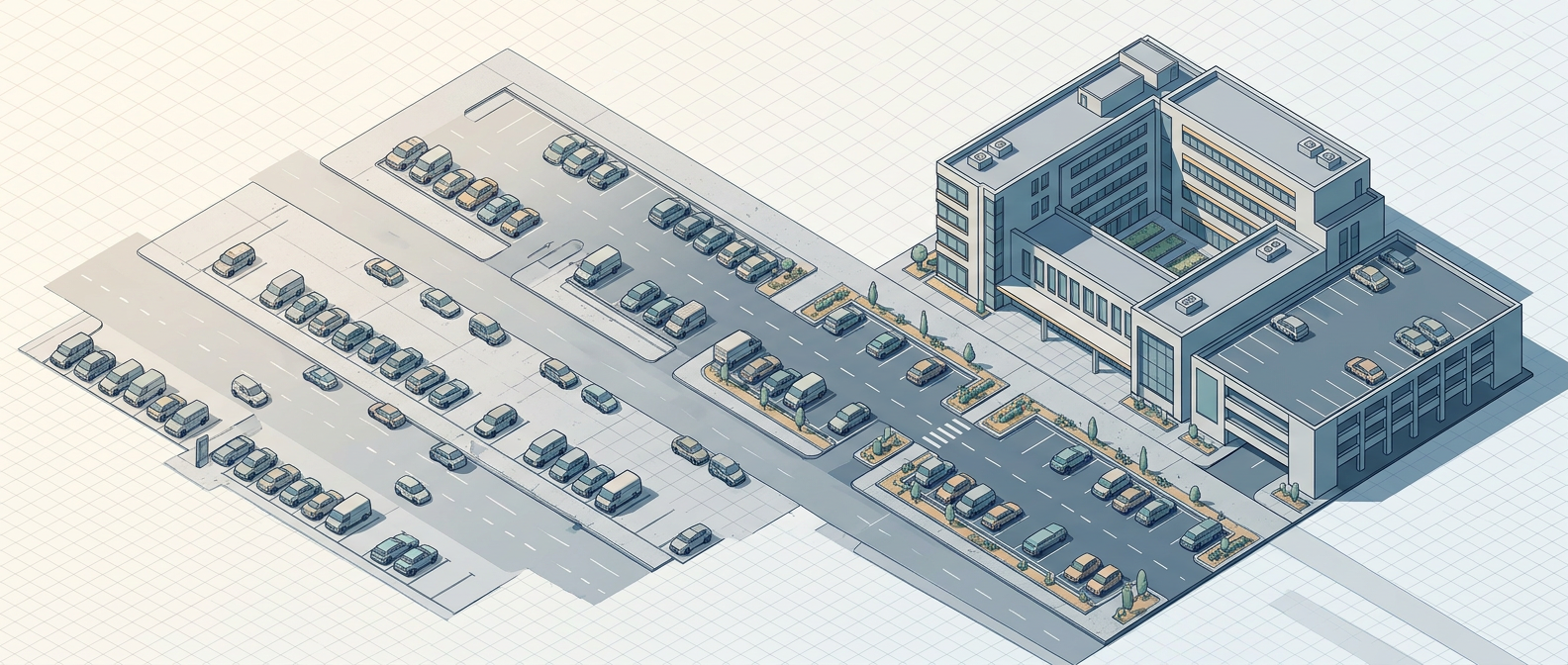
The 2026 Mies van der Rohe Award — the European Union Prize for Contemporary Architecture — has been granted to the revitalization of the Charleroi Palais des Expositions, a sprawling 1950s convention center in southern Belgium. The project, led by Brussels-based AgwA and Architecten Jan de Vylder Inge Vinck, represents a seven-year effort to reactivate a 50,000-square-meter relic of mid-century modernism. In choosing this work, the jury has made a statement that extends well beyond a single building: the most consequential architecture of this era may not involve building anything new at all.
The original 1954 Palais was a monument to industrial-era scale, conceived during a period when Charleroi — once among Belgium's wealthiest cities thanks to its coal and steel industries — still projected confidence about its economic future. Over the decades that followed, deindustrialization hollowed out much of the city's purpose, and the convention center grew increasingly disconnected from the urban fabric around it. The building remained structurally intact but functionally dormant, a condition familiar to dozens of postwar civic structures across Europe.
Repair as method
Rather than proposing a total overhaul or demolition followed by new construction, the design team opted for what the jury described as a "bold yet resourceful" approach that worked within the building's inherent constraints. The intervention involved stripping back certain facades and selectively removing elements to unlock new spatial possibilities, effectively turning the vast, monolithic site into a more porous and social environment. Walls were opened, circulation was rethought, and the building's relationship to its surrounding streets was renegotiated — all without erasing the structural logic of the original design.
This strategy belongs to a broader architectural current that has gained momentum over the past decade. Adaptive reuse — the practice of repurposing existing buildings rather than replacing them — has moved from the margins of the discipline toward its center, driven by two converging pressures. The first is environmental: the construction industry accounts for a significant share of global carbon emissions, and demolition-and-rebuild cycles are among the most resource-intensive activities in the built environment. The second is cultural: as postwar modernist buildings reach the age where they face either renewal or demolition, a generation of architects has begun to argue that these structures carry historical and civic meaning worth preserving, even when their original functions have lapsed.
The Mies van der Rohe Award, administered biennially by the Fundació Mies van der Rohe in partnership with the European Commission, has historically favored new construction — landmark cultural buildings, housing complexes, public infrastructure. Its selection of a repair-driven project in Charleroi marks a notable departure. Previous cycles have recognized projects that engaged with existing fabric, but the Palais des Expositions is perhaps the most explicit endorsement of conservation-as-design the prize has offered.
What Charleroi signals for European urbanism
In its citation, the jury praised the project for demonstrating how architecture can turn scarcity into opportunity. By treating repair as a powerful design strategy, the architects preserved the historical weight of the Palais while adapting it for contemporary use. The word "scarcity" is worth pausing on. Charleroi is not Brussels or Amsterdam; it is a post-industrial city with limited public budgets and a complicated relationship to its own built heritage. The project's success suggests that fiscal constraint, rather than being an obstacle to architectural ambition, can become a generative condition — one that forces designers to think more carefully about what already exists before reaching for what does not.
The implications extend beyond Belgium. Across Europe, municipalities face similar questions about aging civic infrastructure: sports halls, exhibition centers, municipal offices, and social housing blocks built in the postwar decades are reaching the end of their initial design life. The default instinct — demolish, remediate, rebuild — carries enormous financial and environmental costs. Charleroi offers an alternative template, one in which the architect's primary skill is not invention but judgment: knowing what to keep, what to remove, and where restraint itself becomes the design gesture.
Whether this signals a durable shift in how Europe's most prestigious architecture prize defines excellence, or whether it reflects a particular moment of environmental and fiscal anxiety, remains an open question. What is harder to dispute is that the Palais des Expositions has reframed a familiar debate. The tension is no longer between preservation and progress — it is between two competing definitions of progress itself.
With reporting from Dezeen Architecture.
Source · Dezeen Architecture