For nearly a thousand years, the Crab Nebula has served as a luminous monument to a stellar cataclysm. The remnant of a supernova first recorded by astronomers in 1054, it remains one of the most studied objects in the night sky. Recent observations from the Hubble Space Telescope provide a precise accounting of how this debris field continues to shift and evolve across the vacuum of space.
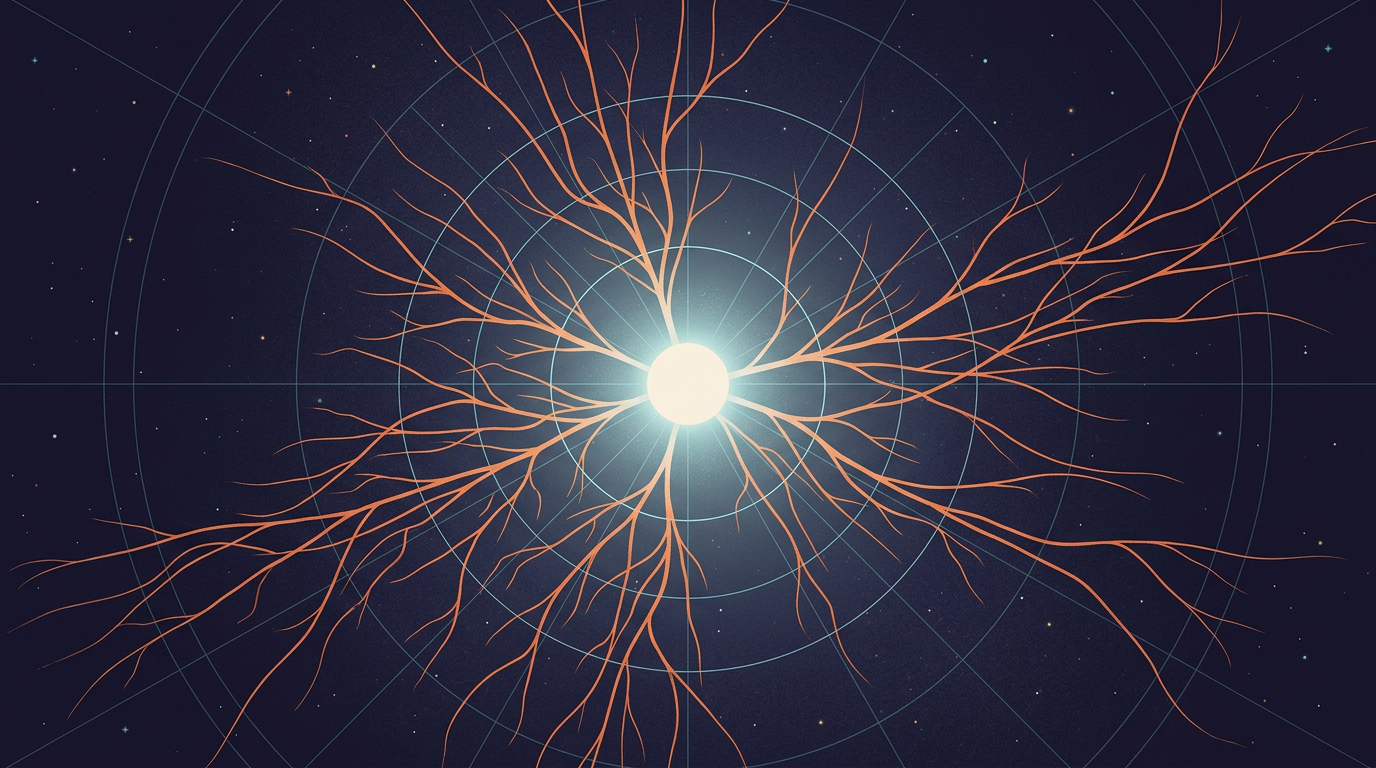
By comparing current imagery with data collected over the past 25 years, researchers have mapped the nebula's intricate, filamentary skeleton in detail that earlier instruments could not achieve. These structures — composed of ionized gas and dust — are racing outward from the center of the explosion at a velocity of 3.4 million miles per hour, a pace that underscores the immense kinetic energy released during the star's terminal collapse.
A laboratory written in light
The Crab Nebula occupies a singular position in astrophysics. Its parent supernova, designated SN 1054, was bright enough to be visible in daylight for weeks, a phenomenon documented independently by Chinese, Japanese, and Arab chroniclers. That historical record gives modern astronomers something unusual: a firm date of origin for the explosion, which in turn allows precise calibration of how fast the remnant is expanding and how its morphology has changed over the intervening centuries.
At the nebula's core sits a pulsar — a rapidly spinning neutron star roughly the diameter of a mid-sized city — that emits beams of radiation with metronomic regularity. The pulsar's rotational energy drives a wind of charged particles into the surrounding gas, inflating the nebula from within even as the original blast wave pushes material outward. This dual engine makes the Crab Nebula a natural laboratory for studying the interplay between compact stellar remnants and the interstellar medium. Few other objects offer such a clean test case: a known explosion date, a well-characterized central engine, and a debris field close enough — roughly 6,500 light-years from Earth — to resolve in fine structural detail.
The filaments that Hubble tracks are not mere wisps. They are dense fingers of matter enriched with heavy elements forged in the final stages of the progenitor star's life and in the supernova itself. Carbon, oxygen, silicon, iron — the raw inventory from which rocky planets and organic chemistry eventually emerge — are being flung into the galaxy at velocities that will, over millions of years, mix with ambient gas clouds and contribute to the next generation of star formation.
Hubble's long baseline and what comes next
The longevity of the Hubble mission has transformed the telescope into a high-resolution time-lapse camera for the cosmos. Launched in 1990, Hubble has now accumulated a deep enough archive that astronomers can overlay images separated by decades and detect structural changes that would be invisible in any single observation. The Crab Nebula is an ideal subject for this technique: its expansion rate is fast enough to register on Hubble's sensors within a human career span, yet slow enough to require patient, multi-epoch monitoring.
This kind of longitudinal dataset carries weight beyond a single object. Understanding how supernova remnants evolve informs models of galactic chemical enrichment — the process by which successive generations of stellar explosions seed the interstellar medium with the elements necessary for planet formation and, ultimately, biology. Each refinement in the Crab Nebula's expansion map tightens constraints on the energy budget of the original explosion and on the physics governing how that energy dissipates over time.
The James Webb Space Telescope, operating primarily in infrared wavelengths, has already begun its own observations of the Crab Nebula, probing cooler dust structures that Hubble's optical instruments cannot fully resolve. The combination of Hubble's quarter-century visible-light baseline with Webb's infrared sensitivity creates a multi-wavelength portrait of the remnant that neither telescope could produce alone. Whether that complementary dataset will settle open questions — about the precise mass of the progenitor star, or the role of the pulsar wind in shaping the nebula's outer boundary — remains to be seen. What is clear is that a thousand-year-old explosion still has information to yield, provided the instruments keep watching.
With reporting from NASA Breaking News.
Source · NASA Breaking News