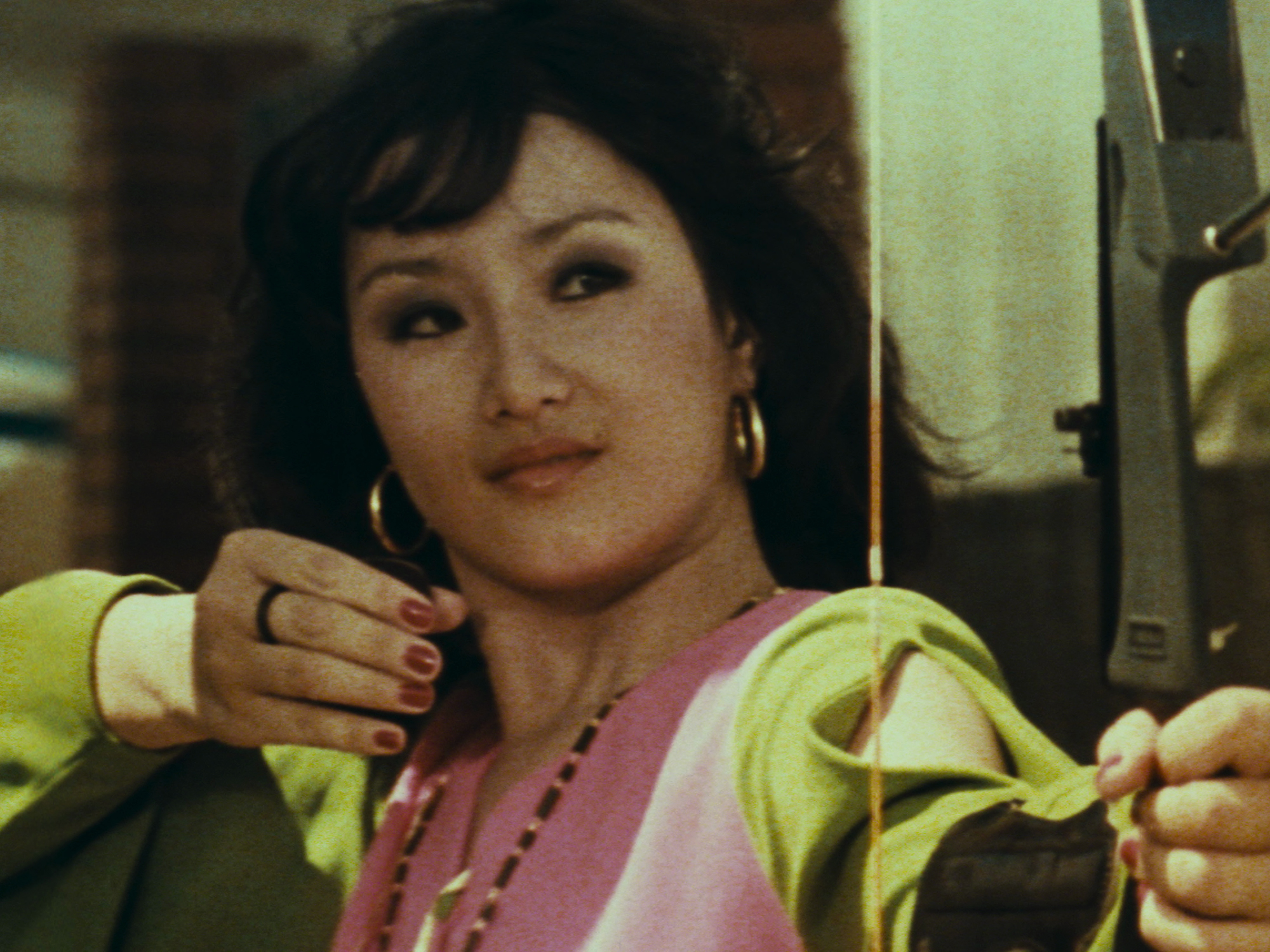
In 1977, a 17-year-old named Doris Young answered an advertisement in Singapore's The Straits Times seeking someone "beautiful, sexy, and equally fast with hands and brains." The role was for an Interpol agent in a spy thriller, a part Young secured over hundreds of other hopefuls. Under the stage name Marrie Lee — a nod to martial arts legend Bruce Lee — she became the face of They Call Her… Cleopatra Wong (1978), a film that would eventually stand as a singular moment in Southeast Asian cinema. Now, a new restoration is bringing the picture back into focus, both literally and culturally.
Directed by Filipino filmmaker Bobby A. Suarez, the film was a high-octane synthesis of mid-century aesthetics and global genre trends. It drew heavily from the James Bond franchise and American blaxploitation hits like Cleopatra Jones, while grounding itself in the kinetic choreography of Hong Kong action cinema. As an Interpol operative dismantling a counterfeit currency ring, Young performed her own stunts, carving out a space for the Asian female lead in an era when such roles were vanishingly rare in international distribution.
A cross-border genre experiment
The production circumstances of Cleopatra Wong reflect a mode of filmmaking that was common across Southeast Asia in the 1970s but has received limited scholarly attention. Suarez, operating out of Manila, was part of a loose network of producers and directors who made genre pictures designed to circulate beyond their domestic markets. The Philippines, Singapore, and Hong Kong served as nodes in a regional exploitation circuit where budgets were modest, shooting schedules compressed, and genre formulas borrowed freely across borders. These films rarely entered the Western critical canon, but they reached audiences through grindhouse theaters, drive-ins, and later through VHS distribution channels that gave them extended afterlives.
What distinguished Cleopatra Wong within this ecosystem was its female lead. The blaxploitation wave of the early 1970s had produced figures like Pam Grier and Tamara Dobson, but their equivalents in Asian cinema remained scarce. Young's Cleopatra Wong was not a supporting figure or a romantic interest; she was the operational center of the narrative, handling firearms and martial arts sequences with a physicality that the film foregrounded rather than minimized. The character predated the broader wave of female-led action cinema that would emerge in Hong Kong through the 1980s and early 1990s, making Lee's performance something of an outlier in the timeline of the genre.
Restoration as cultural reclamation
Film restoration, particularly of low-budget genre work from the Global South, carries stakes that extend beyond archival fidelity. Prints of films like Cleopatra Wong degrade, distribution rights become tangled, and the institutional infrastructure for preservation in countries like Singapore and the Philippines has historically lagged behind that of wealthier film industries. When a title falls out of circulation, the cultural record narrows. Restoration efforts in this context function less as nostalgia projects and more as acts of recovery — reasserting the existence of creative traditions that mainstream film history has tended to overlook.
The film's influence has lingered in the margins of cult cinema for decades, famously cited by Quentin Tarantino as a touchstone for the visual and thematic language of Kill Bill. That association has kept the title in circulation among genre enthusiasts, but citation by a prominent Western director is a narrow form of legacy. The restoration offers an opportunity for the film to be evaluated on its own terms: as a product of a specific regional industry, a document of cross-cultural genre exchange, and an early case study in the commercial viability of female-led action narratives.
By cleaning the grain and sharpening the frames of this 1978 production, archivists are doing more than preserving a genre film. They are surfacing a set of questions about whose cinema gets remembered, which genre traditions are treated as canonical, and how the geography of film history might look different if preservation resources were distributed more evenly. Whether Cleopatra Wong finds a new audience or remains a specialist concern will depend in part on how distributors position the restoration — but the fact that it exists at all shifts the conversation.
With reporting from Little White Lies.
Source · Little White Lies