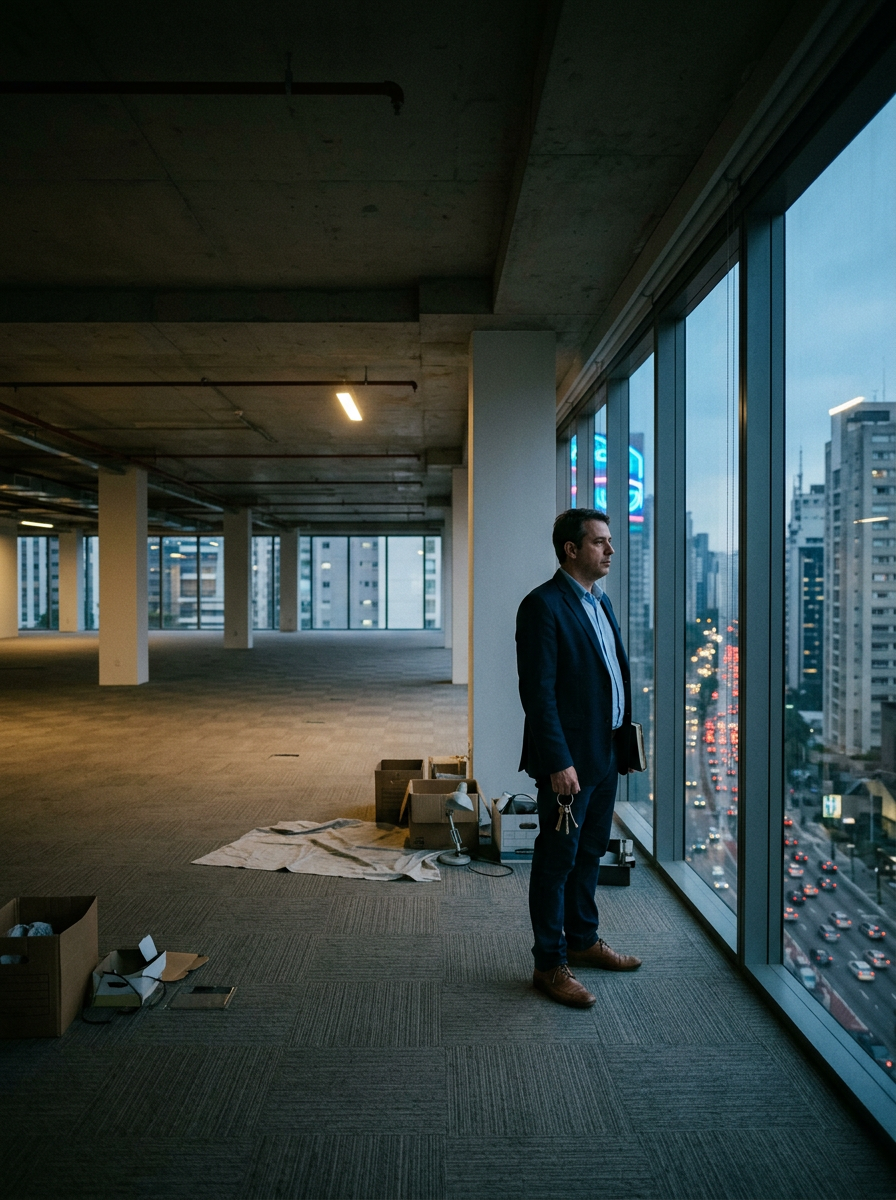
The corporate landscape in São Paulo is undergoing a quiet recalibration. Following the departure of Banco Master from the Auri Plaza Faria Lima, 14,000 square meters of prime real estate in Vila Olímpia have hit the market. While a vacancy of this scale might once have signaled retreat, it has instead sparked immediate interest from two major financial institutions seeking to occupy the building as sole tenants. The episode is less about one bank's exit than about a structural shift in how large companies think about office space in Brazil's financial capital.
Banco Master's move is part of a broader liquidation: the bank has returned a total of 22,000 square meters across São Paulo. The reasons behind that particular exit are tied to the institution's own strategic repositioning, but the market's response — rapid absorption rather than prolonged vacancy — tells a more consequential story. Demand for massive, contiguous office footprints is rising at a pace that would have seemed improbable just a few years ago.
The monousuário model gains ground
Before the pandemic, requests for single-tenant office spaces exceeding 10,000 square meters were rare in São Paulo, occurring perhaps once or twice a year. Today, they have become a recurring feature of the commercial real estate pipeline. The shift is driven by two converging forces: aggressive return-to-office mandates and a corporate desire to consolidate teams that were scattered across multiple addresses during the remote-work era.
The logic is straightforward. Companies that operated from three or four smaller offices discovered inefficiencies — duplicated infrastructure, fragmented culture, logistical friction in moving people between sites. A single large floor plate, by contrast, offers operational density: shared amenities, unified security, and the intangible but persistent benefit of physical proximity among teams. The "monousuário" model, as the Brazilian market calls it, is not new — major banks and law firms have long favored it — but its appeal has broadened to include technology companies, e-commerce players, and financial services firms that previously embraced distributed setups.
The first-quarter numbers reflect this consolidation trend. The average lease size in São Paulo climbed to 1,923 square meters, the highest level since late 2022. That metric, while a blunt instrument, captures a directional truth: tenants are leasing bigger, not smaller.
Scarcity as accelerant
São Paulo's premium office corridors — Faria Lima, Vila Olímpia, Itaim Bibi — have operated under tightening supply conditions for several quarters. New construction in these neighborhoods is constrained by zoning, land cost, and long development cycles. When a block of 14,000 square meters becomes available in a single building, it represents a rare opportunity for a company seeking to plant a flag without waiting years for a build-to-suit project to materialize.
This scarcity dynamic creates a self-reinforcing cycle. As vacancy rates compress in prime corridors, tenants who might have waited are compelled to act quickly, which in turn compresses vacancy further. The rapid interest in the Auri Plaza Faria Lima space illustrates the pattern: the building did not linger on the market.
The broader context matters as well. Companies like Shopee have been expanding their physical presence in São Paulo, absorbing space that others vacate. The Southeast Asian e-commerce giant's growth in Brazil has required substantial office infrastructure, and it is not alone. Several sectors — fintech, digital banking, logistics platforms — are in expansion mode in the Brazilian market, and their hiring trajectories demand physical space that coworking arrangements and flexible leases cannot always provide.
What emerges is a commercial real estate market where the old pandemic-era assumptions — that offices would shrink, that flexibility would dominate, that the hub-and-spoke model would replace the campus — have not played out in São Paulo's premium segment. Instead, the city's top corridors are experiencing a return to concentration. Whether this reflects a durable structural preference or a cyclical moment driven by specific sectors' growth phases remains an open question. The tension between the cost of consolidation and the operational gains it promises will shape leasing decisions for the next several years — and the answer may differ sharply by industry, by company size, and by how long the current economic cycle holds.
With reporting from Metro Quadrado.
Source · Metro Quadrado