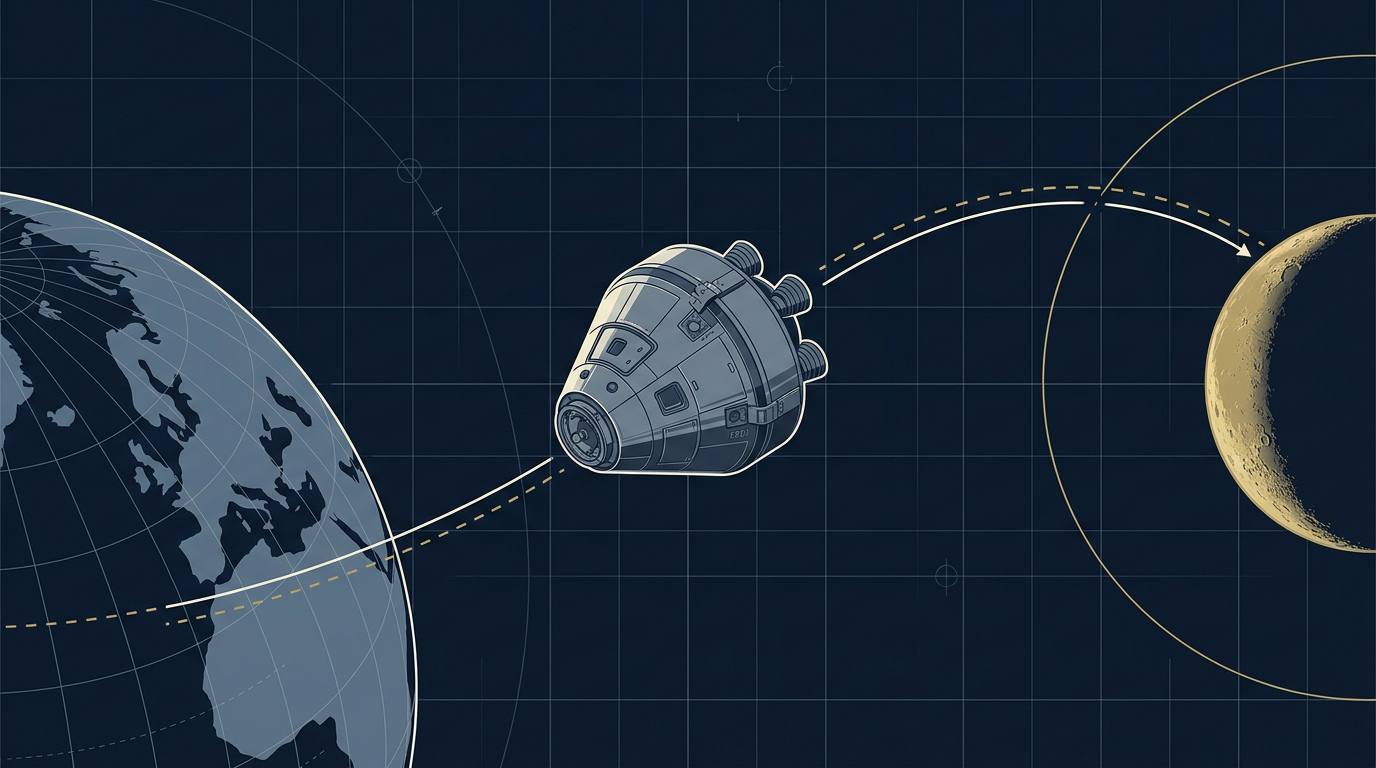
The splashdown of the Orion spacecraft in the Pacific Ocean this April represented more than the conclusion of a ten-day mission; it marked the successful crossing of a threshold that has remained unpassed for over five decades. Artemis II, the first crewed flight of NASA's new lunar era, carried commander Reid Wiseman, pilot Victor Glover, and mission specialists Christina Koch and Jeremy Hansen on a high-stakes trajectory around the Moon and back. It was a rigorous validation of the hardware and life-support systems required for a sustained human presence in deep space.
Behind the orbital mechanics of the mission lay the technical infrastructure provided by NASA's Ames Research Center. Located in Silicon Valley, Ames has served as a quiet but essential engine for the Artemis program, translating the data gathered during the uncrewed Artemis I flight in 2022 into the operational realities of a crewed mission. From thermal protection systems to complex simulations, the center's work ensured that the Orion capsule could withstand the atmospheric reentry that concluded the mission on April 10.
From Artemis I Data to Crewed Operations
The lineage between Artemis I and Artemis II is more than sequential — it is methodological. The uncrewed Artemis I mission, which sent an empty Orion capsule on a loop around the Moon in late 2022, generated a substantial dataset on vehicle performance under deep-space conditions. Ames Research Center's role was to interpret that dataset and feed its findings into the engineering decisions that would govern a crewed flight. The center's expertise in computational fluid dynamics and thermal modeling proved particularly relevant during the design refinement of Orion's heat shield, which must endure reentry speeds approaching those of an object returning from lunar distance — far higher than those encountered on returns from low Earth orbit.
The thermal protection challenge is not trivial. When a capsule reenters Earth's atmosphere from the Moon, it encounters temperatures and aerodynamic forces that exceed what crews returning from the International Space Station experience. Ames has decades of institutional knowledge in this domain, stretching back to the ablative heat shield research conducted during the Apollo program. That continuity of expertise — rare in an agency that has undergone repeated programmatic shifts — gave the Artemis II engineering team a foundation that would have been difficult to reconstruct from scratch.
Simulation work at Ames also extended to mission planning and contingency modeling. Deep-space crewed missions operate under communication delays and trajectory constraints that leave narrower margins for real-time improvisation than low Earth orbit flights. The ability to model thousands of failure scenarios in advance and pre-load response protocols into mission operations is a discipline Ames has refined across multiple programs.
What Artemis II Validates — and What It Does Not
The successful return of a four-person crew from lunar orbit closes one of the most significant open questions in NASA's current exploration roadmap: whether the Orion vehicle and its European-built service module can reliably support human life beyond low Earth orbit. That question had remained technically unanswered since Apollo 17 in December 1972. The half-century gap between crewed lunar flights is itself a reminder of how institutional capability can atrophy when programs lose sustained funding and political support.
Yet Artemis II was, by design, a circumlunar flight — not a landing mission. The crew did not enter lunar orbit in the traditional sense, nor did they interact with the lunar surface or with any orbital infrastructure. The next phases of the Artemis program involve substantially different engineering challenges: docking with the Gateway station, transferring crew to a lunar lander, and sustaining surface operations. Each of those steps introduces failure modes that Artemis II was not configured to test.
The role of centers like Ames will likely evolve as the program advances. Thermal protection and simulation remain relevant, but the integration challenges ahead — coordinating vehicles built by multiple contractors and international partners — demand a different kind of systems engineering. Whether NASA's distributed center model, in which specialized facilities like Ames contribute discrete capabilities to a centrally managed program, can scale to meet the complexity of landing missions is a structural question the agency has not yet fully answered.
The distance between orbiting the Moon and landing on it has historically proven larger than it appears on a mission timeline. Artemis II has demonstrated that the first half of that distance can be covered with the current architecture. The second half remains an open engineering and organizational problem — one whose difficulty should not be underestimated by the momentum of a successful splashdown.
With reporting from NASA Breaking News.
Source · NASA Breaking News