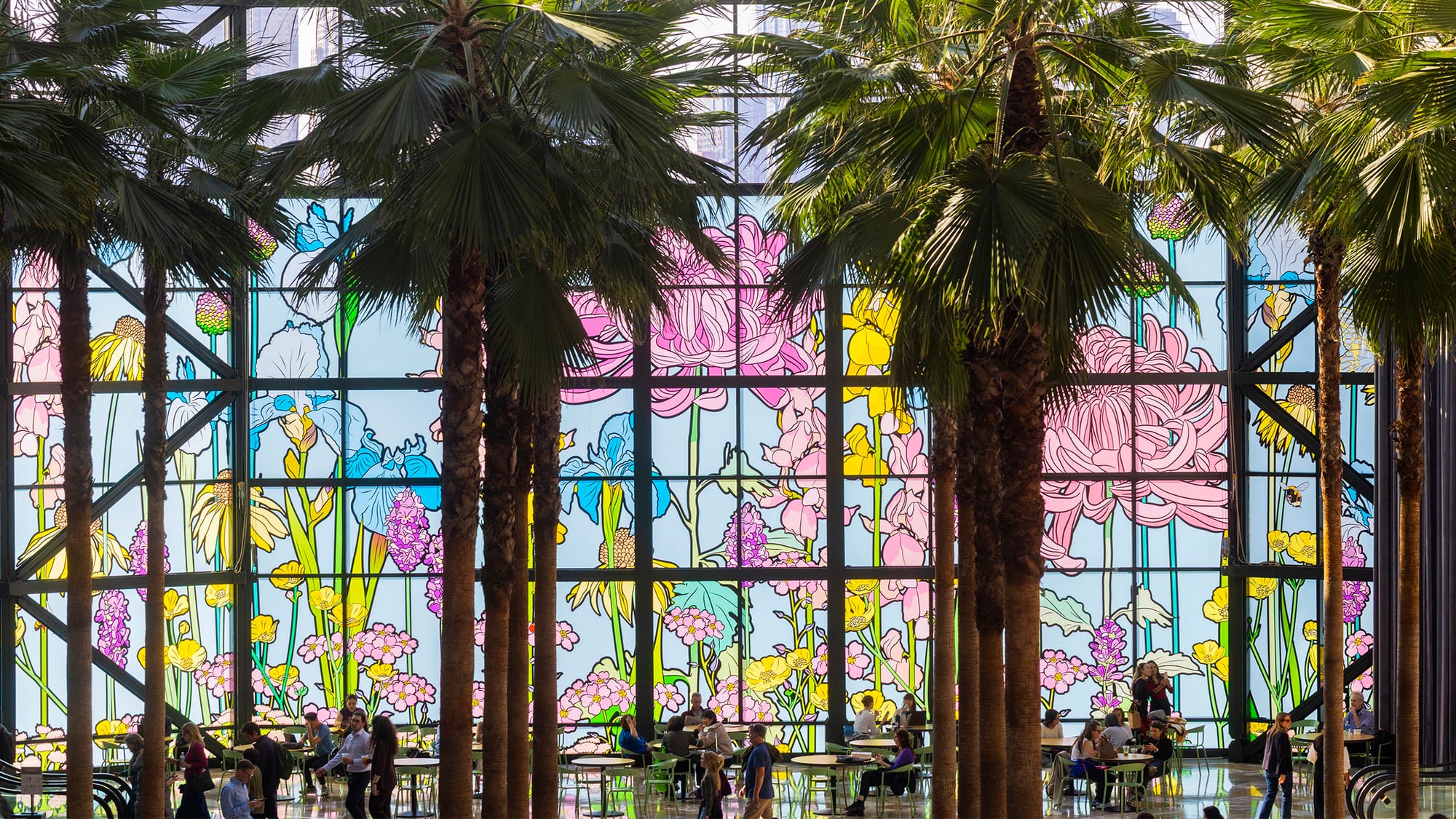
In the glass-and-steel expanse of Lower Manhattan's Brookfield Place, the British artist duo Graphic Rewilding has introduced a vibrant, hyper-saturated disruption. Titled Fleeting Opulence, the installation marks Catherine Borowski and Lee Baker's tenure as the recipients of the Brookfield Place New York Annual Arts Commission. Their work, which will remain on view through October 2026, transforms the iconic Winter Garden — a vaulted atrium flanked by sixteen palm trees and framed by a massive glass curtain wall — into a cathedral of oversized flora and cherry blossoms.
The installation functions as a study in scale and sensory immersion. By weaving larger-than-life botanical forms into the architecture of the commercial complex, Borowski and Baker aim to arrest the typical momentum of urban life. The colors of the petals and leaves are designed to shift in tandem with the changing natural light filtering through the atrium, creating a visual experience that is both static in its graphic precision and dynamic in its atmospheric effect.
Art in the Atrium: The Logic of Corporate Commissions
Brookfield Place's annual arts commission belongs to a well-established tradition of corporate-sponsored public art in New York. Since the Winter Garden was rebuilt after its destruction on September 11, 2001, the atrium has served as both a transit corridor and a cultural venue, hosting performances, exhibitions, and site-specific installations. The annual commission program positions the space as something more than a luxury retail concourse — it frames the building as a civic amenity, a quasi-public interior where art can reach audiences who may never set foot in a gallery.
This model carries familiar tensions. Corporate patronage provides artists with resources and visibility that few institutional grants can match, but it also places creative work in a context shaped by commercial interests. The artwork must coexist with retail tenants, office workers, and tourist foot traffic. For Graphic Rewilding, the friction appears to be the point. Their practice is built around inserting natural imagery into precisely the kind of environments — polished, climate-controlled, architecturally assertive — that most aggressively exclude the organic. The Winter Garden's existing palm trees already perform a version of this gesture; Fleeting Opulence amplifies it to a scale that becomes impossible to ignore.
The broader category of large-scale botanical installation art has gained traction in recent years. Projects that bring exaggerated natural forms into urban interiors — whether through living plants, fabricated sculptures, or digital projections — tap into a persistent cultural appetite for encounters with nature in settings defined by its absence. The line between genuine ecological engagement and decorative spectacle is not always clear, and the most interesting work in this space tends to sit deliberately on that boundary.
Rewilding as Visual Strategy
Graphic Rewilding's broader mission centers on the concept of "rewilding" the urban landscape through visual intervention. The term "rewilding," borrowed from conservation ecology, typically refers to restoring ecosystems by reintroducing native species and reducing human management. Borowski and Baker adapt the concept metaphorically: their interventions do not restore actual ecosystems but instead flood built environments with graphic representations of botanical abundance. The result is less restoration than provocation — a reminder of what the built environment displaces.
The duo's use of hyper-saturated color and exaggerated scale places their work closer to pop art and graphic design than to landscape architecture or environmental art. There is no pretense of ecological function. The flora in Fleeting Opulence is frankly synthetic, its colors too vivid, its proportions too theatrical to be mistaken for the real thing. This honesty about artifice may be what gives the installation its particular charge. It does not ask viewers to believe they are in a garden; it asks them to notice that they are not.
In a city often defined by its density and pace, Fleeting Opulence offers a contemplative pause, inviting passersby to look upward and consider the persistent, if synthetic, presence of the wild. Whether that pause constitutes a meaningful intervention in how people relate to urban space — or simply a pleasant distraction on the way to the office — depends on what one expects public art to accomplish. The installation will remain in place through the fall, long enough for the seasons outside the glass to catch up with the permanent bloom within it.
With reporting from Hyperallergic.
Source · Hyperallergic