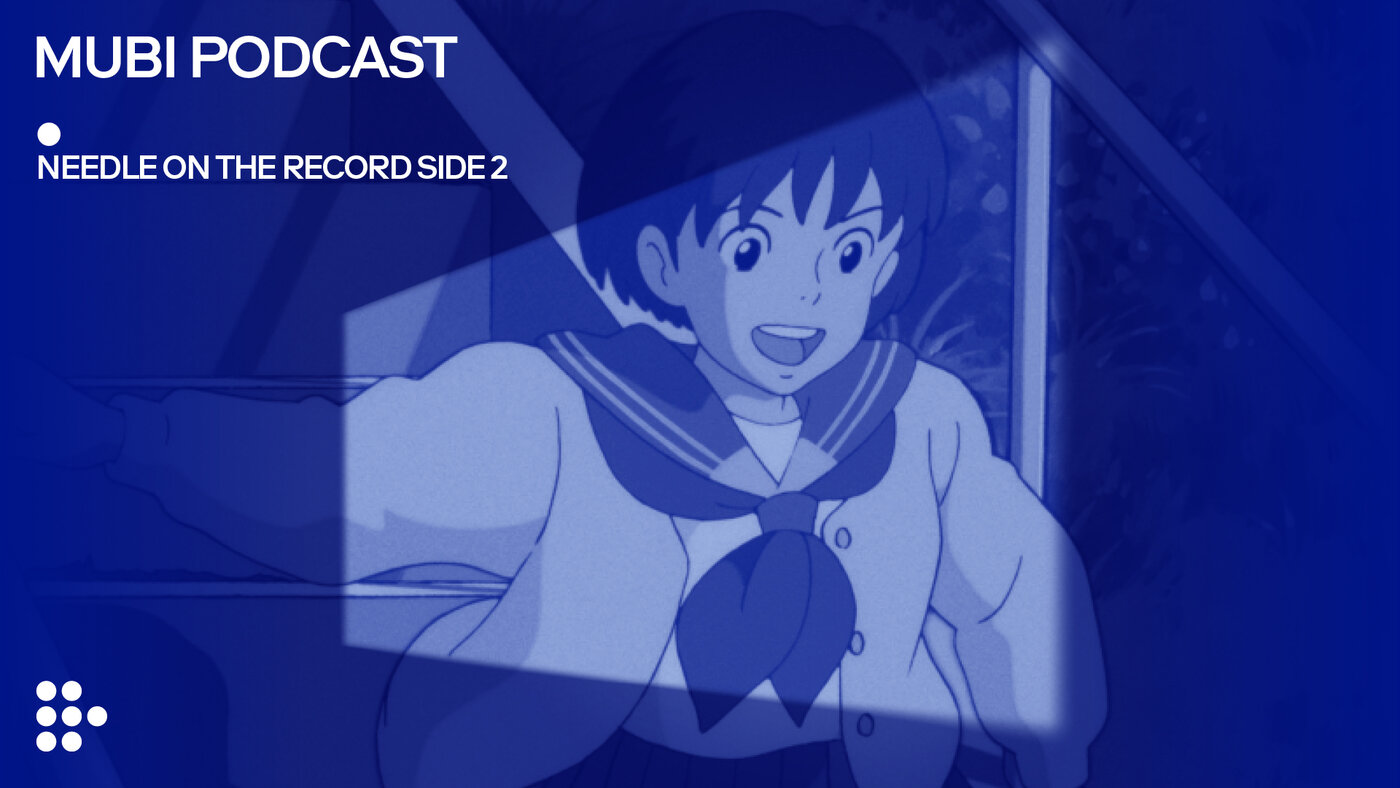
In 1995, Studio Ghibli released Whisper of the Heart, a coming-of-age story directed by Yoshifumi Kondō and written by Hayao Miyazaki. Central to the film's emotional architecture was an unexpected musical choice: John Denver's 1971 folk-pop hit, "Take Me Home, Country Roads." The song, a sentimental ode to the American South — specifically West Virginia — was recontextualized into a narrative about a young girl navigating adolescence in suburban Tokyo. Over the three decades since the film's release, the Japanese-language adaptation of the song has become embedded in the country's cultural memory, sung in school music classes and recognized by audiences who may never have encountered Denver's original recording.
The new season of the MUBI Podcast, titled "Needle on the Record," takes this transpacific migration as one of its case studies. Hosted by Rico Gagliano, the season examines so-called "needle drops" — the precise moments in cinema where a pre-existing piece of music fuses with image to produce an effect greater than either element alone. The term, borrowed from the physical act of placing a turntable needle onto vinyl, has become shorthand in film criticism for a director's deliberate deployment of a song to reframe or deepen a scene's meaning.
A Song Rewritten, Not Just Translated
The journey of "Country Roads" into Whisper of the Heart was not a simple matter of licensing. Mamiko Suzuki, daughter of Ghibli co-founder and longtime producer Toshio Suzuki, provided the Japanese lyrics that shifted the song's thematic center. Where Denver's version channels a specific geographic nostalgia — the Blue Ridge Mountains, the Shenandoah River — the Ghibli adaptation redirects that longing toward something more interior: a young person's search for purpose and creative identity. The melody remains intact, but the emotional destination changes.
This kind of cultural adaptation has a long lineage in Japanese popular music. The practice of translating Western pop songs into Japanese, common throughout the postwar decades, often involved substantial rewriting rather than literal translation. What distinguishes the Whisper of the Heart case is the degree to which the adapted song became inseparable from the film itself. For many Japanese listeners, "Country Roads" is not a John Denver song borrowed by Ghibli; it is a Ghibli song that happens to share a melody with an American folk-pop record. The podcast episode traces this inversion through interviews with both the song's co-writer Bill Danoff and members of the Suzuki family, mapping the creative decisions that enabled it.
The Needle Drop as Cultural Bridge
The broader argument of "Needle on the Record" — that needle drops represent a distinct form of cinematic craft — finds fertile ground in this particular example. The most discussed needle drops in Western film criticism tend to involve songs deployed with ironic distance or stylistic bravado: a violent scene set to cheerful pop, a period piece scored with anachronistic rock. The Whisper of the Heart case operates differently. There is no irony in the deployment. The song is played earnestly, performed by the protagonist herself, and its emotional register aligns directly with the narrative. The power comes not from contrast but from displacement — an American song about homesickness made to articulate a Japanese teenager's yearning for something she cannot yet name.
Yoshifumi Kondō, who directed the film, died in 1998 at the age of 47, reportedly from overwork — a fate that cast a long shadow over discussions of labor practices within the Japanese animation industry. Whisper of the Heart remains his only feature as director, a fact that lends the film an additional layer of poignancy that the podcast does not need to manufacture.
What "Needle on the Record" ultimately surfaces is a question about ownership and resonance. A song written in a car on the way to a party in Washington, D.C. — as the origin story of "Country Roads" is commonly told — became, through a chain of creative reinterpretation, a defining emotional artifact for audiences on the other side of the Pacific. Whether that chain represents cultural appropriation, cultural exchange, or something that resists either label depends on where the listener stands. The melody, at least, travels without a passport.
With reporting from MUBI Notebook.
Source · MUBI Notebook