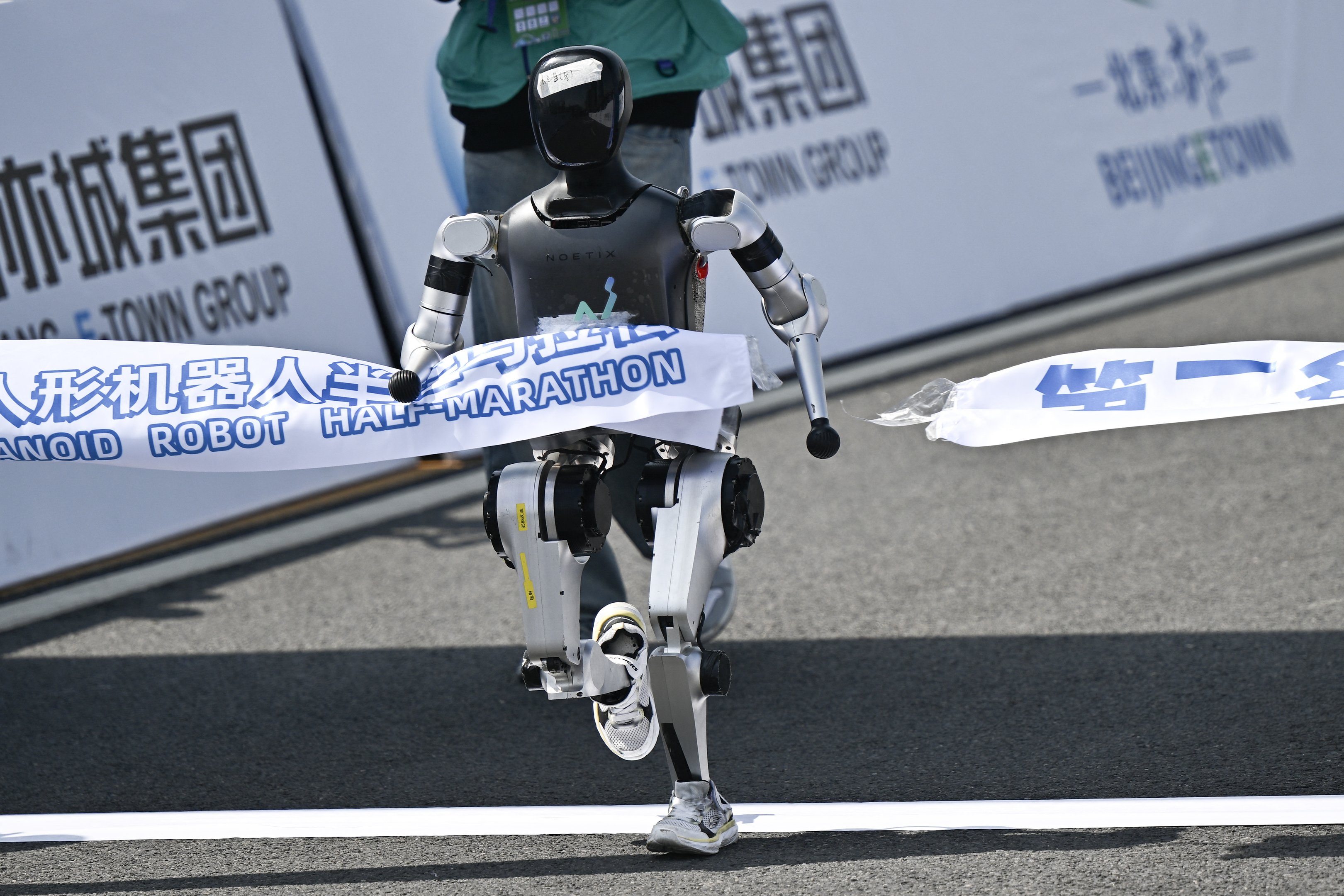
Last Sunday, the streets of Beijing hosted what may become one of the more consequential publicity events in the short history of commercial humanoid robotics. During a half marathon organized in the Chinese capital, dozens of humanoid robots developed by domestic companies completed the 21-kilometer course — and several of them finished ahead of experienced human runners. The event drew attention not for its competitive stakes, which were largely symbolic, but for what it revealed about the state of bipedal robotics engineering in China.
The robots that participated were produced by multiple Chinese firms operating in a sector that has attracted substantial government support and private capital in recent years. Their ability to complete a half marathon distance without catastrophic failure — maintaining balance, managing battery reserves, and navigating a real urban course — marks a tangible step beyond the controlled laboratory demonstrations that have characterized much of the industry's public output to date.
From controlled demos to open road
The technical challenge of running 21 kilometers on two legs is non-trivial for a machine. Bipedal locomotion requires constant real-time adjustment to terrain irregularities, shifts in center of gravity, and energy allocation across dozens of actuated joints. For years, the benchmark moments in humanoid robotics involved far simpler tasks: walking across a flat stage, opening a door, recovering from a push. Boston Dynamics' Atlas robot became famous in part for videos showing it stumbling and falling — the implicit message being that even failure was instructive.
What the Beijing event suggests is that Chinese manufacturers have made meaningful progress on the interrelated problems of dynamic balance, thermal management, and battery endurance. Running generates heat in motors and control boards; sustaining that output over a half marathon distance demands energy budgets that would have been implausible for bipedal platforms even a few years ago. The fact that multiple robots from different companies completed the course indicates that the advances are not confined to a single laboratory but reflect broader capability gains across the Chinese robotics ecosystem.
It is worth noting that the comparison with human runners, while visually striking, is somewhat asymmetric. Elite half marathon times sit well under 60 minutes; the robots were outpacing recreational and mid-tier athletes, not professional competitors. The achievement is better understood as an endurance and reliability milestone than a speed record in any athletic sense.
Strategic signals beyond the finish line
The demonstration carries implications that extend well past the sporting frame. The global humanoid robotics sector has entered a phase of intensifying competition, with companies in the United States, Japan, South Korea, and China all vying to prove that their platforms can operate reliably in unstructured environments. Tesla's Optimus program, several well-funded startups in the Bay Area, and legacy Japanese robotics firms are all pursuing variations on the same thesis: that a general-purpose humanoid form factor will eventually serve logistics, manufacturing, eldercare, and hazardous-environment applications.
China's advantage in this race is partly structural. The country's manufacturing base, its deep supply chains for motors, sensors, and batteries — many of them refined through the electric vehicle boom — and a regulatory environment that tends to encourage large-scale public testing all create conditions favorable to rapid iteration. The Beijing half marathon functions, in this context, as both a technical proof point and an industrial policy signal: Chinese firms can build machines that operate autonomously over meaningful distances in real-world conditions.
The question that remains open is whether endurance on a road course translates into commercial utility. A robot that can run 21 kilometers is not necessarily one that can sort packages in a warehouse, assist a patient out of bed, or navigate a construction site. The gap between locomotion capability and useful task execution remains significant, and no company — Chinese or otherwise — has yet demonstrated a humanoid platform generating revenue at scale in unstructured work environments.
What Beijing did establish is that the hardware constraints once considered prohibitive for sustained bipedal operation are eroding faster than many observers expected. Whether the resulting machines find their market before the investment cycle demands returns is a different problem entirely — and one that engineering alone cannot solve.
With reporting from Exame Inovação.
Source · Exame Inovação