In 2020, the vision was articulated with the grandiosity of a neoclassical revival: a "National Garden of American Heroes" featuring 250 larger-than-life statues of figures ranging from George Washington to Alex Trebek. It was to be a "beautiful complex," a permanent fixture of the American landscape intended to celebrate the nation's 250th anniversary on July 4, 2026. Yet, as that deadline approaches, the project remains a collection of intentions rather than bronze and stone.
The silence surrounding the garden has become its most defining feature. Foundries and artists across the country, who initially expressed interest in the massive undertaking, report that they are still awaiting formal instructions or contracts. Despite the appointment of Washington-based architect Michael Franck to lead the design, the logistical machinery required to cast, transport, and install hundreds of monumental sculptures has seemingly failed to turn.
A Project Without a Process
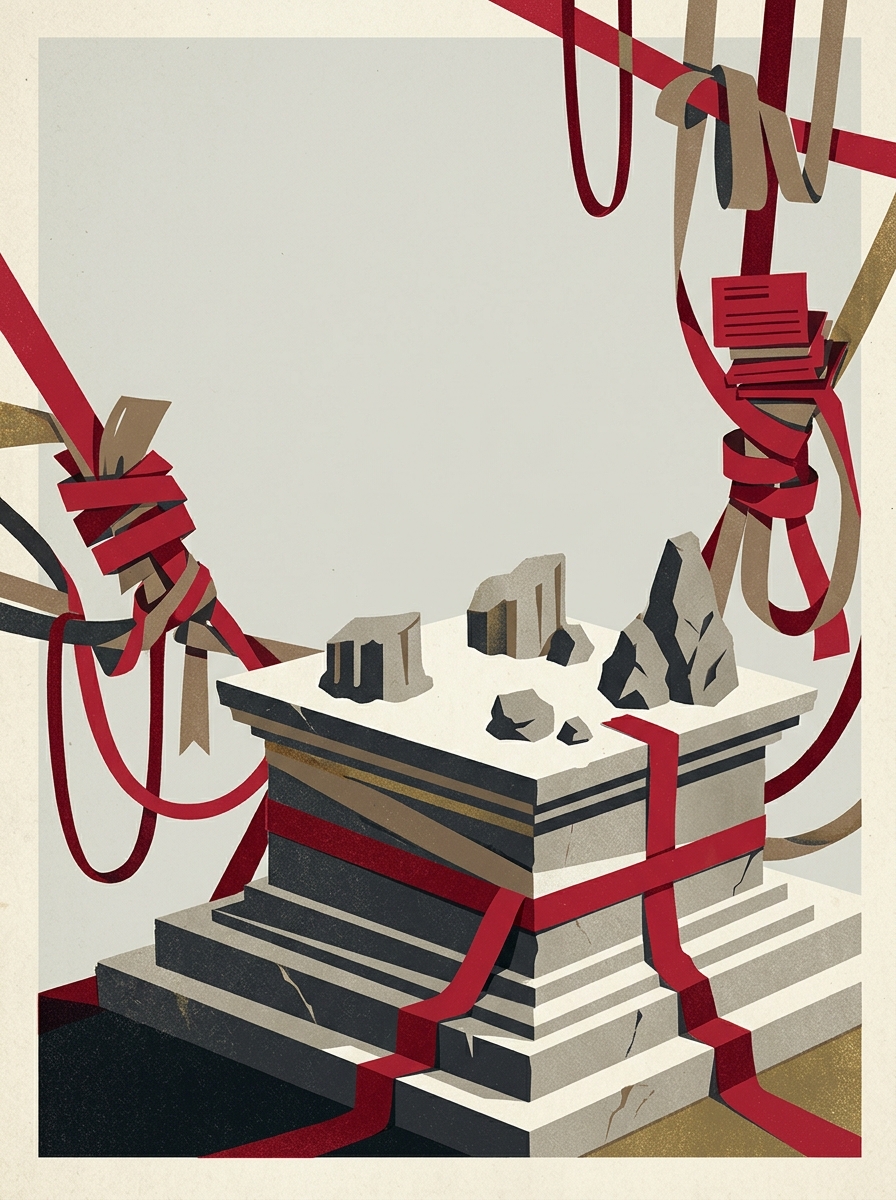
Beyond the physical absence of the statues, the project has yet to clear the most basic regulatory hurdles. Neither the Commission of Fine Arts nor the National Capital Planning Commission — the bodies responsible for vetting permanent additions to the capital's landscape — have received formal plans for review. Though the commissions are currently populated with Trump appointees, the project has been notably absent from recent meeting agendas. For now, the proposed site in West Potomac Park remains empty, a testament to the distance between political rhetoric and the slow, exacting reality of urban monumentality.
The regulatory gap is not a minor procedural footnote. Washington's review process for public monuments exists precisely because the capital's landscape carries outsized symbolic weight. The Commission of Fine Arts, established in 1910, was created in part to prevent the ad hoc proliferation of memorials that had begun to clutter the National Mall in the late nineteenth century. Any permanent installation in West Potomac Park — a site adjacent to the Lincoln Memorial and the Martin Luther King Jr. Memorial — would ordinarily undergo months, if not years, of design review, environmental assessment, and public comment. The absence of any submission suggests the project has not yet advanced beyond the conceptual stage in any operationally meaningful sense.
The scale of the undertaking compounds the difficulty. Monumental figurative sculpture is among the most time-intensive forms of public art. A single bronze figure at the scale described can require a year or more from maquette to finished casting, involving clay modeling, mold-making, foundry work, patination, and structural engineering for the base. Multiplying that process across 250 individual statues — each presumably depicting a distinct historical figure with period-appropriate detail — represents a production challenge with few modern precedents. The logistics of coordinating dozens of sculptors and foundries, maintaining stylistic coherence, and managing a site installation of that density would test even a well-funded, well-staffed federal agency.
The Politics of Monuments
The National Garden was first proposed during a period of intense public debate over monuments in the United States. Statues of Confederate figures were being removed or toppled across the country in the summer of 2020, and the garden was framed, in part, as a counter-narrative — a celebration of figures deemed unambiguously heroic. The original executive order listed names drawn from military history, the sciences, civil rights, and popular culture, a breadth that invited both praise for inclusiveness and criticism for incoherence.
That political context has not disappeared, but it has shifted. The urgency of the monument debate has receded from daily headlines, and the administrative energy required to sustain a project of this magnitude appears to have dissipated with it. Large-scale federal commemorative projects have historically required sustained institutional champions — the Vietnam Veterans Memorial took nearly a decade from authorization to dedication, and the World War II Memorial took even longer. Without a dedicated office, a clear funding stream, and a bureaucratic advocate willing to shepherd the project through review, monumental commissions tend to stall indefinitely.
What remains is a gap between the declarative force of an executive order and the grinding procedural reality of building something permanent in the nation's capital. West Potomac Park sits unchanged. The foundries wait. The commissions have nothing to review. Whether the project eventually materializes in some reduced form, migrates to a less regulated site, or quietly fades from the agenda altogether may depend less on political will than on whether anyone is willing to do the administrative work that monuments, unlike rhetoric, demand.
With reporting from ARTnews.
Source · ARTnews