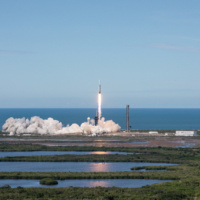
NASA has awarded SpaceX a $175.7 million contract to launch the European Space Agency's Rosalind Franklin rover on a Falcon Heavy rocket, with a target window in late 2028. The deal represents a significant milestone for the long-troubled ExoMars program, which has endured more than a decade of delays, partner swaps, and geopolitical disruption. But the contract comes with a conspicuous caveat: the White House's proposed FY2027 budget would cut NASA science funding by roughly 23%, placing the Rosalind Franklin — along with nearly 50 other science missions — in direct fiscal jeopardy.
The rover, named after the British chemist whose X-ray crystallography work was instrumental in revealing the structure of DNA, is designed to drill up to two meters beneath the Martian surface. That capability is unique among current Mars missions and central to the scientific case for the program: subsurface samples are far more likely to preserve organic molecules shielded from the harsh radiation that bombards the planet's surface. Losing the mission would mean losing a tool no other planned spacecraft can replicate.
A mission shaped by geopolitics as much as science
The ExoMars program's history reads less like a space exploration timeline and more like a case study in alliance management under fiscal pressure. NASA was originally a full partner in the endeavor, but withdrew from its commitments in 2012 amid sequestration-era budget cuts. ESA then turned to Roscosmos, Russia's space agency, which agreed to provide the Proton rocket for launch and a landing platform. That partnership produced the Trace Gas Orbiter, successfully placed in Mars orbit in 2016, but the rover portion of the collaboration collapsed in 2022 when ESA severed ties with Russia following the invasion of Ukraine.
The current arrangement, formalized in a 2024 agreement, brought NASA back into the fold. Under its terms, the United States is expected to supply the launch vehicle, descent braking engines, and critical electronic components — contributions that together form the mechanical backbone of the mission's entry, descent, and landing sequence. NASA's decision to secure a launch reservation with SpaceX now, even as the budget picture remains unresolved, suggests an institutional effort to preserve optionality. Cancelling a signed contract is politically and bureaucratically harder than simply never signing one. The move has the hallmarks of a pragmatic hedge: lock in the logistics while the Planetary Society and sympathetic members of Congress work to restore the funding line.
For SpaceX, the contract offers something beyond revenue. Falcon Heavy has flown successfully since its dramatic 2018 debut, but its manifest has been dominated by national security payloads and heavy communications satellites. An interplanetary science mission to Mars would expand the rocket's demonstrated envelope and reinforce SpaceX's credentials as a deep-space launch provider — a positioning that matters as NASA continues to evaluate commercial options for future planetary missions.
The budget arithmetic and what it obscures
The proposed 23% reduction in NASA's science budget is not an isolated line item. It reflects a broader pattern in the FY2027 request, which seeks to redirect federal spending priorities across multiple agencies. For planetary science specifically, the consequences extend well beyond ExoMars. The Mars Sample Return program, already restructured after cost overruns, faces its own funding uncertainties. The cumulative effect is a period of unusual instability for NASA's science directorate, one in which mission teams must plan against scenarios ranging from full funding to outright cancellation.
History offers a cautionary parallel. When NASA withdrew from ExoMars in 2012, the decision did not merely delay the mission — it set off a chain of compromises that ultimately left the program dependent on a geopolitical partnership that proved unsustainable. A second American withdrawal would carry reputational costs with ESA and could complicate future transatlantic science cooperation at a moment when Western space agencies are increasingly seeking to coordinate their efforts.
The tension at the core of the Rosalind Franklin's fate is structural, not incidental. Planetary launch windows to Mars open roughly every 26 months. Miss the 2028 window and the next opportunity falls in 2030, adding years of cost and institutional drag to a program already measured in decades. The question facing policymakers is not simply whether the science justifies the expenditure — few dispute the rover's scientific value — but whether the political will exists to protect a long-horizon investment during a period of short-horizon fiscal constraint. The answer will reveal as much about how the United States prioritizes international scientific commitments as it does about any single mission to Mars.
With reporting from Payload Space.
Source · Payload Space