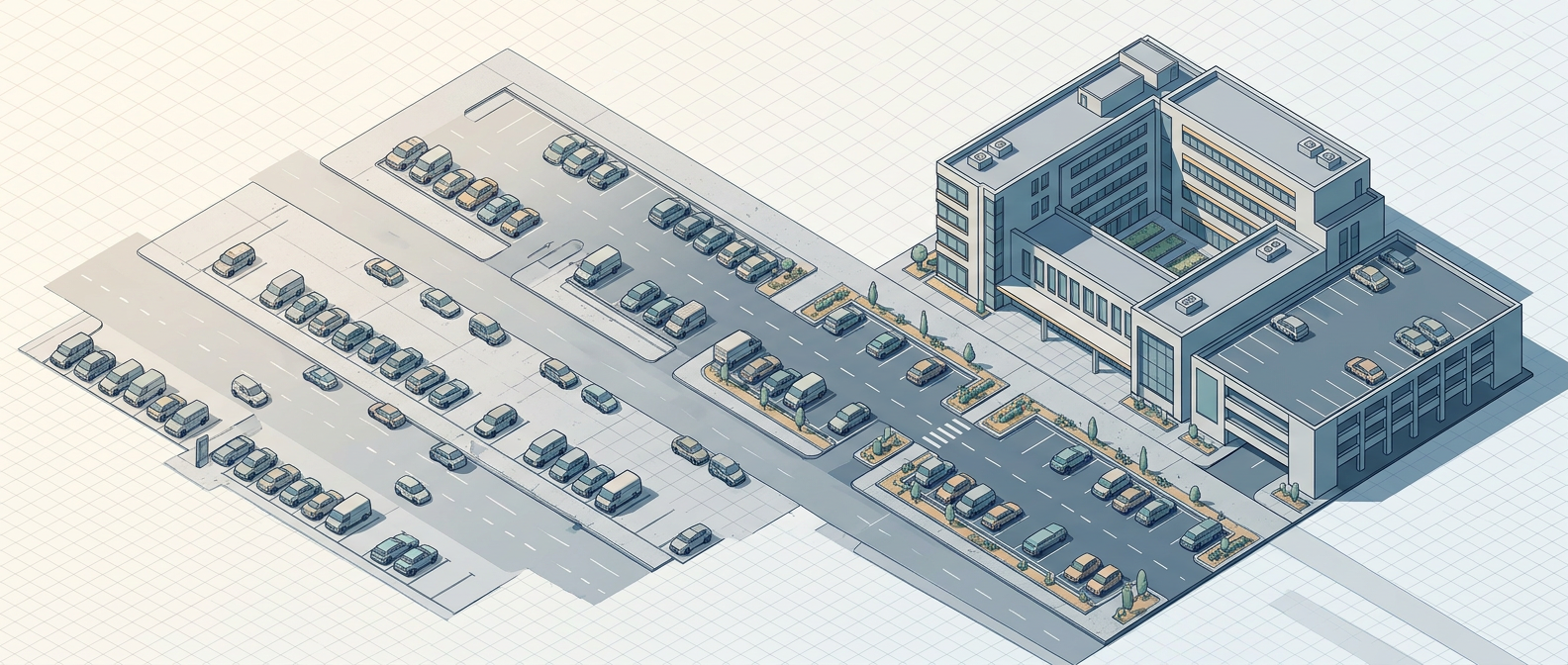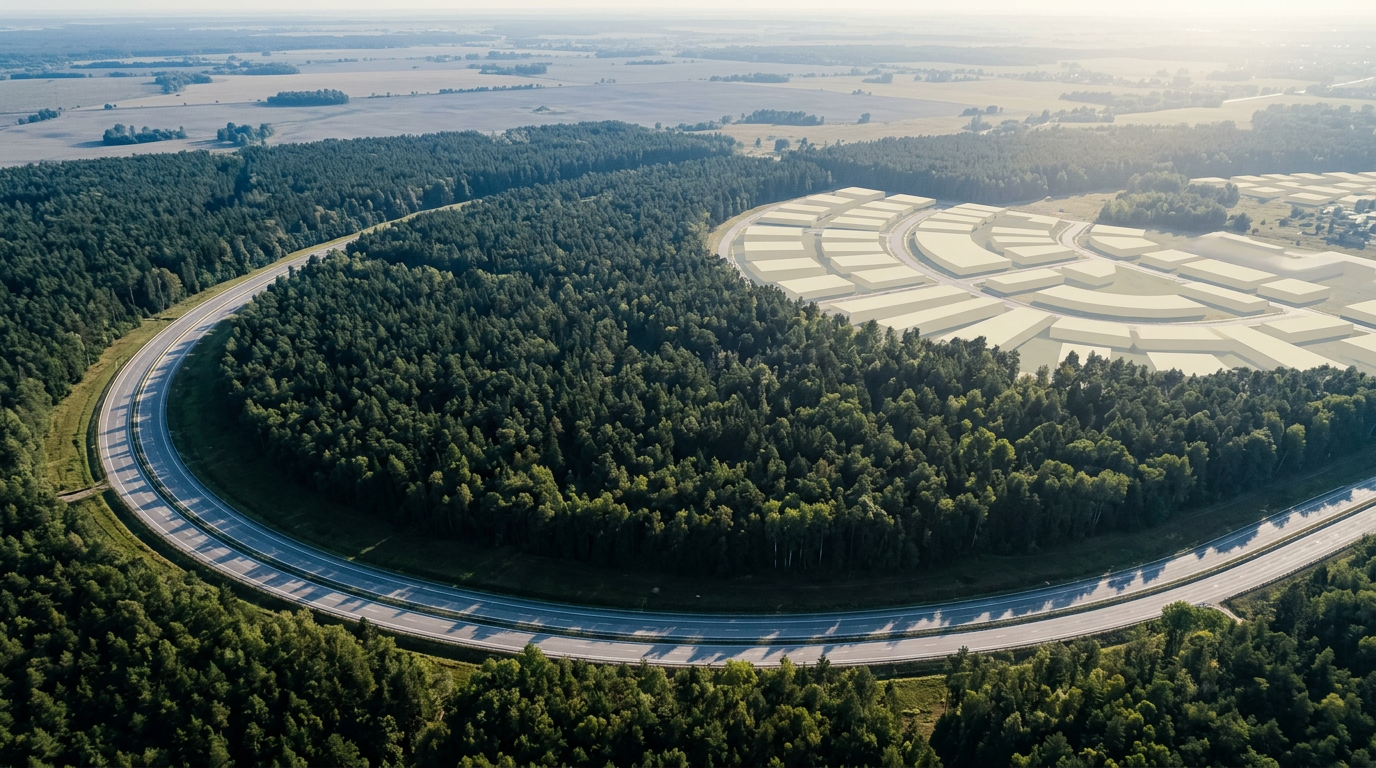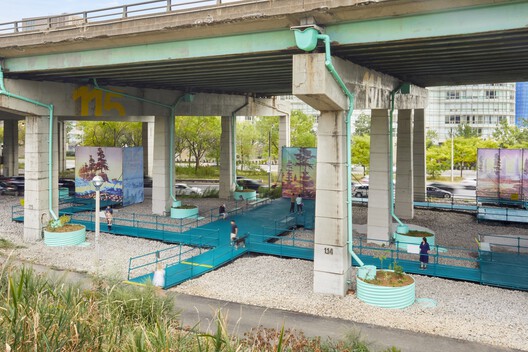
Elevation has long served as a default solution in urban transport planning — a way to lift the friction of transit above the complexity of street-level life. Highways, metro lines, and railway viaducts are engineered to prioritize uninterrupted flow, clearance, and speed. In the process, they produce a secondary landscape: the space beneath. These zones, tucked under flyovers and elevated rail corridors, are the structural consequences of a design philosophy that treats the ground plane as an obstacle rather than a destination.
Historically, these "undercrofts" have been classified as residual leftovers rather than deliberate public assets. Because transport systems are typically engineered independently of the neighborhoods they bisect, the resulting spaces are physically present but programmatically vacant. They disrupt pedestrian pathways, fragment street grids, and exist in a planning limbo — often omitted entirely from formal urban design strategies. Research by firms such as Arup and various academic reviews of infrastructure-adjacent urbanism have consistently identified the same pattern: these areas are defined by the structure above them, yet they lack any clear role in the life of the city below.
From residual void to contested ground
The phenomenon is neither new nor geographically limited. From the elevated expressways built across American cities during the mid-twentieth-century highway boom to the railway viaducts of European industrial cities, the undercroft has been a recurring byproduct of infrastructure investment. In many cases, the spaces were deliberately left undefined — zoned as easements, fenced off for maintenance access, or simply abandoned to informal uses ranging from parking to encampments.
What has shifted in recent decades is the framing. A growing body of urban design practice now treats the undercroft not as a void to be tolerated but as a site with latent civic value. Projects in cities as varied as São Paulo, London, and Seoul have demonstrated that the space beneath elevated infrastructure can accommodate markets, sports courts, gardens, cultural programming, and pedestrian connections — provided the design is intentional rather than incidental. The critical distinction lies in whether the ground-level condition is considered during the infrastructure's initial design or retrofitted afterward. Retrofit is more common, but also more constrained: ceiling heights, column spacing, drainage, noise, and air quality all impose limits that were never calibrated for human occupation.
The broader context matters as well. As cities face mounting pressure to densify without expanding their footprints, underused land of any kind attracts renewed attention. The undercroft represents a category of space that is already publicly owned in most jurisdictions, already serviced by adjacent streets and utilities, and already located in areas of high connectivity — precisely because the infrastructure above was routed there for access reasons in the first place.
Design philosophy versus engineering logic
The deeper tension is disciplinary. Transport engineers optimize for throughput and structural performance; urban designers optimize for ground-level experience and social use. When infrastructure is planned in isolation — as it frequently still is — the resulting undercroft reflects the priorities of the engineering brief alone. Reintegrating these spaces into the urban fabric requires not just architectural imagination but institutional coordination: agreements between transport authorities and municipal planning departments, maintenance responsibilities that cross agency boundaries, and funding models that treat ground-level activation as a legitimate infrastructure outcome rather than an afterthought.
There is also a question of permanence. Elevated infrastructure has long operational lifespans, often measured in decades. Any program inserted beneath it must contend with the possibility of structural maintenance, seismic retrofitting, or eventual demolition — all of which can disrupt or erase ground-level investments. The most resilient undercroft projects tend to be those designed with flexibility in mind: lightweight structures, modular programming, and governance frameworks that anticipate change.
The challenge, then, is not simply aesthetic or architectural. It is a question of whether cities can reconcile two competing logics — the logic of movement, which demands elevation and clearance, and the logic of place, which demands continuity and inhabitation. The undercroft sits precisely at the intersection of these forces, a space shaped by one philosophy and now being claimed by another. How that tension resolves will depend less on any single project than on whether planning institutions learn to treat the ground beneath infrastructure as part of the infrastructure itself.
With reporting from ArchDaily.
Source · ArchDaily