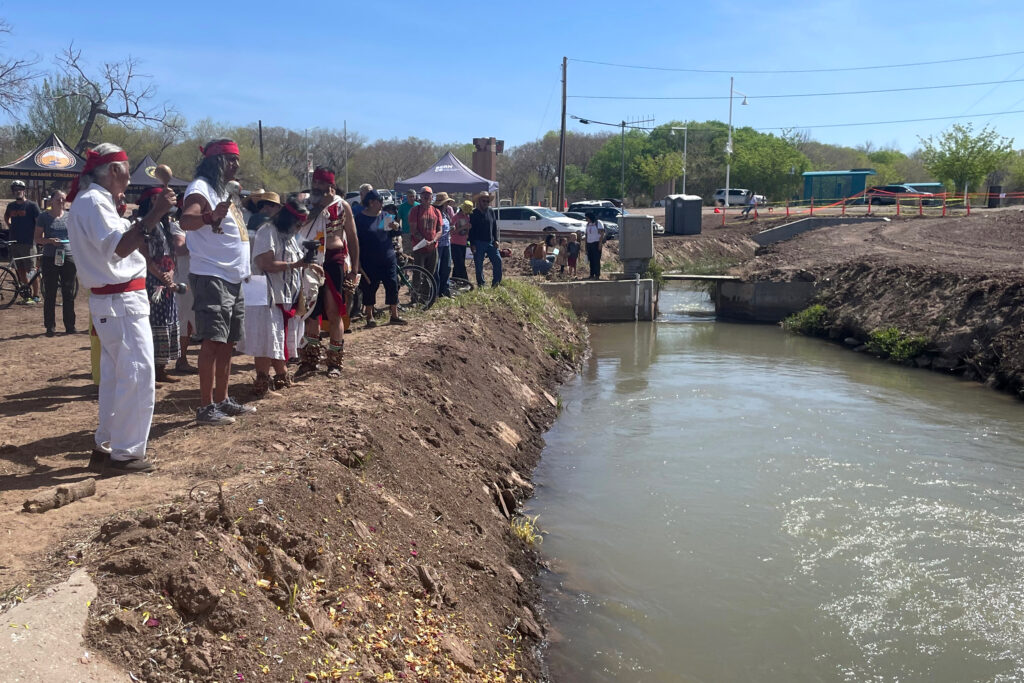
In Albuquerque's South Valley, the arrival of spring is traditionally marked by a ritual of hope. Recently, that ceremony involved a toddler tossing flower petals into an irrigation ditch — a symbolic blessing of the water that has sustained this region since the 16th century. But this year, the gesture carries a heavy subtext of anxiety. The Rio Grande, the lifeblood of the communal canals known as acequias, is drying out months earlier than expected, the victim of record-low snowpack and a warming atmosphere.
The acequias are more than mere infrastructure. They represent a living system of governance and culture. For centuries, these hand-dug channels have distributed water based on shared responsibility and mutual aid, fostering a unique agricultural heritage in the high desert. Today, however, the social fabric of these communities is being tested by a hydrological reality that no longer aligns with historical patterns. Water managers are increasingly forced to look beyond the river, turning to prayers and the finite reserves of groundwater to keep the system from collapsing.
A System Built on Snowmelt, Facing a World Without It
The acequia model traces its roots to Moorish irrigation practices brought to the Iberian Peninsula and later transplanted to the Americas by Spanish colonists. In New Mexico, these systems predate statehood by roughly three centuries and are recognized under state law as political subdivisions with their own elected officials — the mayordomos who oversee water allocation. The governance structure is inherently communal: users share both the labor of maintaining the ditches and the obligation to distribute water equitably, particularly in lean years.
That communal logic, however, was designed for a climate that no longer exists in the same form. The Rio Grande's flow through central New Mexico depends overwhelmingly on snowpack accumulated in the mountains of southern Colorado and northern New Mexico during winter months. When spring temperatures rise, that snow melts and feeds the river through the irrigation season. The pattern has been reliable enough for centuries to anchor an entire civilization of small-scale farming.
What has changed is the relationship between temperature and precipitation. Warmer winters mean more precipitation falls as rain rather than snow, reducing the slow-release reservoir effect that snowpack provides. Warmer springs accelerate melt, pushing peak flows earlier in the calendar. And hotter summers increase evaporation from both the river and the soil. The result is a compounding squeeze: less water stored, less water delivered, and more water lost to the atmosphere before it reaches a field.
New Mexico is not alone in confronting this dynamic. Across the American West, snowpack-dependent water systems — from the Colorado River basin to California's Central Valley — have experienced analogous stress. But the acequia communities face a particular vulnerability: they operate at the smallest scale, with the least financial cushion, and their water rights, while legally recognized, often sit junior to those of larger municipal and industrial users in the prior-appropriation hierarchy that governs Western water law.
Groundwater as Lifeline and Liability
The turn toward groundwater is a rational response to surface scarcity, but it introduces its own set of risks. Aquifers in the Middle Rio Grande basin are not infinite reserves. Decades of pumping for municipal and agricultural use have already drawn down water tables in parts of the region. Increased reliance by acequia communities adds another straw to an already stressed system.
There is also a legal dimension. In New Mexico, surface water and groundwater are managed under a single permit system administered by the Office of the State Engineer, but the practical enforcement of groundwater rights remains contested and uneven. Communities that have historically relied on surface flows may find that transitioning to wells requires navigating a permitting process that favors larger, better-capitalized users.
More fundamentally, the shift from surface water to groundwater changes the character of the acequia itself. The ditch is not merely a delivery mechanism; it is the organizing principle of the community. When water flows through the channel, neighbors gather to clean it, disputes are mediated by the mayordomo, and the rhythm of planting follows the rhythm of the current. Replace the ditch with a well, and the communal architecture dissolves — even if the crops survive.
The crisis in New Mexico's acequias sits at the intersection of climate science, water law, and cultural preservation. The hydrological trend is clear and unlikely to reverse on any policy-relevant timeline. The legal tools available to small irrigators remain limited. And the cultural stakes — the survival of one of North America's oldest continuous agricultural traditions — do not translate easily into the cost-benefit frameworks that typically drive water policy. Whether the acequia system adapts, contracts, or eventually disappears may depend less on engineering than on whether the broader political economy of Western water is willing to make room for institutions that predate it by centuries.
With reporting from Inside Climate News.
Source · Inside Climate News