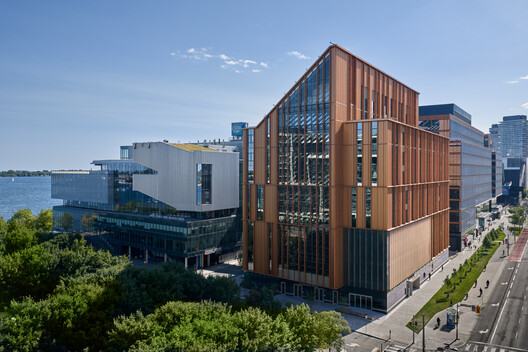
In the evolving skyline of Toronto's waterfront, Limberlost Place stands as a quiet defiance of the steel-and-glass hegemony. Designed by Moriyama & Teshima Architects for George Brown College, the 203,000-square-foot facility is a study in the scalability of mass timber. By utilizing cross-laminated timber (CLT) — engineered panels made by layering and bonding wood boards at right angles for structural rigidity — and glue-laminated columns, the project moves beyond the boutique applications of wood to prove that heavy-timber construction can meet the rigorous demands of a ten-story institutional hub.
The building's environmental logic is as structural as it is aesthetic. Limberlost Place is designed to achieve net-zero carbon emissions, leveraging the inherent carbon sequestration of its wooden frame alongside advanced passive cooling and ventilation systems. Its "breathing" facade and solar chimney allow for natural airflow, reducing the reliance on mechanical systems that typically dominate large-scale academic buildings.
Mass timber at institutional scale
For most of its modern history, timber construction occupied a narrow band of the architectural spectrum: single-family homes, low-rise pavilions, and the occasional cultural building designed to showcase craft. The emergence of mass timber — a category that includes CLT, glue-laminated timber (glulam), and nail-laminated timber — has begun to change that calculus. Engineered wood products can now rival steel and concrete in load-bearing capacity while offering a fraction of the embodied carbon. A timber frame sequesters carbon dioxide absorbed during the tree's growth, effectively locking it into the structure rather than releasing it during manufacturing, as concrete production does.
Limberlost Place enters a growing but still modest cohort of tall wood buildings worldwide. Projects such as Mjøstårnet in Brumunddal, Norway — an eighteen-story mixed-use tower completed in 2019 — and the Brock Commons Tallwood House at the University of British Columbia in Vancouver have demonstrated that mass timber can reach meaningful heights. Yet most of these precedents serve residential or mixed-use functions. A ten-story academic building designed for high-occupancy use, with laboratories, studios, and gathering spaces, presents a distinct set of challenges around fire safety, acoustic performance, and structural vibration. That Limberlost Place tackles these within a mass-timber framework makes it a notable reference point for institutional clients considering the material.
The fire performance question, often the first raised by skeptics, has a well-documented answer in engineering terms. Mass timber chars predictably at a known rate, forming an insulating layer that protects the structural core — a behavior that can outperform unprotected steel, which loses strength rapidly at high temperatures. Canadian building codes have been updated in recent years to accommodate taller wood structures, reflecting a broader regulatory shift across jurisdictions in North America and Europe.
Beyond carbon: the biophilic argument
The environmental case for mass timber is by now well rehearsed. What Limberlost Place adds to the conversation is a design argument rooted in occupant experience. The exposed wood ceilings and columns are not concealed behind drywall; they form the visible interior environment. A growing body of research in environmental psychology links exposure to natural materials with reduced stress and improved cognitive performance — findings that carry particular relevance in an academic setting where the building itself becomes part of the pedagogical mission.
The passive ventilation strategy reinforces this orientation. Rather than sealing the building envelope and relying entirely on mechanical HVAC, the design uses a solar chimney — a vertical shaft heated by solar gain to draw air upward — and operable facade elements to create stack-effect ventilation. The approach reduces energy consumption but also reconnects occupants with external conditions in a way that fully mechanized buildings deliberately suppress.
As cities confront the reality that the built environment accounts for a substantial share of global carbon emissions, the pressure on architects and developers to rethink material choices will only intensify. Limberlost Place does not resolve every tension inherent in that transition — questions of sustainable forestry supply chains, cost premiums over conventional construction, and the scalability of mass timber beyond mid-rise remain open. But it places a working example in the middle of one of North America's largest cities, where it will be tested daily by thousands of students and faculty. Whether it becomes a prototype or an outlier depends less on the building itself than on the willingness of institutions and regulators to follow the path it outlines.
With reporting from ArchDaily.
Source · ArchDaily