In the desert landscape along the Red Sea, a dormant giant is waking up. Saudi Arabia has officially restarted construction on the Jeddah Tower, an architectural endeavor that seeks to do what no structure has done before: reach the milestone height of 1,000 meters. Originally conceived as the crown jewel of Jeddah Economic City, the project represents a pivot back to grand-scale physical infrastructure after years of delays and economic recalibration.
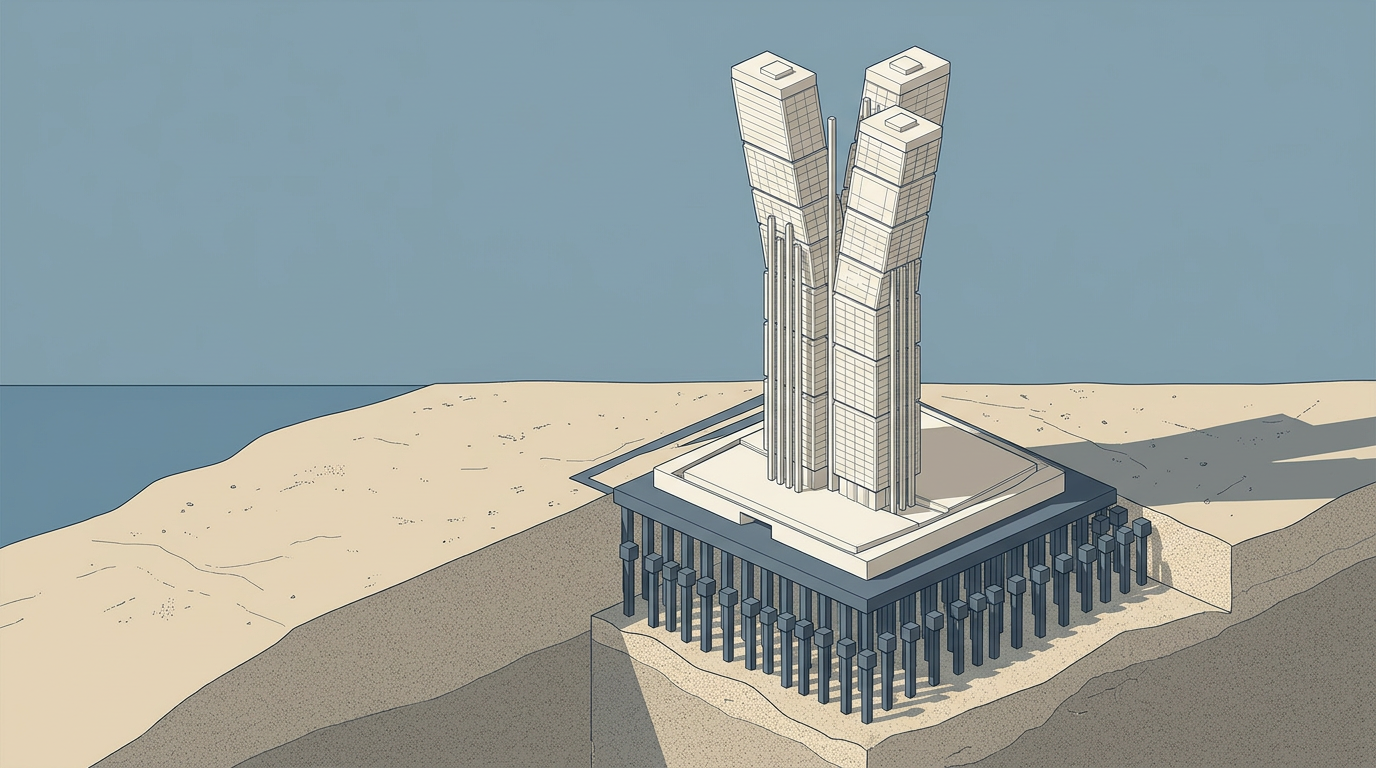
Designed by Smith + Gill Architecture, the tower's form is dictated by the physics of extreme altitude. Its three-winged, Y-shaped footprint is not merely aesthetic; it is a strategic aerodynamic choice to "confuse" the wind, shedding the powerful vortexes that can cause tall buildings to sway dangerously. Beneath the surface, the structure rests on a massive network of high-resistance concrete piles, driven deep into the coastal earth to support a weight that pushes the boundaries of material science.
Engineering at the edge of the known
The technical challenges of building at this scale are qualitatively different from those faced by the current record holder, the Burj Khalifa in Dubai, which stands at roughly 828 meters. At extreme heights, the variables compound: wind loads increase nonlinearly, concrete must be pumped to altitudes where pressure differentials and curing times behave unpredictably, and elevator systems require engineering that goes well beyond conventional vertical transit. The Y-shaped plan of the Jeddah Tower addresses the wind problem by ensuring that no two faces of the building present the same profile to prevailing gusts at the same time, disrupting the formation of coherent vortex patterns. It is a design philosophy rooted in structural necessity rather than visual ambition.
The foundation work itself illustrates the scale of the undertaking. Coastal soil near the Red Sea is not the most forgiving substrate for a structure of this mass. The deep-driven piles must transfer loads through layers of variable density to reach stable geological strata, a process that demands precision boring and materials calibrated for long-term chemical interaction with saline ground conditions. Each of these subterranean decisions carries consequences that will play out over decades.
A symbol in search of its era
The path to the clouds has been anything but linear. Since its foundation was first laid in 2013, the project has weathered financial crises and internal restructuring, leaving its skeletal frame as a silent monument for much of the last decade. The original timeline envisioned completion years ago; instead, the tower became an inadvertent case study in how sovereign megaprojects absorb macroeconomic shocks. With the appointment of new construction consortia in 2024, the logistical machinery — including a suite of specialized, high-altitude cranes unique in the world — is moving again.
The broader context matters. Saudi Arabia's Vision 2030 program has channeled enormous capital into physical landmarks intended to signal economic diversification beyond hydrocarbons. The Jeddah Tower sits alongside projects like NEOM and The Line as statements of infrastructural intent. Yet each of these ventures faces the same underlying tension: the gap between announcement and delivery, between rendered image and occupied space. The history of supertall construction globally — from the long-delayed Freedom Tower in New York to the financial turbulence surrounding several megatall proposals in China — suggests that the final stretch of such projects is where ambition meets the friction of logistics, capital, and political will most acutely.
The tower now stands as a test case for whether the era of the "megatall" skyscraper remains the definitive symbol of global infrastructure, or whether it belongs to a chapter that is slowly closing. The engineering is, in principle, solvable. The deeper question is whether the economic and urban logic that once justified kilometer-high construction still holds in a period when remote work, distributed cities, and climate-conscious design pull planning orthodoxy in the opposite direction. The crane arms turning again above Jeddah do not answer that question. They merely ensure it will be asked at a higher altitude than ever before.
With reporting from Olhar Digital.
Source · Olhar Digital