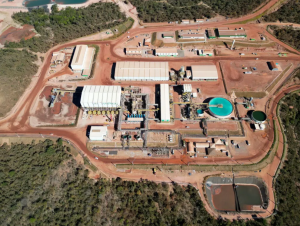
USA Rare Earth has announced a $2.8 billion deal to acquire the Brazilian miner Serra Verde, a move that signals a significant consolidation in the global race to secure critical minerals. The transaction, structured as a combination of $300 million in cash and 126.9 million newly issued shares, is expected to close in the third quarter of 2026. The acquisition is the cornerstone of a broader strategy to build a vertically integrated supply chain encompassing mining, processing, and the manufacturing of high-performance magnets.
The prize of the acquisition is Serra Verde's Pela Ema mine, which occupies a unique position in the global mineral landscape. According to USA Rare Earth CEO Barbara Humpton, it is the only large-scale producer outside of Asia capable of providing the four essential magnetic rare earth elements. The mine is particularly valued for its deposits of "heavy" rare earths, such as dysprosium and terbium — elements that are indispensable for the permanent magnets used in electric vehicle motors and wind turbines, yet remain notoriously difficult to source outside of Chinese-controlled networks.
The geopolitical logic of vertical integration
The deal is underpinned by substantial backing from the United States government, reflecting the geopolitical stakes of the energy transition. Earlier this year, USA Rare Earth secured a $1.6 billion financing package from federal and private sources, while Serra Verde closed its own $565 million funding round with Washington's support. Furthermore, Serra Verde has entered into a 15-year agreement to supply its entire initial production phase to a government-capitalized entity, effectively insulating the supply from market volatility.
The scale of public financing involved underscores a broader pattern in Western industrial policy. Since the mid-2020s, the United States, the European Union, and allied nations have moved aggressively to reduce dependence on China for the minerals and processed materials that underpin the clean energy transition. China has long dominated not just the mining of rare earth elements but, more critically, the midstream stages of refining, separation, and magnet production — the steps where raw ore becomes a usable industrial input. Western governments have recognized that securing a mine means little if the ore must still be shipped to Chinese facilities for processing. The USA Rare Earth–Serra Verde combination is designed explicitly to close that gap.
By integrating Serra Verde's extraction capabilities with its own processing and manufacturing ambitions, USA Rare Earth is attempting to solve the "midstream" problem that has long plagued Western efforts to rival Asian dominance in the sector. The goal is no longer just to pull ore from the ground, but to control the entire lifecycle of the materials that will power the next generation of industrial technology. The distinction matters: permanent magnets made from neodymium, praseodymium, dysprosium, and terbium are embedded in everything from EV drivetrains to defense systems to industrial robotics. Control over their production confers leverage that extends well beyond any single commodity market.
What stands between ambition and execution
The strategic logic is clear, but the operational challenge remains formidable. Building separation and magnet manufacturing capacity outside of Asia requires not only capital but also technical expertise that has been concentrated in Chinese and Japanese firms for decades. Previous Western attempts to establish independent rare earth supply chains — most notably the repeated struggles of Molycorp with its Mountain Pass mine in California during the 2010s — foundered not on the mining itself but on the economics and complexity of downstream processing. Whether USA Rare Earth can avoid a similar fate depends on execution at industrial scale, sustained government commitment across political cycles, and the ability to attract the specialized workforce that such facilities demand.
Brazil's role in this equation adds another dimension. The country holds some of the world's largest rare earth reserves, yet its mining sector has historically been oriented toward iron ore, bauxite, and other bulk commodities. A transaction of this size could catalyze further foreign investment in Brazilian critical minerals, though it also raises questions about resource sovereignty and the terms under which strategic assets are transferred to foreign entities.
The 15-year offtake agreement with a government-backed buyer provides a measure of demand certainty that most mining ventures lack. It also reveals the degree to which this supply chain is being constructed as a matter of national security rather than pure market economics. The tension between those two frameworks — strategic necessity and commercial viability — will define whether the vertically integrated model USA Rare Earth envisions becomes a durable feature of the Western industrial landscape or an expensive experiment sustained only as long as political will endures.
With reporting from InfoMoney.
Source · InfoMoney