The U.S. Space Force's strategy for orbital access is built on a fragile duopoly — one that is currently being tested by the technical teething pains of United Launch Alliance's Vulcan rocket. Intended to be the reliable, heavy-lift peer to SpaceX's Falcon 9, the Vulcan is now facing its second grounding in less than two years. For the Pentagon, the issue is not simply a missed schedule; it is a question of whether its primary alternative to Elon Musk's launch dominance is ready for the high-stakes demands of national security.
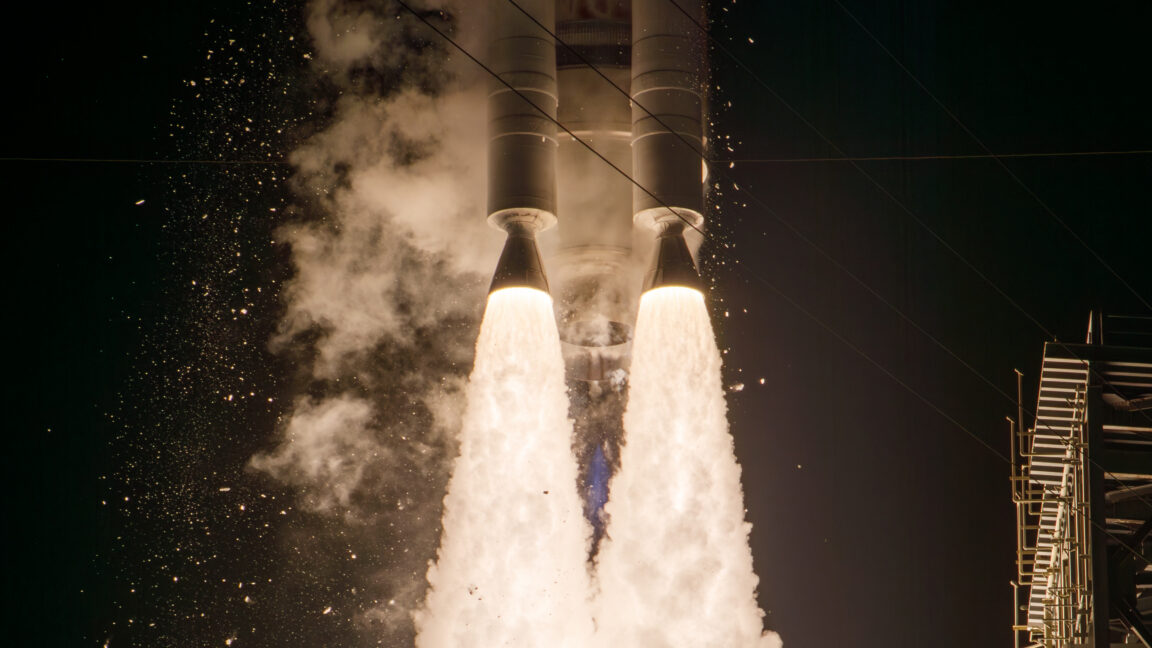
The technical culprit is a recurring anomaly with the rocket's solid rocket boosters. In both October 2024 and February 2025, exhaust nozzles on the boosters failed during ascent. While the Vulcan managed to reach its intended orbits despite these hardware losses, the pattern has alarmed military leadership. With a backlog of nearly 70 launches and only four flights completed since the rocket's debut in early 2024, ULA's slow ramp-up is creating a bottleneck that threatens the Pentagon's longstanding "assured access to space" doctrine — the principle that the United States must always have at least two independent pathways to orbit for its most critical payloads.
A duopoly under structural strain
The current architecture of national security launch dates to the mid-2010s, when the Department of Defense began the National Security Space Launch (NSSL) program to replace its earlier reliance on legacy vehicles — chiefly ULA's Atlas V, which depended on Russian-made RD-180 engines. The NSSL Phase 2 competition, concluded in 2020, split contracts between ULA's then-unflown Vulcan and SpaceX's Falcon 9 and Falcon Heavy, with ULA receiving roughly 60 percent of the missions. The rationale was straightforward: maintaining two providers would guard against the risk of a single-point failure grounding all national security launches simultaneously.
That logic assumed both providers would reach operational maturity on roughly comparable timelines. SpaceX, however, has spent the intervening years compiling a flight record that now numbers in the hundreds of Falcon 9 missions, while Vulcan's cadence has remained in single digits. The booster nozzle anomalies compound the disparity. Solid rocket boosters are a mature technology — Northrop Grumman supplies the GEM-63XL motors used on Vulcan — and recurring failures in a well-understood subsystem raise questions that go beyond a single design flaw. They suggest integration or quality-control challenges in a production pipeline that has yet to reach the tempo the Pentagon requires.
A three-star general signaled this week that these reliability issues will "absolutely" be a factor in the Space Force's next major launch competition. The statement, while measured, carries significant procurement weight. Moving a substantial number of missions from ULA to SpaceX would not merely adjust a contract ledger; it would reshape the competitive landscape of an industry the Defense Department has spent a decade trying to diversify.
The cost of dependence, in either direction
The Pentagon's dilemma is not simply choosing the more reliable rocket. Concentrating launches on a single provider — even one with SpaceX's track record — reintroduces the very risk the dual-source strategy was designed to mitigate. A grounding of Falcon 9, however unlikely on current evidence, would leave the United States without a proven vehicle for its most sensitive intelligence and military satellites. The Defense Department has historically paid a premium to avoid exactly that scenario.
Yet the alternative — continuing to reserve a large share of missions for a vehicle that has not demonstrated consistent performance — carries its own operational risk. Delayed launches mean delayed capability on orbit, a calculus that grows more urgent as both China and Russia expand their own space programs and anti-satellite capabilities.
The next NSSL procurement cycle will therefore test whether the Pentagon treats assured access as a structural principle worth subsidizing or as a market outcome that must be earned through demonstrated performance. ULA's parent companies, Boeing and Lockheed Martin, retain deep institutional ties to the defense establishment, but institutional relationships have limited currency when boosters malfunction on ascent.
The tension is clear: a single-provider market is strategically fragile, but a two-provider market in which one provider cannot reliably fly is operationally fragile. How the Space Force resolves that tension — and whether ULA can close the reliability gap before the next contract decisions are made — will define the structure of American national security launch for the remainder of the decade.
With reporting from Ars Technica Space.
Source · Ars Technica Space