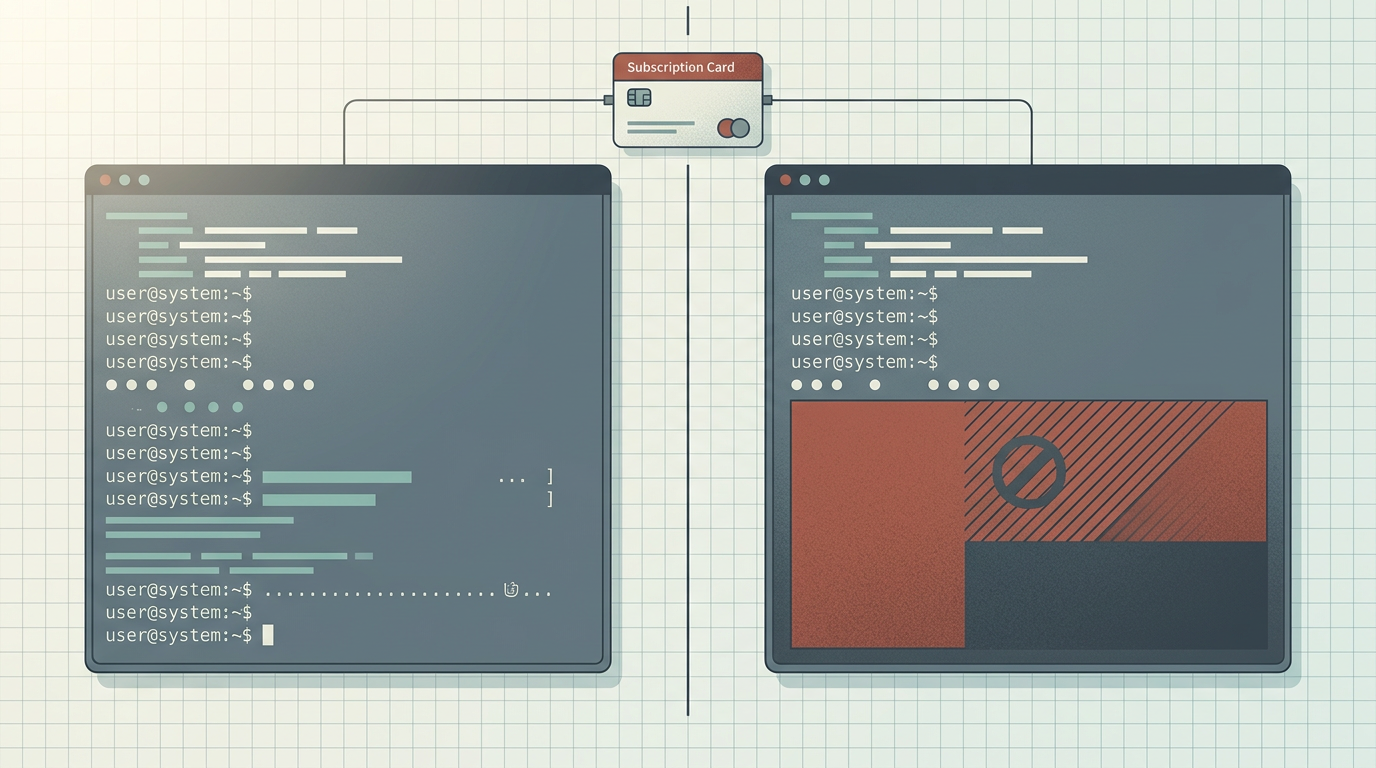
Anthropic has begun restricting access to Claude Code for a small subset of new Pro subscribers, framing the move as an A/B test that affects roughly 2% of new sign-ups. But changes to the company's official payment plan page tell a more ambiguous story: updated documentation now indicates that Pro-tier users will no longer have access to the tool, a discrepancy that has drawn scrutiny from developers who rely on it.
Claude Code is Anthropic's command-line coding agent, designed to let developers interact with Claude directly inside their terminal to write, refactor, and debug code across entire repositories. Since its introduction, the tool has become a meaningful differentiator for Anthropic's Pro plan, which sits between the free tier and the more expensive Max subscription. Removing it from Pro — even experimentally — touches a sensitive nerve in a market where developer tooling is a primary battleground among AI companies.
The gap between "test" and "policy"
A/B tests are routine in consumer software. Companies regularly expose a fraction of users to different feature sets, pricing structures, or interface layouts to measure behavioral impact. The practice is unremarkable on its own. What makes Anthropic's situation unusual is the simultaneous update to its public-facing plan documentation. When the written terms of a subscription change to exclude a feature, the framing of a "limited experiment" becomes harder to sustain. Users and observers are left to reconcile two signals: a company saying the restriction is narrow and temporary, and a plan page that reads as though the restriction is general and permanent.
This kind of ambiguity is not unique to Anthropic. Software companies frequently use staged rollouts to test user tolerance for feature removal before making a change official. The A/B test label can serve a dual purpose — it generates data on churn and engagement, while also providing rhetorical cover if the backlash proves too costly. Whether that is the intent here is unclear, but the pattern is familiar enough to warrant attention.
Developer tooling as competitive leverage
The broader context matters. The race among frontier AI labs to capture developer loyalty has intensified considerably. OpenAI, Google, and a growing roster of startups are all investing heavily in coding assistants, IDE integrations, and agentic developer workflows. In this environment, access to a capable coding agent is not a peripheral perk — it is often the reason a developer chooses one platform over another.
For Anthropic, Claude Code has served as a compelling reason for technical users to pay for Pro rather than relying on the free tier or switching to a competitor. Pulling it from that tier, even partially, risks pushing cost-sensitive developers toward alternatives at exactly the moment when switching costs are still low and competing products are improving rapidly. On the other hand, if Claude Code usage at the Pro price point is economically unsustainable — compute-intensive agentic coding sessions are expensive to serve — Anthropic may be testing whether it can reserve the feature for higher-revenue tiers without unacceptable attrition.
The tension is structural: AI companies need developer adoption to build ecosystem gravity, but they also need unit economics that work as usage scales. Giving away expensive capabilities to grow a user base is a familiar startup strategy, but it has a shelf life. The question is whether Anthropic has reached that inflection point or is simply probing its boundaries.
How this resolves will depend on what the data shows — and on how loudly the affected users push back. If the 2% cohort churns at elevated rates or migrates to competing tools, the experiment may end quietly. If retention holds, the restriction could become the new default, with Claude Code migrating permanently to higher-priced plans. Either outcome carries strategic consequences, not just for Anthropic's subscription architecture, but for the emerging norm of how AI companies package and gate their most resource-intensive features.
With reporting from XDA developers.
Source · XDA developers