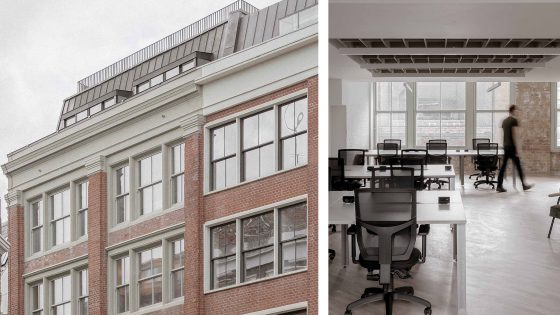
Architecture for London has completed a refurbishment and extension of a Victorian warehouse in Clerkenwell, one of central London's most architecturally layered neighborhoods. The project applies a restrained, minimalist approach to an industrial structure, modernizing the interior and adding new floor area while preserving the character of the original building.
Clerkenwell, situated on the fringe of the City of London, has long served as a testing ground for adaptive reuse. Its dense stock of Victorian and Georgian commercial buildings — former workshops, print houses, and warehouses — has attracted successive waves of creative and professional tenants since the area's post-industrial decline in the mid-twentieth century. The district's planning context tends to reward interventions that respect existing fabric rather than replace it, making it a natural setting for the kind of careful reworking Architecture for London has undertaken.
Adaptive reuse as architectural discipline
Stripping back a Victorian warehouse is not merely a stylistic choice. Buildings of this era were typically constructed with load-bearing brick walls, timber floors, and cast-iron columns — materials that, when exposed and properly maintained, offer both structural integrity and visual warmth. The minimalist aesthetic described in the project aligns with a broader tendency in contemporary British practice: letting the existing structure do much of the expressive work, rather than layering new finishes over old bones.
This approach carries practical advantages. Retaining and refurbishing an existing structure avoids the embodied carbon cost of demolition and new construction, a consideration that has moved from the margins to the center of architectural discourse over the past decade. The extension component adds usable area without requiring a ground-up build, a trade-off that planning authorities in conservation-sensitive areas of London have increasingly been willing to support when the design demonstrates sensitivity to context.
Architecture for London, a practice known for its focus on sustainable residential and commercial projects, has built a portfolio that leans heavily on retrofit and extension work. The Clerkenwell warehouse fits within that pattern. The firm's design philosophy tends to favor natural materials, passive environmental strategies, and spatial clarity — principles that align well with the inherent qualities of Victorian industrial buildings, where generous ceiling heights and robust construction provide a strong starting point.
Clerkenwell and the economics of heritage conversion
The warehouse conversion also reflects a durable economic logic specific to inner London. Clerkenwell's commercial rents have historically rewarded distinctive, character-rich spaces — the kind that adaptive reuse delivers more convincingly than new-build office stock. The neighborhood's proximity to Farringdon station, now a Crossrail interchange, has reinforced its appeal to professional services firms, design studios, and technology companies willing to pay a premium for atmosphere.
This dynamic is not unique to Clerkenwell. Across London and other major European cities, the conversion of nineteenth-century industrial buildings into offices, studios, and mixed-use spaces has become a well-established asset class. What distinguishes projects like this one is the degree of architectural ambition applied to what could otherwise be a routine commercial fit-out. The decision to strip back rather than cover up, to extend rather than demolish, positions the building within a lineage of thoughtful London warehouse conversions stretching back to the loft developments of the 1980s and 1990s in neighborhoods like Shoreditch and Bermondsey.
Whether this model of careful, low-intervention refurbishment can scale to meet London's broader need for commercial and mixed-use space remains an open question. The city's stock of convertible Victorian industrial buildings is finite, and each project operates within site-specific constraints — structural condition, listed status, planning policy — that resist standardization. At the same time, the growing regulatory and market pressure to reduce whole-life carbon in construction gives retrofit-first strategies a structural tailwind that pure economics alone might not provide. The tension between the bespoke nature of heritage conversion and the scale of demand for sustainable workspace is one the profession will continue to navigate.
With reporting from Architects Journal.
Source · Architects Journal