In the hills of Fuliang County, just outside Jingdezhen — the city long synonymous with Chinese porcelain production — a modest architectural project raises questions that extend well beyond its 720-square-meter footprint. The Mine Resort, designed by the Shanghai-based firm siarchitecture, occupies a former mining site in Wuxi Village, Jiangxi Province. Rather than concealing the terrain's industrial scars, the project embeds itself within them, treating topography as both material and narrative.
The resort, completed in 2025 and titled "Hill" by its designers, is part of a broader wave of rural architectural commissions across China that attempt to reconcile post-industrial landscapes with the demands of contemporary tourism. Jingdezhen's surrounding countryside, shaped by centuries of mineral extraction tied to the ceramics trade, presents a particularly layered context: the land itself is an artifact of human industry, not a pristine wilderness waiting to be framed.
Building Into the Scar
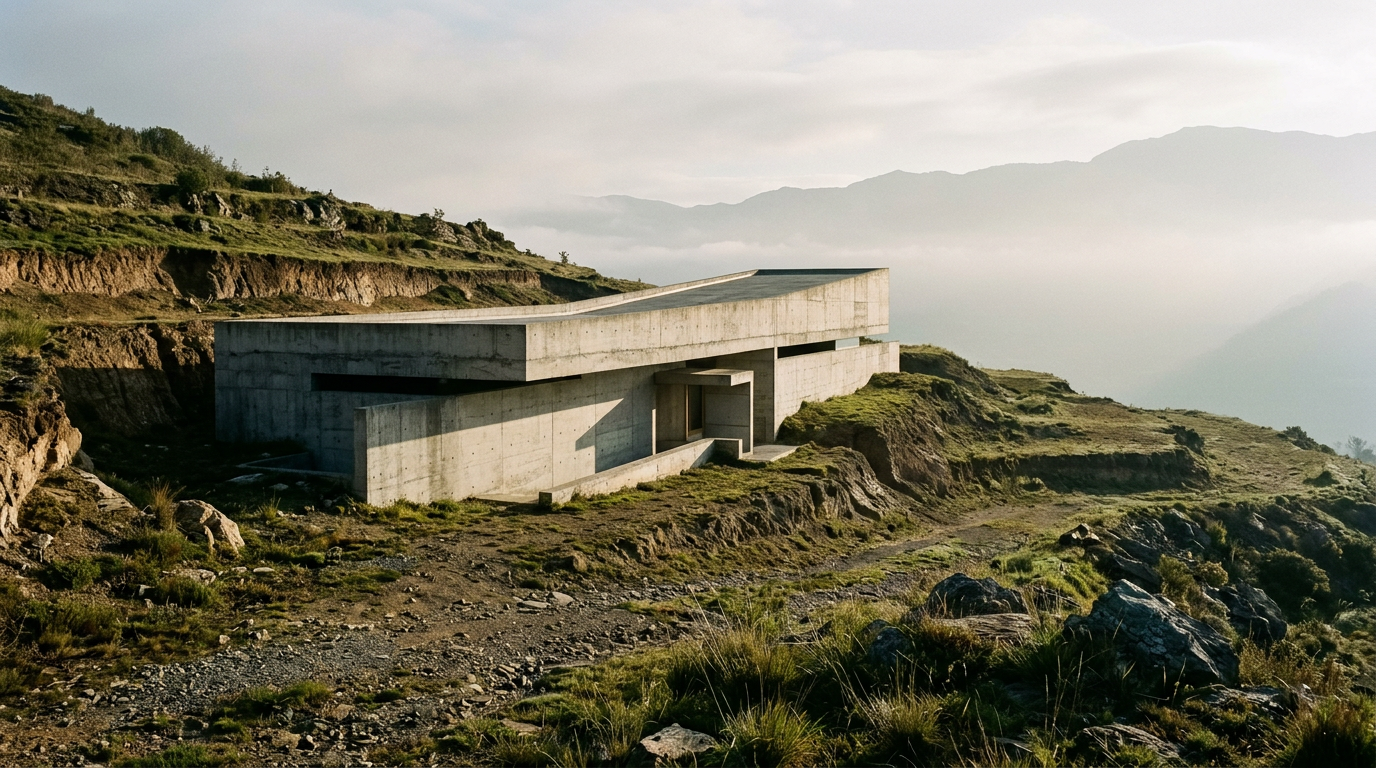
The design strategy at the Mine Resort belongs to a lineage of landscape-responsive architecture that treats the existing ground condition as a generative constraint rather than an obstacle. By following the contours of the hillside, siarchitecture avoids the common resort typology of a freestanding object placed atop a flattened site. Instead, the building reads as a continuation of the slope — rooflines tracking the grade, volumes stepping with the terrain, interiors opening onto views shaped by the hill's own geometry.
This approach carries a specific ethical dimension in a mining context. Extraction landscapes are, by definition, sites where the earth has been reorganized for economic purposes. The architectural choice to work with the resulting topography — rather than regrading or masking it — implicitly acknowledges that history. The scarred hillside is not treated as a problem to be solved but as a condition to be inhabited. A minimalist material palette reinforces this posture, keeping the visual emphasis on the textures and colors of the Jiangxi landscape rather than on the building itself.
The method echoes precedents elsewhere in China's rural architecture movement. Projects such as those by DnA Design and Architecture in Zhejiang Province's Songyang County have demonstrated that small-scale interventions in post-agrarian or post-industrial villages can catalyze tourism without erasing local identity. The Mine Resort operates in similar territory, though its specific challenge — building on land shaped by extraction rather than cultivation — adds a layer of complexity around what "restoration" actually means.
Rural Revitalization and Its Tensions
China's rural revitalization policy framework, which has accelerated since the late 2010s, has generated a significant pipeline of architectural commissions in the countryside. The stated goals are economic: attract visitors, create service-sector employment, stem rural depopulation. Architecture, in this context, functions as infrastructure for a new rural economy built around hospitality, culture, and landscape experience.
The results have been uneven. At their best, these projects produce buildings that are genuinely attentive to place — structures that draw visitors precisely because they feel specific rather than generic. At their worst, they produce aesthetic objects parachuted into villages with little connection to local life or economy, serving primarily as backdrops for social media content.
Where the Mine Resort falls on that spectrum will depend on factors that architecture alone cannot determine: the economic model sustaining it, the degree of local employment and ownership involved, and whether the project functions as an isolated destination or as part of a broader network of village-scale interventions. The building's formal sensitivity to its site is evident. Whether that sensitivity extends to the social and economic fabric of Wuxi Village is a separate question — and arguably the more consequential one.
Jingdezhen itself is undergoing a parallel transformation, as the city repositions its ceramics heritage as a cultural asset rather than a purely industrial one. The Mine Resort sits at the periphery of that shift, occupying the literal ground where raw materials were once extracted. The tension between preservation and reinvention, between honoring industrial memory and packaging it for leisure consumption, remains unresolved — and is perhaps more productive left that way.
With reporting from ArchDaily.
Source · ArchDaily