For nearly half a century, the British weekly 2000 AD has served as a laboratory for a specific brand of cynical, high-concept science fiction. While its most famous export, Judge Dredd, has seen mixed success in Hollywood — a bombastic 1995 Sylvester Stallone vehicle followed by the leaner, better-received Dredd in 2012 — the publication remains a deep well of untapped intellectual property. Now, director Duncan Jones, whose debut Moon remains a touchstone of modern cerebral sci-fi, is turning his attention to Rogue Trooper, a story that trades urban dystopia for the bio-chemical horrors of a planetary front line.
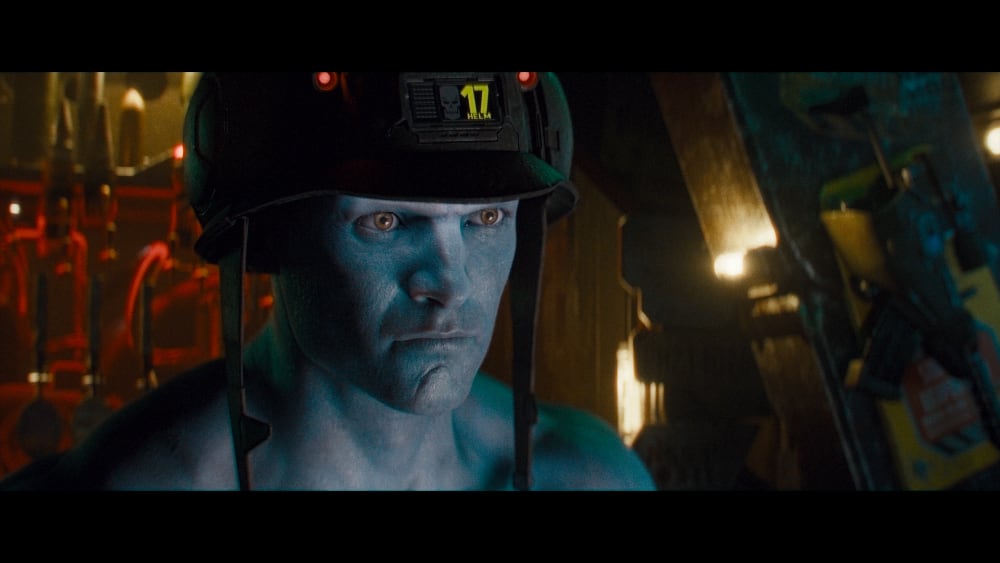
Created by Gerry Finley-Day and Dave Gibbons, Rogue Trooper first appeared in 2000 AD in 1981. It is set on Nu Earth, a world so thoroughly devastated by chemical warfare between the "Southers" and "Norts" that its atmosphere is lethal to baseline humans. The narrative centers on the Genetic Infantry: blue-skinned, bio-engineered super-soldiers designed to survive the toxic environment without the cumbersome hazmat suits required by their creators. It is a war of attrition where biology is just another weaponized asset. The protagonist, Rogue, carries the digitized consciousness of three fallen comrades embedded in his equipment — helmet, rifle, and backpack — making him simultaneously a one-man squad and a walking memorial.
From Page to Screen: Why Now
The teaser recently released by Jones suggests a visual fidelity to the original comic's grim aesthetic. That choice matters. Comic book adaptations have increasingly moved toward tonal sanitization, smoothing rough edges to reach the widest possible audience. Rogue Trooper resists that impulse by design: its source material is steeped in the anti-war tradition of British comics, where satire and horror coexist without apology. Gibbons, who would go on to illustrate Watchmen with Alan Moore, brought a visceral clarity to the strip's depiction of trench warfare reimagined through a science fiction lens. The comic owes as much to Wilfred Owen as it does to pulp adventure.
Jones is an interesting fit for the material. Moon dealt with the ethics of corporate exploitation through cloned labor. Source Code interrogated identity under technological duress. Even Mute, his more divisive Berlin-set noir, circled questions of personhood in a world shaped by technology's unintended consequences. Rogue Trooper sits squarely within that thematic territory. The Genetic Infantry are, in essence, purpose-built tools — soldiers engineered to fight in conditions their makers cannot survive, then discarded when their utility ends. The parallel to contemporary debates around autonomous weapons systems and the ethics of engineering life for military application is difficult to ignore.
The adaptation also arrives at a moment when the broader entertainment industry is reassessing which comic properties carry untapped potential. The dominance of Marvel and DC adaptations over the past two decades has created a market where audiences are literate in the grammar of comic book storytelling but increasingly fatigued by its most familiar forms. Properties from outside the American mainstream — 2000 AD, the Franco-Belgian tradition, manga beyond the most obvious titles — represent a frontier for studios seeking differentiation.
The Harder Question: Audience and Ambition
The commercial challenge for Rogue Trooper is straightforward. The property lacks the name recognition of even second-tier Marvel characters in most markets outside the United Kingdom. Its tone — bleak, militaristic, philosophically uncomfortable — does not lend itself to the four-quadrant blockbuster model. Jones himself has never operated at tentpole scale; his filmography is defined by constraint and intimacy, not spectacle.
But constraint may be precisely what the material demands. The most effective war films tend to work through compression rather than expansion — limiting scope to amplify the psychological weight of conflict. If Jones approaches Nu Earth the way he approached the lunar base in Moon, as a claustrophobic arena where identity fractures under institutional pressure, the film could carve a distinct space in a crowded genre landscape.
The tension worth watching is between the property's cult origins and the commercial apparatus required to bring it to screen. Whether Rogue Trooper can maintain its corrosive edge while navigating the economics of modern film production is a question that will define not just this project, but the viability of 2000 AD as a cinematic pipeline. The Genetic Infantry were built to survive hostile environments. Whether their story can survive the equally hostile terrain of Hollywood development remains an open question.
With reporting from Ars Technica.
Source · Ars Technica