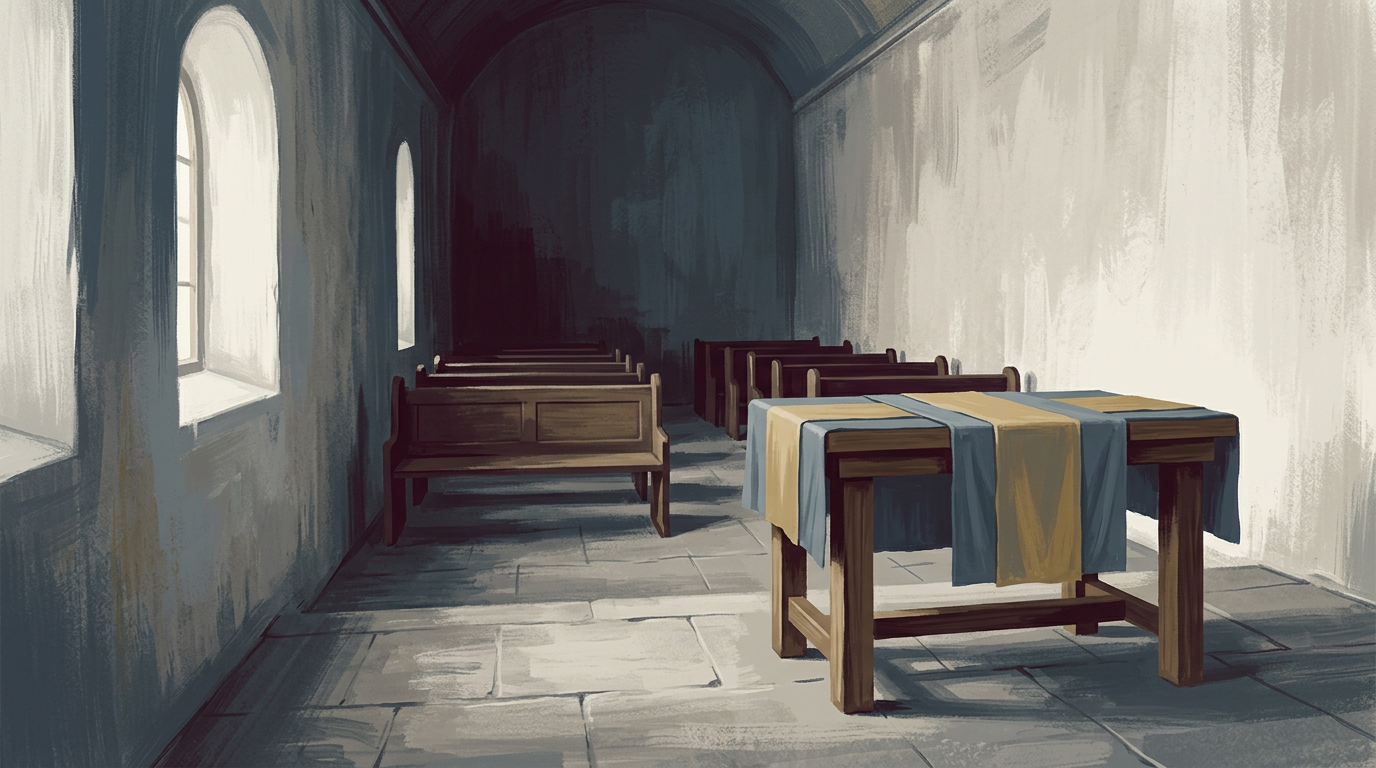
Erik Helmerson, a Swedish author and columnist, has published a new novel that imagines a near-future Sweden in which nationalist devotion has effectively replaced religious faith as the country's moral framework. The book, reviewed by Dagens Nyheter, stages a confrontation between the demands of an ethno-nationalist state and the humanitarian obligations that religious and liberal traditions have long claimed as foundational. At its center is a protagonist who has betrayed refugees in the name of national purity — and who must reckon with whether any authority, divine or otherwise, will hold him accountable.
The premise is speculative, but the raw materials are not. Sweden's political landscape has shifted markedly over the past decade, with immigration policy moving from one of Europe's most permissive frameworks to a considerably more restrictive posture. The Sweden Democrats, a party with roots in far-right movements, became a parliamentary support party for the governing coalition in 2022, reshaping the terms of public debate around identity, belonging, and national cohesion. Helmerson's fiction does not map directly onto current politics, but it draws from an atmosphere that Swedish readers will recognize.
The Altar of the State
The novel's central conceit — that patriotic devotion can function as a surrogate religion — belongs to a long tradition in political thought. The concept of civil religion, articulated most famously by Jean-Jacques Rousseau and later adapted by sociologist Robert Bellah in his analysis of American public life, describes the way states generate sacred symbols, rituals, and moral vocabularies that parallel those of organized faith. Helmerson appears to push this idea to its logical extreme: a society in which the state's claim on loyalty is not merely parallel to religious obligation but has actively displaced it.
This displacement carries specific weight in the Swedish context. The Church of Sweden, historically a state church until its formal separation from the government in 2000, has in recent decades positioned itself as a voice for refugee rights and humanitarian concern — sometimes in direct tension with prevailing political winds. A novel that asks what happens when that voice is silenced, or rendered irrelevant, is engaging with a real institutional and cultural fault line.
Helmerson reportedly avoids the trap of simple polemic. Rather than constructing a morality play with clear heroes and villains, the narrative dwells on the psychology of complicity: the small accommodations, the strategic silences, the gradual erosion of principle that allow an individual to participate in systemic cruelty while maintaining a self-image of decency. This territory has been explored in European literature before — from Günter Grass's reckoning with German guilt to Michel Houellebecq's provocations about French cultural surrender — but each national context produces its own particular anxieties.
Conscience as Narrative Engine
The protagonist's central question — whether God will judge him for his betrayal of refugees — functions less as a theological proposition than as a device for exploring moral accountability in a society that has restructured its value system. When the state defines virtue exclusively in terms of loyalty to the nation, the traditional sources of moral authority — scripture, conscience, universal human rights — become subversive. The novel, by this account, is interested in what happens to individuals who still carry those older moral frameworks inside them, even as the public culture has moved on.
The speculative novel as a vehicle for political anxiety has a robust recent history in Scandinavia. Works by authors across the Nordic countries have used near-future settings to examine the fragility of social democratic consensus, the appeal of authoritarian simplicity, and the tension between openness and cohesion. Helmerson's contribution appears to add a specifically religious dimension to this conversation, asking whether secular societies that abandon their inherited ethical vocabularies leave themselves vulnerable to replacement creeds that are less merciful.
What remains unresolved — and perhaps deliberately so — is whether the novel treats religious faith as a genuine counterweight to nationalist excess or merely as another form of collective myth-making, no more reliable than the ideology it opposes. The tension between these readings may be precisely the point. A society debating the terms of belonging is also, inevitably, debating the sources of moral authority — and whether any of them can hold when the pressure is sufficient.
With reporting from Dagens Nyheter.
Source · Dagens Nyheter