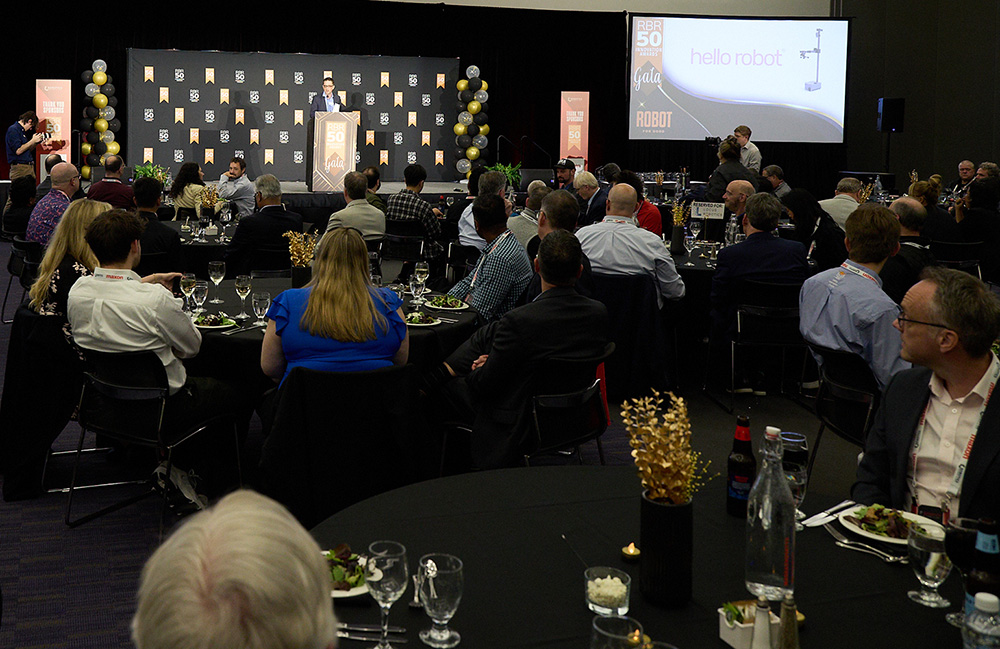
The robotics industry continues to shift from theoretical potential toward tangible, specialized utility — a transition that will be central to the 2026 Robotics Summit & Expo. The event, scheduled for May 27 at the Thomas M. Menino Boston Convention and Exhibition Center, will culminate in the RBR50 Gala, an annual assembly of the field's most influential architects and the presentation of the RBR50 Robotics Innovation Awards.
This year's honorees reflect a broader industry focus on sensory refinement and human-centric applications. Amazon's Vulcan robot, named Robot of the Year, exemplifies this trend through its advanced sense of touch, which has begun to automate the nuanced tasks of warehouse picking and stowing. Meanwhile, the startup Physical Intelligence (PI) has been recognized for its foundational models, which aim to fundamentally change how machines learn and generalize tasks, moving away from rigid, hard-coded programming.
From Warehouses to Wearables
The RBR50 list has long served as a barometer of where commercial robotics is heading, and the 2026 cohort signals a decisive pivot. For years, the dominant narrative in the field centered on mobility — getting robots to navigate unstructured environments. The emphasis now appears to be shifting toward dexterity and perception: not just where a robot can go, but what it can feel, grasp, and interpret.
Amazon's Vulcan is a case in point. Warehouse automation has historically relied on robots that move bins and pallets — large, predictable objects on known paths. The challenge of picking individual items from cluttered shelves, each with different shapes, weights, and fragility profiles, has remained one of the hardest unsolved problems in logistics robotics. Tactile sensing, the ability for a gripper to detect pressure, slip, and texture in real time, represents a meaningful step toward closing that gap. That Amazon chose to develop this capability internally, rather than acquire it, speaks to the strategic importance the company assigns to fine-grained manipulation in its fulfillment infrastructure.
Physical Intelligence's recognition points to a parallel development. Foundation models — large-scale neural networks trained on broad datasets and then fine-tuned for specific tasks — have transformed language processing and image generation over the past several years. Applying the same paradigm to robotic control is an active area of research across multiple labs and startups. The core promise is that robots could learn general physical intuition from diverse training data, then adapt to new tasks with minimal additional programming. Whether that promise translates into reliable, deployable systems at scale remains an open question, but the direction of investment is clear.
Robotics as a Medium for Care
The awards also underscore the growing intersection of robotics and healthcare. Harvard University's Soft Exoskeleton, a wearable device designed to assist patients with ALS and stroke-induced impairments, was named Application of the Year. Similarly, Tatum Robotics received the Robots for Good award for its Tatum1 hand, a device capable of tactile sign language communication. These developments suggest a trajectory where robotics is defined as much by its capacity for assistance and accessibility as by its industrial efficiency.
Soft exoskeletons occupy a distinct niche within rehabilitation engineering. Unlike rigid exoskeletons, which use metal frames and powerful actuators, soft variants employ compliant materials — fabrics, cables, pneumatic bladders — that conform to the body's natural movement. The trade-off is typically lower force output in exchange for lighter weight, greater comfort, and reduced risk of injury. For patients recovering from stroke or managing degenerative conditions, wearability over extended periods matters as much as peak performance.
Tatum Robotics' sign language hand, meanwhile, sits at an unusual intersection of robotics and communication technology. Translating language into physical gesture requires not only mechanical precision but also a nuanced understanding of how meaning is conveyed through hand shape, movement, and timing. The recognition of such a device alongside warehouse automation and AI foundation models illustrates how broad the definition of "robotics innovation" has become.
The evening's centerpiece will be a conversation between Aaron Parness, director of applied sciences at Amazon Robotics, and Steve Crowe, executive editor of The Robot Report. Their discussion is expected to provide a technical post-mortem on the development of Vulcan, offering a rare look into how one of the world's largest logistics operations navigates the complexities of modern automation.
What the 2026 RBR50 list ultimately frames is a tension between two modes of progress: the scaling of robotic intelligence through general-purpose models, and the careful engineering of specialized systems for specific human needs. Whether the field consolidates around one approach or continues to advance on both fronts simultaneously may define the next several years of the industry.
With reporting from The Robot Report.
Source · The Robot Report