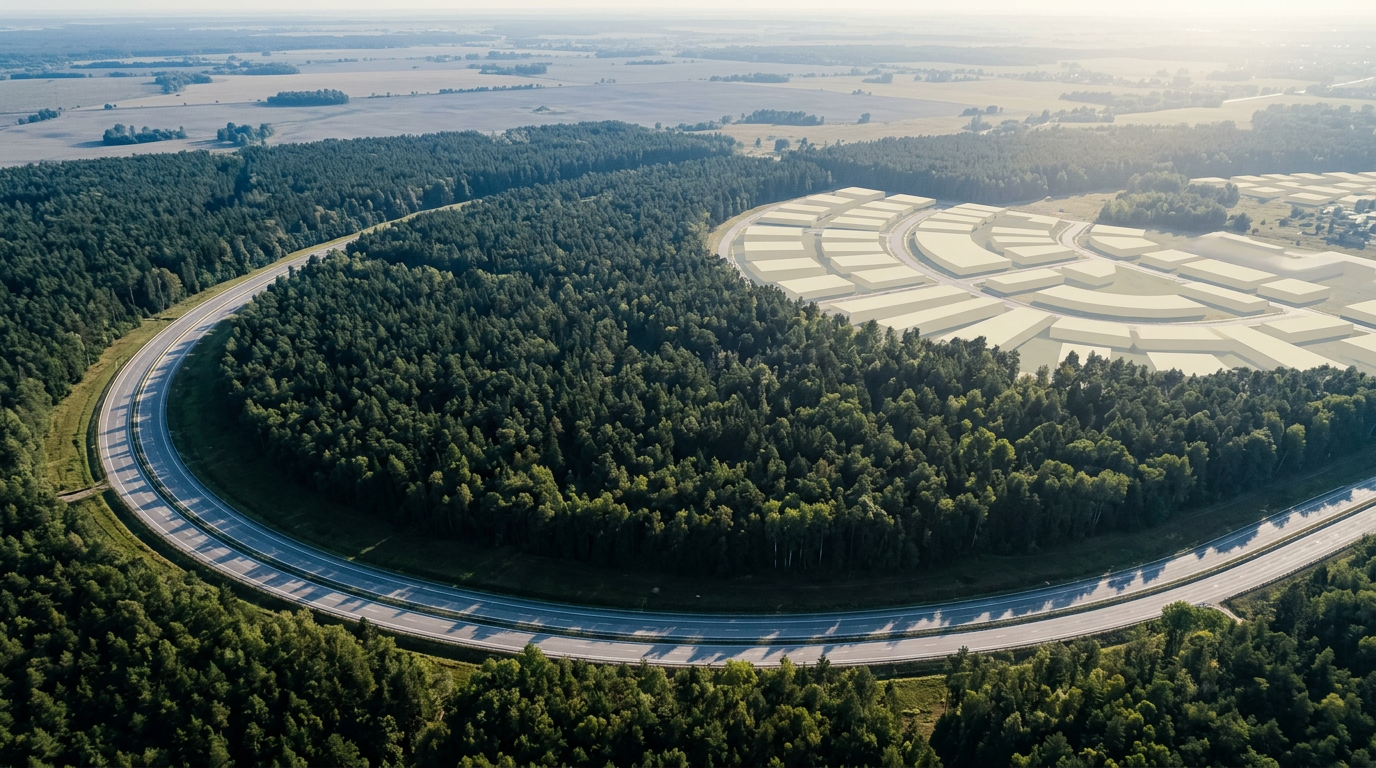
Robotic construction firm ICON has formalized its ambitions for the federal sector with the launch of ICON Prime, a new business unit dedicated to scaling its 3D-printing technology for the Department of Defense and NASA. The division will be led by former Texas Representative and CIA officer Will Hurd, a move that signals ICON's intent to navigate the complex intersection of national security and aerospace infrastructure.
The company already manages a robust $360 million portfolio of government contracts. Current projects include a $62.8 million agreement to 3D-print barracks at Fort Bliss, Texas, and a $67.9 million contract for infrastructure at Fort Polk, Louisiana. These domestic military projects serve as a terrestrial proving ground for the company's ultimate objective: developing the automated systems required to build habitable structures on the Moon and Mars.
From Military Barracks to Lunar Regolith
The logic connecting military base construction in Texas to lunar habitats is more linear than it might appear. Both environments demand structures that can be erected quickly, with minimal human labor, using materials available on-site or nearby. Traditional construction methods — shipping prefabricated components, coordinating large crews, managing extended timelines — are expensive and logistically fragile on Earth. On the Moon, they are functionally impossible. Every kilogram launched beyond low Earth orbit carries an extraordinary cost penalty, making in-situ resource utilization not merely desirable but essential for any sustained off-world presence.
NASA has already directed $60 million into ICON's research, including the construction of a simulated Martian habitat at the Johnson Space Center. The technical challenges of off-world construction remain formidable, particularly the management of lunar regolith — the abrasive, razor-sharp dust that coats the Moon's surface and can degrade hardware, seals, and space suits. By printing structures using local materials, ICON aims to provide radiation shielding and pressurized enclosures necessary for long-term human habitation beyond Earth.
The Pentagon's interest runs along a parallel track. The U.S. military has long sought to reduce the time and cost of constructing forward operating bases and permanent installations. Additive construction — the industrial term for large-scale 3D printing of buildings — offers the possibility of deploying structures in austere environments with fewer personnel and shorter timelines. Fort Bliss and Fort Polk function as controlled demonstrations of that capability, generating performance data that can inform both military doctrine and space mission planning.
The Hurd Appointment and the Politics of Dual-Use Technology
The choice of Will Hurd to lead ICON Prime is deliberate. A former CIA officer and three-term congressman who sat on committees overseeing intelligence and technology policy, Hurd brings a network that spans defense procurement, intelligence community leadership, and congressional appropriations — the three pillars that determine whether a government contractor thrives or stalls. His appointment reflects a broader pattern in the defense-adjacent technology sector, where firms increasingly recruit figures who understand both the policy apparatus and the technical requirements of their products.
ICON's positioning also arrives at a moment when the broader space infrastructure market is maturing. NASA's Artemis program, despite schedule adjustments, continues to anchor U.S. lunar exploration strategy. The Department of Defense, meanwhile, has grown more vocal about the strategic importance of cislunar space — the region between Earth and the Moon — as a domain requiring both surveillance and physical presence. A company that can build structures autonomously on the lunar surface sits at the convergence of these two institutional priorities.
Despite the shifting winds of Washington, ICON Prime's leadership views the trajectory toward lunar exploration as a settled matter of national policy. Hurd has framed the alignment between government agencies and private innovators as a mission that transcends election cycles. The underlying bet is that regardless of which administration occupies the White House, the strategic imperative to establish infrastructure beyond Earth will persist.
Whether that bet holds depends on variables ICON cannot control: the pace of Artemis missions, the stability of defense budgets, and the willingness of Congress to fund dual-use construction technology at scale. What the company can control is the terrestrial track record it is building now — one barracks at a time — as evidence that robotic construction works before the stakes become interplanetary.
With reporting from Payload Space.
Source · Payload Space