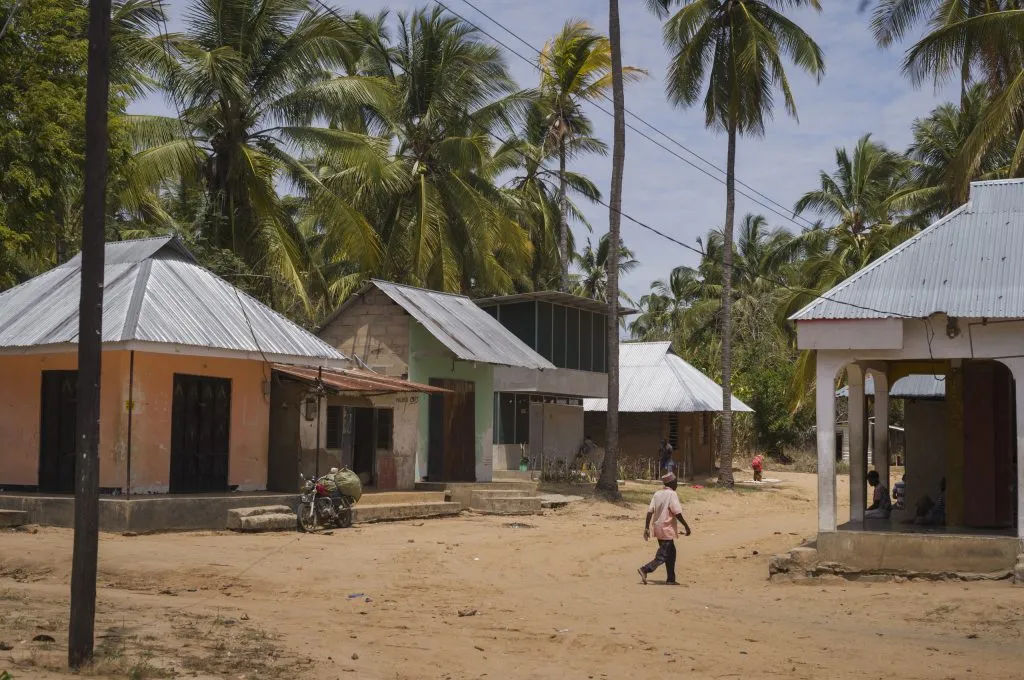
Ingvartsen Architects has completed a set of 110 residences in the Mtwara Region of southern Tanzania. Known as Star Homes, the project is designed to improve the health of residents in rural villages by addressing specific environmental and physiological needs through architectural intervention. The development, situated in one of the country's least urbanized areas, positions residential design as a frontline tool in public health — a proposition with broad implications for housing policy across sub-Saharan Africa.
The Mtwara Region, bordering Mozambique along Tanzania's southeastern coast, has long contended with the health burdens common to rural sub-Saharan communities: vector-borne diseases such as malaria, respiratory conditions linked to indoor air quality, and waterborne illness tied to inadequate sanitation infrastructure. Conventional approaches to these problems have centered on medical intervention — bed nets, vaccination campaigns, water treatment. The Star Homes project operates from a different premise: that the dwelling itself can function as a health intervention.
Architecture as public health infrastructure
The idea that housing design shapes health outcomes is not new. The modern public health movement in nineteenth-century Europe was, in significant part, an architectural movement — driven by the recognition that overcrowded, poorly ventilated tenements bred cholera and tuberculosis. What distinguishes projects like Star Homes is the application of that logic to contexts where formal housing programs remain scarce and where the gap between medical knowledge and built environment conditions is wide.
In rural sub-Saharan Africa, residential construction is overwhelmingly informal, governed by available materials, inherited building traditions, and cost constraints rather than by health-performance criteria. Ventilation patterns, floor materials, roof geometry, and the relationship between cooking spaces and sleeping areas all carry measurable health consequences, yet they rarely figure in housing policy at the national or regional level. The Star Homes project suggests that even modest, replicable design decisions — oriented toward airflow, moisture control, and separation of domestic functions — can shift health outcomes at the household level.
The choice of Mtwara as a site carries its own significance. The region has historically received less development investment than Tanzania's northern corridor or the Dar es Salaam metropolitan area. A demonstration project of this scale in a peripheral region implicitly argues that design-led health housing need not be confined to pilot programs in capital cities or peri-urban zones where donor visibility is higher.
Replicability and the limits of the blueprint
The language of "blueprint" is attractive but warrants scrutiny. Rural housing contexts across sub-Saharan Africa vary enormously — in climate, soil conditions, cultural building practices, household structures, and disease profiles. A design calibrated for the hot, humid coastal lowlands of southeastern Tanzania may require substantial adaptation for the semi-arid Sahel or the highland plateaus of East Africa. The transferability of the Star Homes model depends less on its specific formal solutions than on its underlying methodology: treating health data as a design input with the same rigor typically reserved for structural loads or site orientation.
There is also the question of scale. One hundred and ten homes constitute a meaningful proof of concept, but the rural housing deficit across the continent is measured in the tens of millions. Whether this approach can move beyond the demonstration phase depends on financing mechanisms, government adoption, and the willingness of development agencies to treat housing as health spending rather than as a separate budget line.
Ingvartsen Architects, a Copenhagen-based practice, joins a growing cohort of European and African firms working at the intersection of design and development in sub-Saharan contexts. The trajectory of such projects — whether they remain isolated exemplars or seed broader policy shifts — often hinges on factors well beyond the architect's control: political continuity, land tenure systems, and the institutional capacity to maintain and replicate what has been built.
The Star Homes project poses a question that its own completion cannot answer: whether the architecture profession and the public health establishment can converge on housing as shared territory, or whether projects like this will remain admired exceptions in a landscape still defined by the gap between what is known and what is built.
With reporting from Architectural Review.
Source · Architectural Review