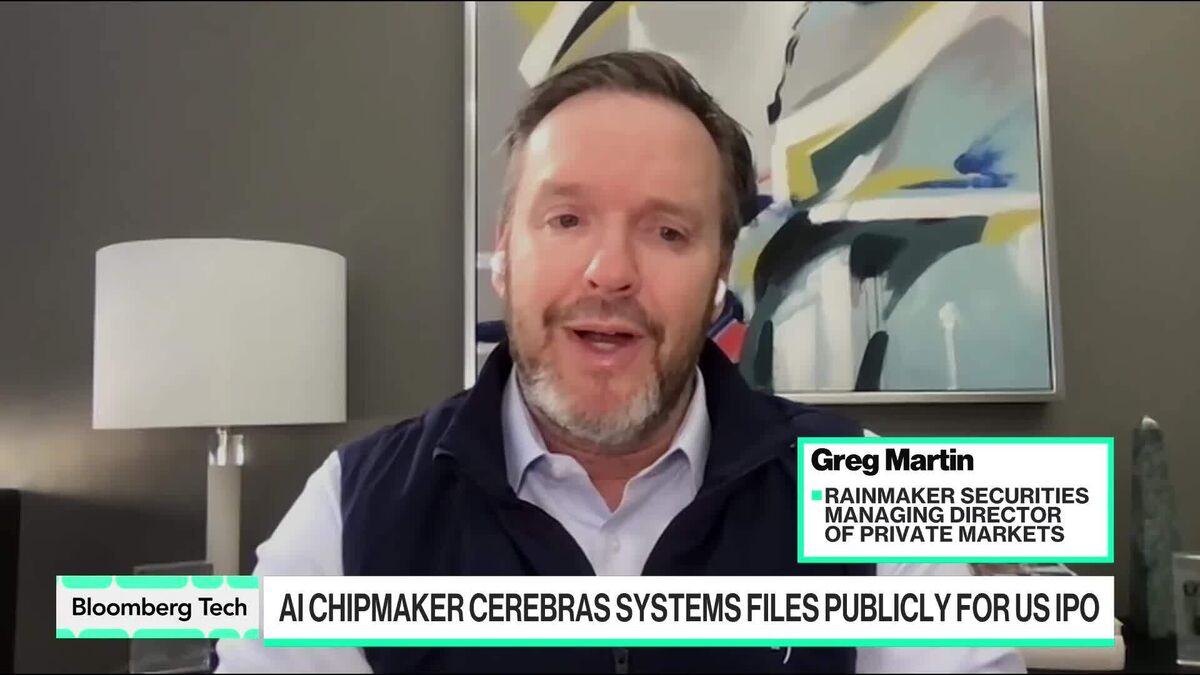
The initial public offering market appears to be regaining momentum after an extended period of subdued activity, with investor attention increasingly focused on a handful of high-profile technology companies that could reshape the landscape for public debuts. Greg Martin, managing director of private markets at Rainmaker Securities, has pointed to anticipated listings from Anthropic, OpenAI, and SpaceX as key drivers of renewed sentiment across both private and public capital markets.
The three companies represent distinct but overlapping segments of the technology economy — artificial intelligence infrastructure, AI applications, and aerospace — and their potential transitions from private to public status carry implications well beyond their individual valuations. Martin's analysis, shared on Bloomberg Television, frames the current moment as one in which the mere expectation of mega-listings is already altering how capital flows through the broader ecosystem.
The IPO drought and what changed
The IPO market spent much of the past several years in a state of contraction. Rising interest rates, volatile equity markets, and a recalibration of technology valuations after the pandemic-era boom combined to make public listings unattractive for many companies and their underwriters. The number of technology IPOs declined sharply from the peaks seen in 2021, and several firms that did go public during that window traded well below their offering prices, further dampening enthusiasm.
What appears to have shifted is not a single catalyst but a convergence of factors. Equity markets have stabilized, and the generative AI cycle has created a new class of companies with rapid revenue growth and intense investor demand. Anthropic and OpenAI, both central to the large language model race, have attracted enormous private capital — but the scale of their ambitions and their capital requirements may eventually necessitate access to public markets. SpaceX, meanwhile, has long been one of the most valuable private companies in the world, and any signal of a public listing tends to reverberate across the venture and growth equity landscape.
The anticipation itself matters. When investors expect a wave of high-quality supply to enter public markets, it can unlock capital that has been sitting on the sidelines. Fund managers begin repositioning portfolios, secondary market activity in private shares accelerates, and underwriters start rebuilding their pipelines. Martin's observation suggests this dynamic is already underway.
Private markets feel the pull
The relationship between private and public markets is rarely static, and the current environment illustrates how tightly the two are linked. Companies like Anthropic and OpenAI have raised successive rounds of private funding at escalating valuations, supported in part by the implicit promise that a public listing would eventually provide liquidity. As those listings move from theoretical to plausible, the pricing of private shares adjusts — sometimes dramatically.
For institutional investors who entered these companies at earlier stages, a credible IPO timeline transforms paper gains into a path toward realized returns. For later-stage investors, the calculus shifts toward whether current private valuations leave sufficient room for appreciation in public markets. Firms like Rainmaker Securities, which specialize in secondary transactions of private company shares, sit at the intersection of these forces and tend to see activity increase well before any formal IPO filing.
The broader question is whether three or four landmark listings can reignite a sustained IPO cycle or whether they remain isolated events in an otherwise cautious market. Previous waves of high-profile debuts — the 2019 cluster that included Uber, Lyft, and Slack, for instance — produced mixed results and did not necessarily open the floodgates for smaller companies. The AI sector carries its own uncertainties: revenue models are still maturing, competitive dynamics shift rapidly, and regulatory frameworks remain incomplete in most jurisdictions.
What is clear is that the gravitational pull of these anticipated listings is already reshaping capital allocation decisions. Whether that energy translates into a durable reopening of the IPO window or dissipates after the initial wave depends on execution, market conditions at the time of pricing, and how public investors ultimately value companies whose growth trajectories remain steep but whose profitability timelines are less certain.
With reporting from Bloomberg — Technology.
Source · Bloomberg — Technology