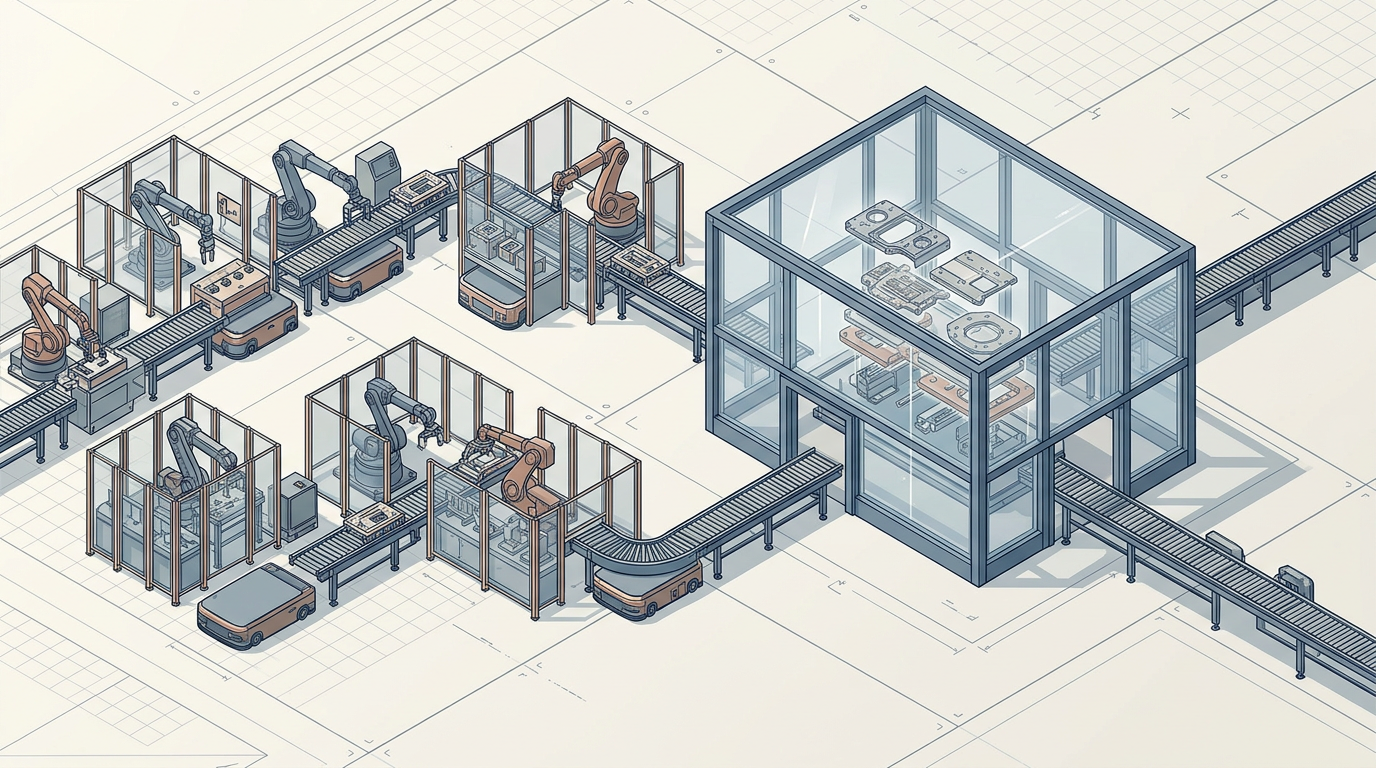
While much of the current AI boom has centered on the digital — generating text, code, and images — Jeff Bezos is making an outsized bet on the corporeal. Project Prometheus, the billionaire's physical AI laboratory, is reportedly nearing the close of a $10 billion funding round that would value the venture at approximately $38 billion. That figure represents a steep climb from the $6.2 billion valuation attached to its launch in late 2025, and it places Prometheus in the rarefied tier of private technology ventures that have historically been reserved for software-native companies.
The sheer scale of the round underscores a shifting thesis among deep-pocketed investors: that the next frontier for artificial intelligence is not another chatbot or image generator, but systems capable of reasoning about the physical world — its friction, its tolerances, its unpredictable material behavior.
From bits to atoms
The AI industry's center of gravity has, until recently, orbited large language models and their multimodal successors. These systems excel at pattern recognition across text, code, and pixels, but they operate in a domain where errors are cheap and reversible. A hallucinated paragraph can be discarded; a miscalculated stress load on an aircraft fuselage cannot.
Project Prometheus is reportedly targeting precisely that gap. Its mandate — developing AI that understands the nuances of physics for applications in aerospace, manufacturing, and drug discovery — places it in a category sometimes called "physical AI" or "world models." The core challenge is building systems that can simulate, predict, and optimize processes governed by the laws of thermodynamics, fluid dynamics, and material science, domains where training data is scarcer and the cost of failure is orders of magnitude higher than in digital environments.
The concept is not entirely new. Industrial simulation software has existed for decades, and companies across the robotics sector have long pursued machine learning approaches to manipulation and locomotion. What distinguishes the current wave is the ambition to apply the scaling paradigm that proved successful in language models — more compute, more data, larger architectures — to the messier physics of the real world. Whether that paradigm transfers cleanly remains an open question. Physical systems are governed by hard constraints that digital token prediction is not, and the feedback loops required to train such models are slower, more expensive, and harder to parallelize.
Industrial stakes and competitive terrain
Bezos's personal involvement adds a layer of strategic significance. His experience building Amazon's logistics infrastructure — one of the most complex physical operations on the planet — and his investment in Blue Origin, a company defined by the unforgiving physics of rocketry, suggest a founder whose intuitions are oriented toward the material world. Prometheus, in that light, reads less as a speculative side project and more as a convergence of long-held interests.
The competitive landscape is forming quickly. Several major technology companies and well-funded startups are pursuing adjacent territory, from robotics foundation models to AI-driven materials discovery. The industrial sector, for its part, has been cautiously receptive. Manufacturers and aerospace firms face persistent pressure to reduce prototyping cycles and optimize production, but they also operate under regulatory regimes that demand explainability and reliability — qualities that current AI architectures do not always deliver.
A $38 billion valuation for a venture less than a year old prices in considerable optimism. It assumes not only that physical AI can be made to work at scale, but that it can be commercialized in industries where adoption cycles are measured in years, not quarters, and where incumbent engineering workflows are deeply entrenched. The capital gives Prometheus runway. Whether the physics cooperates as readily as the funding market is a different matter entirely.
With reporting from The Next Web.
Source · The Next Web