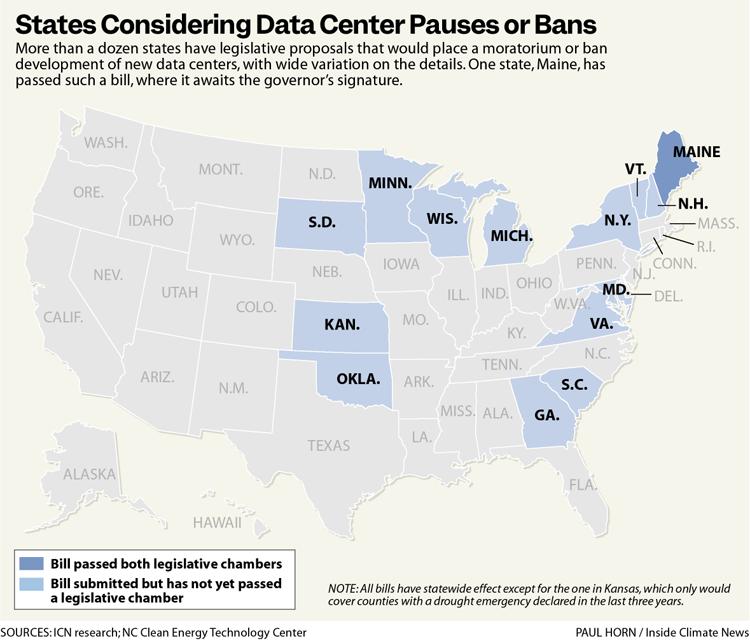
The state of Maine has moved to become the first in the nation to pass a moratorium on the development of large-scale data centers, signaling a shift in how local governments view the physical footprint of the digital economy. The state House and Senate recently approved LD 307, a bill that halts approvals for any facility requiring 20 megawatts or more of electricity until at least October 2027. The legislation now sits on the desk of Governor Janet Mills, whose signature would codify a growing skepticism toward the unchecked expansion of high-demand infrastructure.
The pause reflects a deepening anxiety over the resource intensity of modern computing. As the race for artificial intelligence accelerates, the hardware required to sustain it has become increasingly voracious. Last year, U.S. data centers accounted for more than 50 gigawatts of electricity demand — roughly double the peak demand of the entire New England power grid. For Maine and its neighbors, the prospect of integrating supersized facilities into an aging grid poses a direct threat to both energy stability and the monthly bills of residential ratepayers.
A grid built for a different era
The tension at the heart of Maine's moratorium is not new, but its political expression is. For decades, the American power grid has evolved incrementally, shaped by the slow retirement of fossil fuel plants and the gradual addition of renewable capacity. Data centers, by contrast, arrive as sudden, concentrated loads. A single hyperscale facility can consume as much electricity as a small city, and the timeline from announcement to operation often outpaces the construction of new generation or transmission infrastructure. The result is a mismatch between the pace of digital expansion and the physical capacity of the systems meant to support it.
Maine's grid is particularly exposed. The state relies heavily on natural gas, hydropower, and a growing but still modest share of wind and solar generation. Its transmission infrastructure connects to the broader New England grid through a limited set of corridors. Adding a 20-megawatt-or-greater load to that network is not a trivial engineering exercise — it requires upgrades that take years to plan and build, and the costs often flow downstream to ratepayers who derive no direct benefit from the facility.
This dynamic has played out in other regions. In Northern Virginia, which hosts the densest cluster of data centers in the world, the utility Dominion Energy has struggled to keep pace with demand, leading to delays in new connections and rising concerns about reliability. Similar pressures have emerged in parts of Texas and the Pacific Northwest, where large tech companies have sought to secure power purchase agreements for new facilities. The pattern is consistent: data center developers move faster than the grid can adapt.
The political calculus shifts
Maine is unlikely to remain an outlier. Approximately a dozen states are currently weighing similar proposals to curb or restrict data center development, with analysts pointing to Minnesota and Illinois as the next likely candidates for legislative action. The political logic is straightforward. Data centers generate relatively few permanent jobs compared to the resources they consume. A facility that draws tens of megawatts may employ only a few dozen full-time workers. For communities weighing the trade-offs — higher electricity costs, increased water consumption for cooling, industrial-scale construction — the value proposition is often difficult to defend at the local level.
The industry has responded with familiar arguments: economic development, tax revenue, and the strategic importance of domestic computing infrastructure in an era of geopolitical competition over AI. These arguments carry weight in state capitals, particularly when accompanied by significant capital investment commitments. But the cultural headwind is real. Local opposition to data centers has grown more organized, drawing on the same playbook that communities have used to resist pipelines, power plants, and other large infrastructure projects.
What makes this moment distinct is the scale of demand. The AI boom has compressed years of projected growth into months. Training and running large language models requires computational power — and therefore electrical power — at levels that even optimistic grid planners did not anticipate. The question facing policymakers is whether a moratorium represents a prudent pause to align infrastructure with demand, or a signal that the regulatory environment for data centers in the United States is becoming structurally hostile.
Both readings carry consequences. A coordinated slowdown across multiple states could redirect investment toward regions with surplus power capacity, or toward countries with fewer regulatory constraints. A failure to pause, on the other hand, risks grid instability and a political backlash that could prove far more restrictive than any moratorium. Maine has placed its bet. The rest of the country is watching to see whether the grid — or the market — blinks first.
With reporting from Grist.
Source · Grist