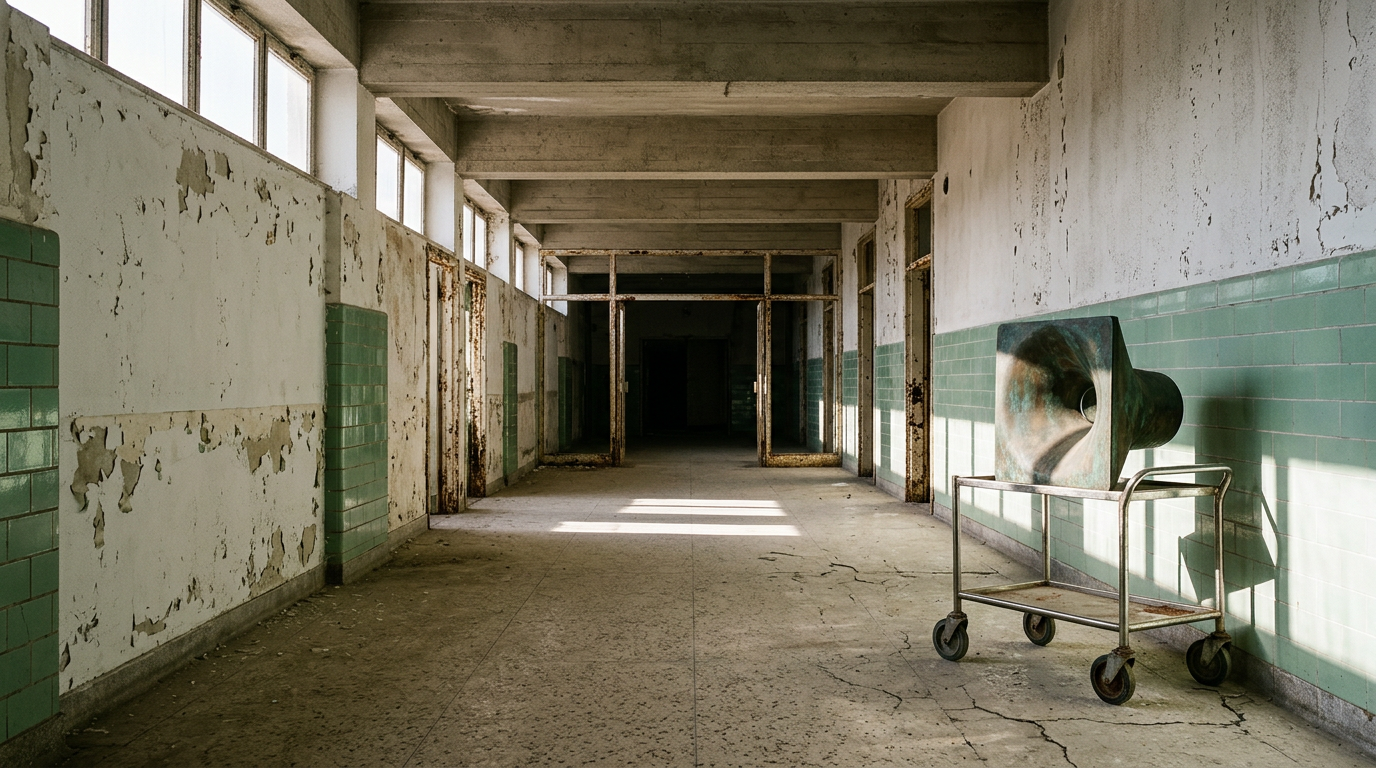
The former Baggio Military Hospital, a sprawling complex on the western periphery of Milan, has been repurposed once more as a stage for experimental design. As part of the Alcova program during Milan Design Week 2026, the site's disused laundry rooms, kitchens, and chapel have been occupied by installations that challenge conventional boundaries between object and environment. The architecture carries the weight of its institutional past — cracking frescoes, dust-covered tiles, corridors scaled for efficiency rather than comfort — and that residue is precisely the point.
Alcova, the itinerant platform founded in 2018 by Valentina Ciuffi and Joseph Grima, has built its reputation on occupying abandoned or transitional spaces across Milan: former factories, slaughterhouses, and military barracks have all served as hosts. The choice of venue is never incidental. Each site becomes an active participant in the exhibition, its history pressing against the work it contains. The Baggio complex, constructed in the early twentieth century to serve the Italian military's medical needs and gradually decommissioned over subsequent decades, offers a particularly charged backdrop — a place where bodies were once processed, regulated, and returned to function.
Objects in Institutional Afterlives
The central tension of this year's program lies in the friction between utility and imagination. Rooms originally designed for clinical hygiene or communal feeding now host speculative installations — objects that refuse to declare a single purpose. A stone wedding, retro speakers reimagined as sculptural forms, a dinner set scaled for rodents: these are not prototypes awaiting manufacture. They are propositions, artifacts of intent that ask what an object becomes when stripped of obligation to serve.
This curatorial strategy draws on a lineage familiar to Italian design culture. The radical design movements of the 1960s and 1970s — groups such as Superstudio and Archizoom — similarly questioned whether objects needed to fulfill practical roles or could instead operate as vehicles for critique and speculation. Alcova does not position itself as a direct heir to those movements, but the resonance is difficult to ignore. By situating contemporary work inside a building that once enforced institutional order, the exhibition foregrounds a recurring question in design discourse: who decides what an object is for, and under what conditions does that meaning shift?
The site itself performs a kind of argument. Military hospitals are spaces of restoration in the narrowest sense — the goal is to return a body to operational capacity. Design, as framed at Baggio, proposes a different kind of restoration: one oriented not toward function but toward desire, ambiguity, and open-ended use.
Materiality as Medium and Message
What distinguishes the Baggio installations from a conventional gallery presentation is the insistence on materiality as context. The objects do not float in white-cube neutrality. They sit against peeling walls, under vaulted ceilings stained by decades of moisture, in rooms where the plumbing infrastructure remains visible. This environmental pressure forces a reading that a polished showroom would not permit. Each piece must contend with the building's own material presence — its mass, its decay, its institutional grammar.
This approach reflects a broader shift within design exhibition culture, where the relationship between object and site has become a subject of increasing curatorial attention. Events such as Milan Design Week have long relied on the spectacle of unexpected venues, but platforms like Alcova push the logic further, treating the venue not as backdrop but as interlocutor. The risk, as with any site-specific strategy, is that the building overwhelms the work. At Baggio, the curators appear to have embraced that risk as a productive condition rather than a problem to solve.
The installations ultimately suggest that design operates most powerfully not when it resolves tension but when it sustains it. The objects at Baggio are carriers of intent — proposals for ways of living that remain deliberately unfinished. They do not answer the question of what design should be in a post-industrial, post-institutional landscape. They hold the question open, embedded in cracked plaster and repurposed tile, waiting for the visitor to bring their own reading.
Whether this mode of exhibition — speculative, site-dependent, resistant to commercial legibility — can sustain itself as design culture grows more market-driven is a tension worth watching. The Baggio complex will not remain available forever. The objects shown there will disperse. What persists is the friction between a building that once demanded compliance and the work that now refuses it.
With reporting from Designboom.
Source · Designboom