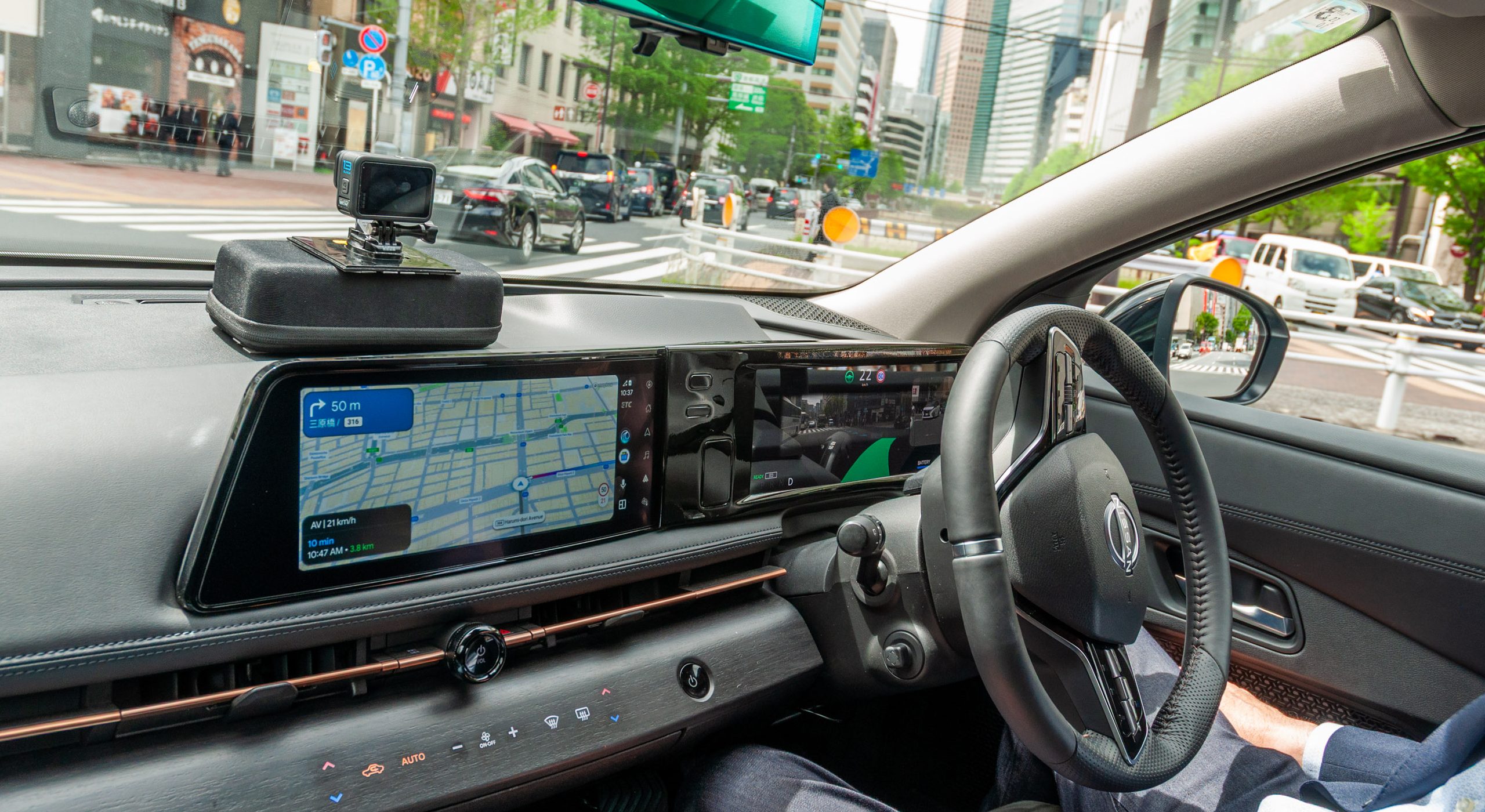
Nissan is recalibrating its position in the autonomous driving race. During a recent demonstration on the streets of Tokyo, the automaker presented a prototype of its next-generation ProPilot Assist system — a software-defined platform built on artificial intelligence rather than traditional rule-based programming — and claimed it can match or exceed the performance of a human driver. The system is scheduled for commercial deployment in 2027.
The prototype, built on a modified Nissan Ariya, completed a 40-minute route through Tokyo's dense urban traffic and highway corridors. The hardware suite comprises 11 cameras, five radar units, and a Lidar array. In its current form, the sensors sit in an external housing mounted on the vehicle; the production version is intended to integrate them into the body panels. Nissan's executive chief engineer, Tetsuya Iijima, framed the system's capabilities as comparable to those of industry leaders such as Tesla and Wayve.
A sensor philosophy at odds with the prevailing trend
The choice to build the next ProPilot around a Lidar-heavy architecture is notable precisely because it cuts against the direction several prominent competitors have taken. Tesla famously removed ultrasonic sensors and committed to a vision-only approach, arguing that cameras paired with sufficiently powerful neural networks can replicate and surpass the spatial awareness provided by laser-based sensors. Waymo, by contrast, has maintained a multi-sensor fusion strategy that includes Lidar, and its robotaxi fleet in the United States remains the most visible commercial deployment of that philosophy.
Nissan's bet sits closer to Waymo's end of the spectrum, at least in hardware terms. The inclusion of Lidar alongside cameras and radar suggests the company views redundancy as a prerequisite for the kind of urban autonomy it demonstrated in Tokyo — environments where pedestrians, cyclists, and erratic lane changes create scenarios that a single sensor modality may struggle to resolve reliably. Whether this approach proves commercially viable at scale depends in part on the continued decline in Lidar unit costs, a trend that has accelerated in recent years as suppliers such as Luminar, Hesai, and Valeo have expanded production.
The software layer is where Nissan signals its sharpest departure from its own history. Previous generations of ProPilot operated on rule-based logic: predefined responses to predefined situations. The next generation replaces that framework with an AI-based stack designed to handle ambiguity — the kind of unscripted, unpredictable driving conditions that characterize real urban traffic. This is the same conceptual shift that companies like Wayve, a London-based startup backed by SoftBank, have pursued with end-to-end learned driving models.
Competing from behind
Nissan's autonomous ambitions arrive at a moment of institutional fragility. The company has spent recent years navigating leadership turbulence, alliance tensions with Renault, and a product lineup that lost momentum in key markets. Positioning ProPilot as a technology on par with the most advanced systems in the industry is as much a corporate narrative exercise as it is an engineering claim.
That said, Nissan has a longer history with commercial driver-assistance than many of its rivals. The original ProPilot launched in 2016 on the Serena minivan in Japan, making it one of the earlier mass-market implementations of highway-level autonomy features. The gap between that system and what was demonstrated in Tokyo is substantial — not merely in sensor count, but in the underlying logic governing how the car interprets its surroundings.
The critical question is whether a 2027 production timeline gives Nissan enough runway to close the gap with competitors who have been accumulating real-world driving data at scale for years. Tesla's fleet collects billions of miles of driving data annually. Waymo has logged millions of autonomous miles across multiple U.S. cities. Nissan's prototype looked competent in a controlled demonstration; the distance between a 40-minute showcase and the statistical confidence required for broad commercial deployment remains considerable.
What Tokyo demonstrated is intent. Whether that intent translates into a system that reshapes Nissan's competitive standing depends on execution speed, data accumulation, and the cost curve of the hardware it has chosen to rely on — three variables that remain, for now, unresolved.
With reporting from The Drive.
Source · The Drive