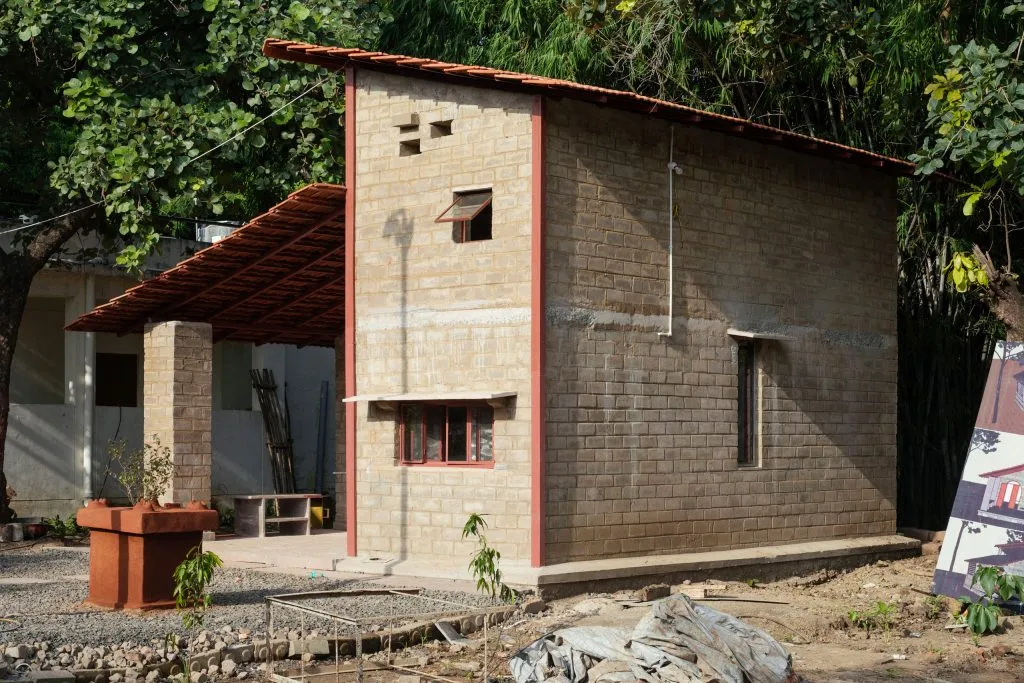
India's rural housing deficit remains one of the largest in the world. Government-led programs have, over the past decade, sought to address the gap through mass construction schemes that prioritize speed and unit count. Within that landscape, Dhammada Collective has taken a different approach: the architecture practice has developed housing prototypes in Bhopal and Indore — two cities in the central Indian state of Madhya Pradesh — that foreground regional design intelligence over standardized templates.
The prototypes are intended for low-income rural residents, a demographic that national housing programs have historically served with uniform plans replicated across vastly different climatic, material, and cultural contexts. Dhammada Collective's work argues, in built form, that effective affordable housing must be context-specific — shaped by local climate, available materials, construction skills, and the social patterns of the communities it serves.
The limits of standardization
Mass housing programs face a structural tension. Standardization reduces cost, simplifies procurement, and accelerates delivery. But India spans tropical, arid, and temperate climate zones; its vernacular building traditions range from mud and thatch to stone and timber. A single floor plan optimized for the plains of Uttar Pradesh performs poorly in the hills of Meghalaya or the semi-arid plateau of Madhya Pradesh. Thermal comfort, ventilation, water management, and spatial organization all vary by region.
This is not a new observation. Architects and planners have debated the trade-off between scalability and local appropriateness since at least the post-independence era, when figures such as Charles Correa and Balkrishna Doshi explored low-cost housing that drew on regional building logic. What makes the current moment distinct is scale: India's rural housing ambitions now number in the tens of millions of units, and the pressure to deliver quickly has, in many cases, tilted the balance decisively toward uniformity.
Dhammada Collective's prototypes in Bhopal and Indore represent a counter-position. By designing models calibrated to the specific conditions of central India — its hot-dry and composite climates, its locally available construction materials, its patterns of domestic life — the practice attempts to demonstrate that regional specificity need not be incompatible with replicability. A prototype, after all, is not a one-off: it is a model intended for adaptation and repetition, but one whose starting assumptions are grounded in a particular place rather than abstracted from all places.
Prototype as argument
The significance of the Bhopal and Indore projects extends beyond their immediate utility. They function as a design argument — a proposition that the prototype itself should encode regional knowledge. Orientation, wall thickness, roof geometry, shading strategies, and material choices all carry embedded intelligence about how a building performs in a given environment. When that intelligence is stripped out in favor of a universal template, the resulting housing may meet quantitative targets while failing qualitative ones: thermal discomfort, poor ventilation, rapid deterioration of inappropriate materials.
The challenge for practices like Dhammada Collective is one of influence. Architectural prototypes, however well-conceived, must find pathways into policy and procurement systems that reward standardization. Regional design intelligence is harder to codify in tender documents than a single repeatable plan. It requires local capacity — builders who understand the materials, engineers who can adapt structural systems, and institutions willing to accept variation within a program's framework.
The tension, then, is not between good design and bad design. It is between two legitimate imperatives: the administrative logic of delivering housing at national scale and the performance logic of designing for specific places. Whether India's housing apparatus can accommodate both remains an open question — one that projects like those in Bhopal and Indore make harder to ignore.
With reporting from Architectural Review.
Source · Architectural Review