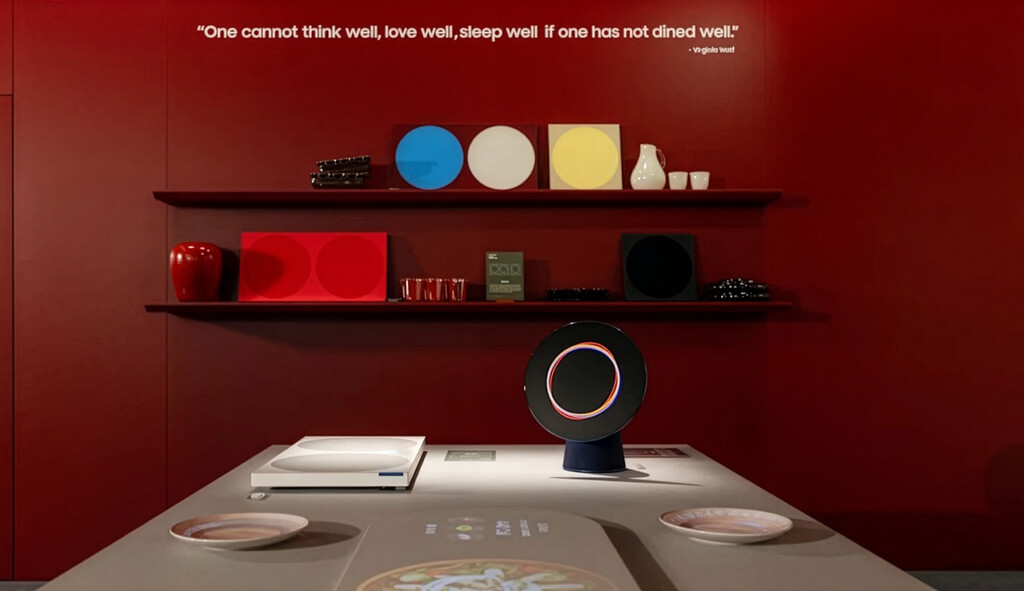
The recent wave of dedicated AI hardware — typified by the pocketable but often underwhelming Rabbit R1 and Humane AI Pin — has largely focused on replacing the smartphone in the palm of your hand. At a recent showcase in Milan, Samsung offered a different thesis for ambient computing. Project Luna is not a portable assistant but a stationary domestic hub, a tabletop device defined by a circular screen that functions less like a monitor and more like an articulating face.
The core of Luna's design is its physical movement. The screen, mounted on a motorized base, can rotate and tilt to maintain a line of sight with a user as they move through a room. This mechanical agency shifts the device from a passive, "black box" speaker into a quasi-robotic presence, one designed to feel interactive rather than merely responsive. In demonstrations, the device acted as a kitchen companion, displaying turntable-style music interfaces, controlling smart lighting, and offering contextual suggestions via voice and visual feedback.
From static speakers to embodied interfaces
The smart home category has been dominated for nearly a decade by a single form factor: the cylindrical speaker. Amazon's Echo, Google's Nest, and Apple's HomePod all share the same fundamental assumption — that a disembodied voice, projected from a stationary object, is the right interface for domestic AI. These devices listen, respond, and occasionally misfire, but they never move. They occupy space without acknowledging it.
Project Luna challenges that premise directly. By giving its display the ability to track and orient toward a user, Samsung introduces what robotics researchers call "social gaze" — the capacity of a machine to signal attention through physical orientation. The concept is well-established in human-robot interaction studies: people respond more naturally to machines that appear to look at them. A device that turns its screen toward a speaker conveys a rudimentary form of engagement that a static cylinder cannot replicate, regardless of how sophisticated its language model might be.
This is a meaningful design choice because it addresses one of the persistent friction points of voice-first interfaces. Smart speakers offer no visual confirmation that they are listening, processing, or confused. Users speak into a void and hope for the best. A rotating display that faces the speaker provides a feedback loop that is spatial, not just auditory — closer to how humans orient toward each other in conversation.
The convergence toward robotic home hardware
Samsung is not alone in exploring this direction. Long-circulating reports suggest that Apple has been developing its own robotic home device, one rumored to feature a screen mounted on a motorized arm capable of similar orientation behavior. If both of the world's largest consumer electronics companies are converging on the same concept — a domestic screen that physically moves to meet the user — it suggests the industry has reached a shared conclusion: the next smart home interface needs a body, however minimal.
The timing is not coincidental. Large language models have made conversational AI substantially more capable over the past two years, but the hardware through which most people access these models remains unchanged. Phones, laptops, and static speakers were all designed before the current generation of AI. Project Luna represents an attempt to build hardware that matches the conversational fluidity of modern AI with a physical form that reinforces the illusion — or the reality — of a present interlocutor.
There are open questions. A device that tracks users through a room raises obvious privacy considerations, particularly one equipped with the sensors necessary to detect position and movement. The history of consumer electronics is littered with camera-equipped home devices that provoked backlash — Amazon's Echo Show and Facebook's Portal both faced scrutiny over always-on visual sensors. How Samsung navigates the tension between attentive hardware and domestic surveillance will matter as much as the engineering itself.
Project Luna remains a concept, with no announced timeline for commercial release. But its significance may lie less in the specific product than in what it reveals about the industry's direction. The era of the invisible assistant — the AI that lives inside a featureless puck on the kitchen counter — appears to be giving way to something more physically present. Whether consumers want a device that literally looks back at them is the question that Samsung, Apple, and their competitors are now preparing to test.
With reporting from Xataka.
Source · Xataka