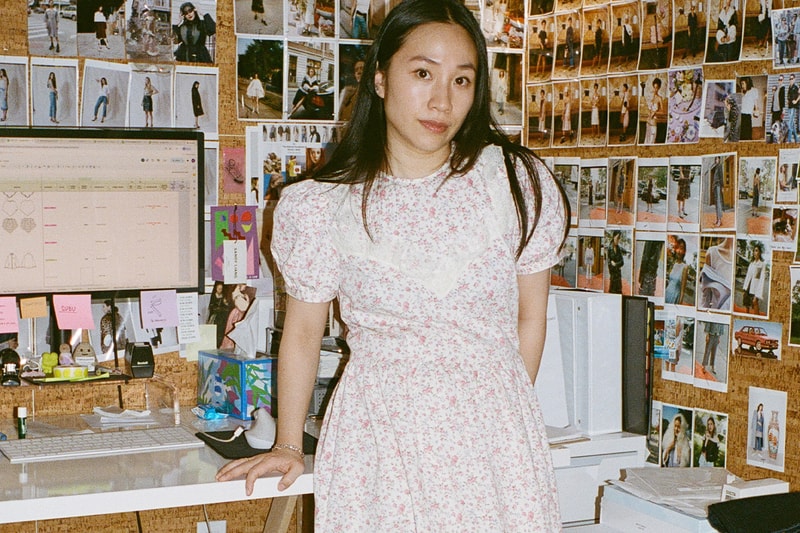
Sandy Liang's influence on the New York sartorial landscape is less about fleeting trends and more about the construction of a specific, hyper-literate uniform. For over a decade, the designer has mapped the intersection of Chinatown nostalgia and a "downtown girlhood" that feels both precious and utilitarian. Now, that evolution is being codified in Dressing Up: Sandy Liang, a 276-page monograph published by Rizzoli New York — a volume that arrives at a moment when the designer's aesthetic vocabulary has become so widely absorbed that its origins risk being flattened into algorithm-friendly shorthand.
Scheduled for release this September, the book functions as both a personal archive and a creative compendium. It traces Liang's trajectory from a local breakout to a global label, featuring previously unseen personal photography alongside contributions from creative director Ava Nirui and stylist Dean DiCriscio. The volume offers a tactile look at the ephemera — the bows, Peter Pan collars, and pleated skirts — that have become the building blocks of her brand's visual vocabulary.
From Chinatown to the Coffee Table
The Rizzoli imprint carries a particular weight in fashion publishing. For decades, the house has served as the de facto canonizer of design careers, lending hardcover permanence to bodies of work that might otherwise exist only in lookbooks, Instagram grids, and editorial tear sheets. A Rizzoli monograph at the ten-year mark of a label's existence signals a kind of mid-career thesis statement — an argument that the work has accrued enough cultural density to merit retrospective treatment.
For Liang, the timing is instructive. Her label launched in a New York fashion ecosystem that was, at the time, dominated by minimalist austerity and streetwear's gravitational pull. The decision to build a brand around hyper-feminine signifiers — ballet flats, fleece pullovers, ribbon details — ran against the prevailing current. That those same signifiers have since migrated into the broader market, adopted and iterated upon by fast-fashion pipelines and social media trend cycles alike, underscores the degree to which Liang's design instincts anticipated a cultural shift rather than merely riding one.
The monograph's inclusion of personal photography and archival material suggests an effort to anchor the brand's identity in something more durable than seasonal collections. Liang's work has always been rooted in a sense of place, specifically the grit and texture of Lower Manhattan. By reclaiming hyper-feminine motifs and recontextualizing them within a modern urban framework, she created a design language that resonates with a fiercely loyal global audience. Dressing Up appears to frame that language not as a mood board but as a biography — one in which neighborhood, family, and girlhood function as raw materials on par with fabric and thread.
The Monograph as Counter-Narrative
There is a broader tension at work in the decision to publish a physical retrospective in an era when fashion discovery happens overwhelmingly through short-form video and algorithmic feeds. The aesthetics Liang pioneered — often grouped under loose labels like "coquette" or "balletcore" by trend forecasters — have been disaggregated and recirculated so rapidly online that the designer's own authorship can become obscured. A monograph reasserts narrative control. It insists on sequence, context, and intention in a medium that rewards none of those things.
This dynamic is not unique to Liang. Independent designers across categories face a recurring dilemma: the very virality that expands their audience simultaneously dilutes their specificity. A book published by Rizzoli does not solve that problem, but it does create a fixed reference point — a document that exists outside the feed and cannot be remixed.
Whether Dressing Up ultimately reads as a capstone or a pivot point depends on what comes next for the label. The monograph codifies a decade of work, but it also raises an implicit question: once an aesthetic becomes legible enough to be catalogued, does the designer who originated it move forward, or does the archive itself become the product? Liang's next collections will answer that in ways a book cannot.
With reporting from Hypebeast.
Source · Hypebeast