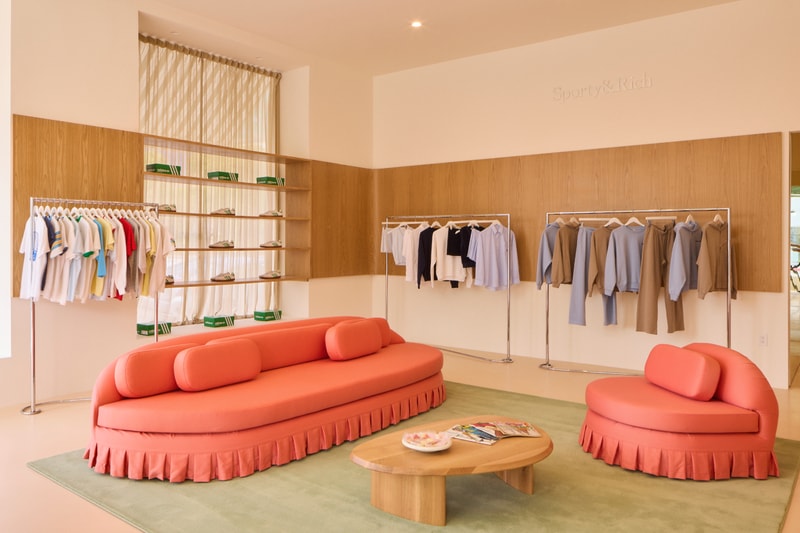
Sporty & Rich, the label founded by Emily Oberg that began as a digital mood board on Instagram, has opened a 5,200-square-foot flagship store on Melrose Avenue in West Hollywood. The space includes a café, a private pilates studio, and interiors designed in collaboration with architecture firm 22Re. It represents the brand's most ambitious move yet from screen-based curation into physical retail — and a broader bet on what a fashion store can be when it stops being primarily about clothes.
The trajectory is worth tracing. Oberg launched Sporty & Rich in 2014 not as a clothing line but as an aesthetic project: a curated feed of vintage tennis imagery, Princess Diana in cycling shorts, old Porsche ads, and the visual grammar of 1990s health clubs. The brand's first products — logo sweatshirts and baseball caps — arrived years later, essentially merchandise for a lifestyle that existed only as reference images. That the label grew into a full ready-to-wear operation with global stockists says something about the commercial power of coherent visual identity in the social media era.
From Feed to Floor Plan
The West Hollywood flagship is an attempt to translate that identity into architecture. The interiors balance industrial materials — custom stainless steel fixtures, lacquered ceilings — with warmer residential elements like white oak accents and furniture from Pierre Augustin Rose. The effect, based on the brand's own presentation, is closer to a curated gallery or private apartment than a conventional retail floor. This is deliberate. Sporty & Rich has always sold proximity to a certain kind of life more than it has sold garments, and the store's design language extends that logic into three dimensions.
The inclusion of a café serving matcha and non-dairy soft serve, alongside a private pilates studio, pushes the concept further. These are not afterthoughts or amenities bolted onto a shop. They are load-bearing elements of the brand's proposition: that wellness, taste, and consumption exist on a single continuum. The store becomes less a place to buy a tennis skirt and more a place to inhabit the world in which that tennis skirt makes sense.
This approach has precedent. Brands like Rapha built cycling clubhouses that doubled as retail and community spaces. Aesop has long treated its stores as site-specific architectural projects. In the luxury tier, Hermès and Chanel have invested in experiential flagships that function as cultural venues. What Sporty & Rich adds to this lineage is a distinctly internet-native sensibility — the store is, in effect, a mood board made physical, designed for a consumer who encountered the brand as imagery before ever touching a product.
The Economics of Atmosphere
The strategic question behind the flagship is whether lifestyle integration translates into durable retail economics. Physical retail remains expensive, particularly on a corridor like Melrose Avenue, and the addition of food service and fitness programming introduces operational complexity that a pure apparel operation does not face. Café margins are thin. Pilates studios require instructors, scheduling infrastructure, and liability considerations. The bet is that these elements drive foot traffic, extend dwell time, and deepen brand affinity in ways that justify the overhead.
There is a broader industry context here. Direct-to-consumer brands that scaled through social media and e-commerce have spent the past several years grappling with the limits of digital-only distribution. Customer acquisition costs online have risen sharply, and the algorithmic unpredictability of platforms like Instagram and TikTok has made owned physical spaces look increasingly attractive as stable, controllable brand touchpoints.
Sporty & Rich arrives at physical retail with an advantage many digitally native brands lack: a visual identity so specific and so consistently maintained that the translation into space feels coherent rather than forced. Whether the economics of a wellness-integrated flagship on one of Los Angeles's most visible retail streets can sustain that coherence over time is a different question — one that depends on execution, foot traffic patterns, and the durability of the aesthetic codes the brand has spent a decade refining.
With reporting from Hypebeast.
Source · Hypebeast