At Milan Design Week 2026, Stone Island is staging a quiet rebellion against the frantic pace of the fashion calendar. The Italian label is reviving its "NO SEASONS" project — a concept originally pioneered by founder Massimo Osti between 1989 and 1994 — which prioritizes the enduring utility of a single garment over the ephemeral nature of seasonal trends. By stripping away the distractions of varied silhouettes and color palettes, the collection refocuses the viewer's eye on the technical evolution of the fabric itself.
The capsule centers on a singular, modernized outerwear archetype. To isolate the variable of material, every iteration is dyed in a uniform piombo, or leaden, hue. This monochromatic approach allows the distinct textures and light-handling properties of Stone Island's textiles to serve as the primary narrative. The six variations range from a resin-coated fabric made with 50% recycled cotton to the light-refracting Prismatic Nylon-TC and the military-grade Raso Gommato Transparent Cover-TC. Other versions utilize the shape-memory David-TC and a raw-edged Panno wool-nylon blend, each reacting to the dye process in subtly different tonal registers.
Fabric as Argument
The original NO SEASONS series, produced during the final years of Osti's direct involvement with Stone Island, was an anomaly in late-eighties fashion. While the industry was accelerating its seasonal cadence — moving from two major collections a year toward the pre-collection and resort cycles that would later become standard — Osti proposed the opposite: a single form, repeated across materials, with no concession to trend. The garment became a controlled experiment, and the fabric became the only variable worth discussing.
That logic remains central to the 2026 revival. Stone Island has long occupied an unusual position in the market — part technical outerwear brand, part subcultural signifier, part textile research laboratory. Its compass-patch logo carries weight in streetwear circles, but the company's deeper identity has always been rooted in industrial process: garment dyeing, resin treatments, membrane lamination. The NO SEASONS format strips the brand back to that core proposition. Where most fashion presentations ask the audience to evaluate shape, proportion, and color in combination, this capsule asks a narrower and more demanding question: what does the cloth do?
The choice of a single leaden hue is not merely aesthetic. By neutralizing color, the collection forces attention toward surface behavior — how light falls across a resin coat versus a wool-nylon blend, how a transparent rubber membrane differs in hand and drape from a shape-memory cotton. These are distinctions that typically get lost in the noise of a full runway presentation. Isolated, they become legible.
The Installation and Its Implications
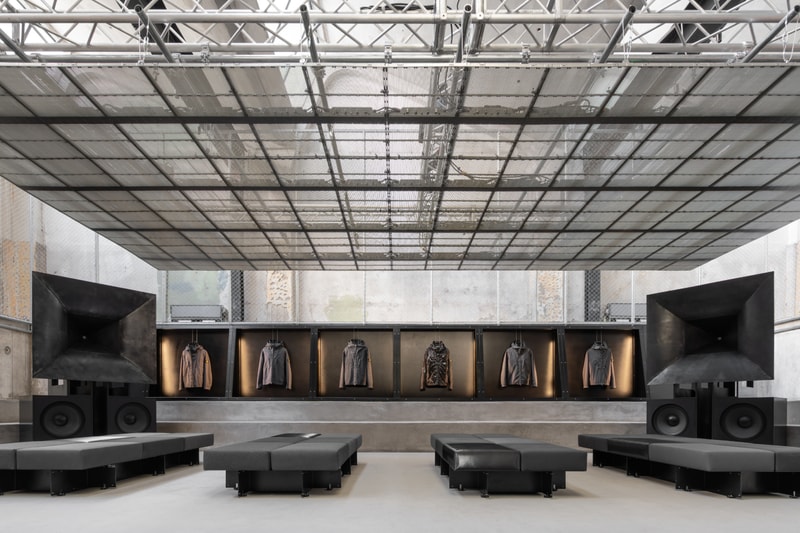
The presentation itself reinforces the thesis. Stone Island commissioned Milanese studio NM3 to create a site-specific installation within a disused swimming pool at Capsule Plaza. The setting — utilitarian, stripped of ornament, defined by hard surfaces and industrial geometry — mirrors the collection's refusal of decorative excess. It is a space designed for looking closely rather than scrolling quickly.
This matters because the broader fashion industry is moving in the opposite direction. The dominant commercial logic of the past decade has rewarded novelty, volume, and visual spectacle optimized for social media. Brands compete for attention through collaborations, drops, and seasonal reinvention. Stone Island's gesture — presenting six versions of the same jacket in the same color — is a deliberate inversion of that logic. Whether it functions as genuine counter-programming or as a sophisticated form of brand mythology is a question worth holding open.
Osti died in 2005, and Stone Island has since passed through corporate ownership changes that have reshaped its commercial trajectory. The revival of NO SEASONS invokes the founder's legacy at a moment when heritage narratives carry significant market value in luxury fashion. The tension between the project's austere, research-driven origins and its current deployment within a design-week spectacle is not a contradiction the brand needs to resolve — but it is one the audience should notice.
What remains genuinely distinctive is the underlying proposition: that a garment's worth can be measured not by its novelty but by the intelligence of its construction. In an industry that overwhelmingly rewards the former, Stone Island is betting — again — that there is an audience for the latter.
With reporting from Hypebeast.
Source · Hypebeast