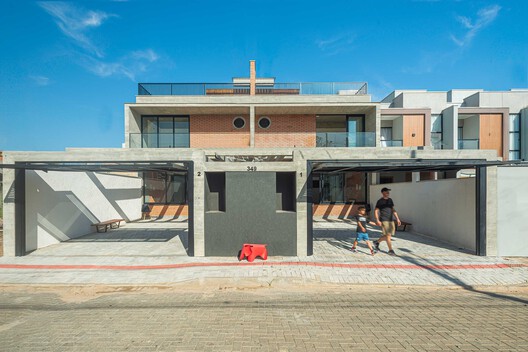
In the coastal town of Balneário Piçarras, Santa Catarina, the TT Houses emerge as a study in geometric restraint. Designed by PJV Arquitetura and completed in 2024, the 291-square-meter residential project navigates the typical density of the Brazilian seaside with a formal clarity that distinguishes it from its more eclectic neighbors. The structure is less an exercise in ornament than an exploration of the articulation of volume — a building that communicates its logic on its facade.
The design relies on a precise structural grammar, where the interplay of light and shadow defines the living spaces. By prioritizing a clean, modular aesthetic, PJV Arquitetura creates a sense of order within a relatively compact footprint. The materiality is handled with characteristic honesty, allowing the building's skeleton to dictate the rhythm of the facade and the internal transition between private and communal areas. In a region where beachfront construction often defaults to speculative repetition or decorative excess, the TT Houses take a different position: that discipline itself can be expressive.
Structural Honesty and the Modernist Inheritance
The vocabulary at work in the TT Houses — exposed structure, modular proportion, the frank expression of load-bearing elements — belongs to a lineage that runs deep in Brazilian architecture. Since the mid-twentieth century, when figures such as Vilanova Artes, Lina Bo Bardi, and Paulo Mendes da Rocha established structural clarity as a defining trait of the country's architectural identity, the idea that a building should reveal how it stands up has carried both aesthetic and ethical weight. The approach treats honesty of construction not as austerity but as a design principle in its own right.
PJV Arquitetura's project does not attempt to replicate the monumental scale of that earlier generation. Instead, it translates the principle to a domestic register. In a house of modest dimensions, the structural grid becomes the organizing device for everything from room proportions to the cadence of openings on the facade. The result is a building where ornament is unnecessary because the structure itself generates visual rhythm. This is a familiar strategy in Brazilian residential work, but one that requires precision in execution — any misalignment between structural intent and built reality becomes immediately legible.
The choice to let materiality speak plainly also carries practical implications for the coastal environment. Balneário Piçarras sits along a stretch of the Santa Catarina littoral that has experienced steady urbanization over the past two decades, driven by tourism and second-home demand. Construction in such settings often prioritizes speed and surface finish over durability. A project that foregrounds the integrity of its structural system implicitly argues for a longer time horizon — buildings designed to age with legibility rather than to be resurfaced every few years.
A Quiet Counter-Position on the Coast
Beyond its formal qualities, the TT Houses represent a broader current in contemporary Brazilian residential design: a return to the fundamentals of modernism, refined for present conditions. Across the south and southeast of the country, a generation of smaller firms has been producing work that shares this sensibility — compact plans, restrained palettes, structural expression as the primary compositional tool. The tendency stands in contrast to two dominant modes of coastal development: the high-rise condominium tower and the themed resort villa, both of which tend to treat architecture as packaging rather than proposition.
What makes this current notable is not its novelty but its persistence. The principles are well established; the challenge lies in applying them consistently within the economic and regulatory constraints of speculative residential markets. Coastal municipalities in Santa Catarina, like many in Brazil, operate under zoning frameworks that shape lot coverage, setbacks, and height limits. Working within those parameters while maintaining formal coherence demands a particular kind of rigor — one where the plan is not merely efficient but generative.
The TT Houses do not announce themselves as a manifesto. Their contribution is quieter: a demonstration that structural logic and geometric discipline remain viable tools for making sense of the evolving urban fabric along the Brazilian coast. Whether that approach gains traction against the prevailing economics of seaside development — where speed of construction and marketable surface area tend to dominate — remains an open question. The tension between architectural conviction and market gravity is not new, but each project that holds the line reshapes the terms of the conversation slightly.
With reporting from ArchDaily.
Source · ArchDaily