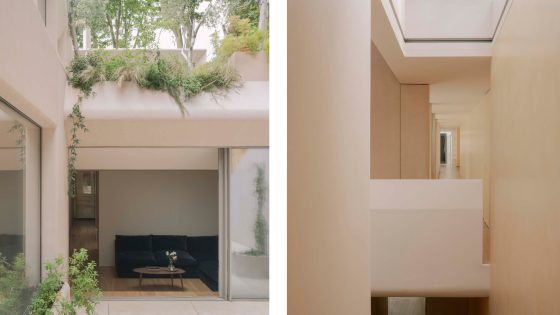
Studio DERA has completed the renovation of Mozart House, a Grade II-listed Georgian terrace in London's Belgravia. The project involved reworking the property behind an intact historic frontage, integrating a two-story extension into the volume of a previously disused swimming pool — a strategy that allowed the practice to add significant living space without altering the building's protected exterior.
Belgravia, developed primarily in the 1820s and 1830s by the Grosvenor family, remains one of London's most architecturally regulated neighborhoods. Its stucco-fronted terraces, laid out by Thomas Cubitt, are subject to stringent conservation controls. Any intervention on a Grade II-listed property in the area must satisfy both local planning authorities and Historic England, the public body responsible for the country's heritage assets. The designation means the building is considered of special interest, warranting effort to preserve it.
Excavating existing volume rather than adding new
The central design move at Mozart House — reclaiming a disused swimming pool as buildable volume — reflects a broader pattern in high-end London residential architecture. Subterranean extensions, commonly referred to as "iceberg basements," became a defining feature of prime central London renovations over the past two decades. Homeowners in Kensington, Chelsea, and Belgravia have routinely dug beneath their properties to add cinemas, gyms, and staff quarters, often provoking neighbor disputes and, eventually, tighter planning restrictions from several London boroughs.
Studio DERA's approach at Mozart House differs from the typical iceberg model in one important respect: rather than excavating new underground space, the practice repurposed a void that already existed. A disused pool represents a pre-existing structural cavity — concrete-lined, already waterproofed, and sitting below the footprint of the property. Converting that cavity into habitable rooms avoids much of the disruption, cost, and engineering risk associated with fresh excavation beneath a historic structure. It also presents a more straightforward case to planning authorities, since the intervention does not expand the building's physical envelope into previously undisturbed ground.
The result is a two-story extension that reads as an addition in section but barely registers from the street. The historic frontage remains untouched, preserving the terrace's contribution to Belgravia's uniform streetscape. This kind of invisible densification — adding floor area behind, below, or within existing shells — has become a recurring theme in conservation-area residential work across London.
Listed buildings and the limits of adaptation
Working within a Grade II listing imposes constraints that go beyond facade preservation. Internal features of architectural or historic interest may also be protected, and any proposed changes must demonstrate that they do not harm the building's significance. The balance between contemporary livability and heritage conservation is negotiated on a case-by-case basis, and the outcomes vary widely depending on the local authority, the heritage officer involved, and the quality of the architectural argument.
Studio DERA's project sits within a lineage of London practices that have built reputations on precisely this kind of constrained residential work — firms that treat planning and heritage regulation not as obstacles but as generative design parameters. The challenge is architectural as much as bureaucratic: how to introduce natural light, modern services, and spatial generosity into structures designed for a fundamentally different domestic life.
The Mozart House renovation raises a question that extends well beyond a single Belgravia terrace. London's historic core contains thousands of listed residential properties, many with underused or obsolete spaces — former service quarters, coal cellars, light wells, and, occasionally, swimming pools. Whether these latent volumes represent a meaningful reservoir of additional housing capacity, or merely a niche opportunity for wealthy homeowners, depends on factors that architecture alone cannot resolve: planning policy, construction economics, and the political appetite for treating heritage buildings as living, adaptable structures rather than fixed artifacts.
With reporting from Architects Journal.
Source · Architects Journal