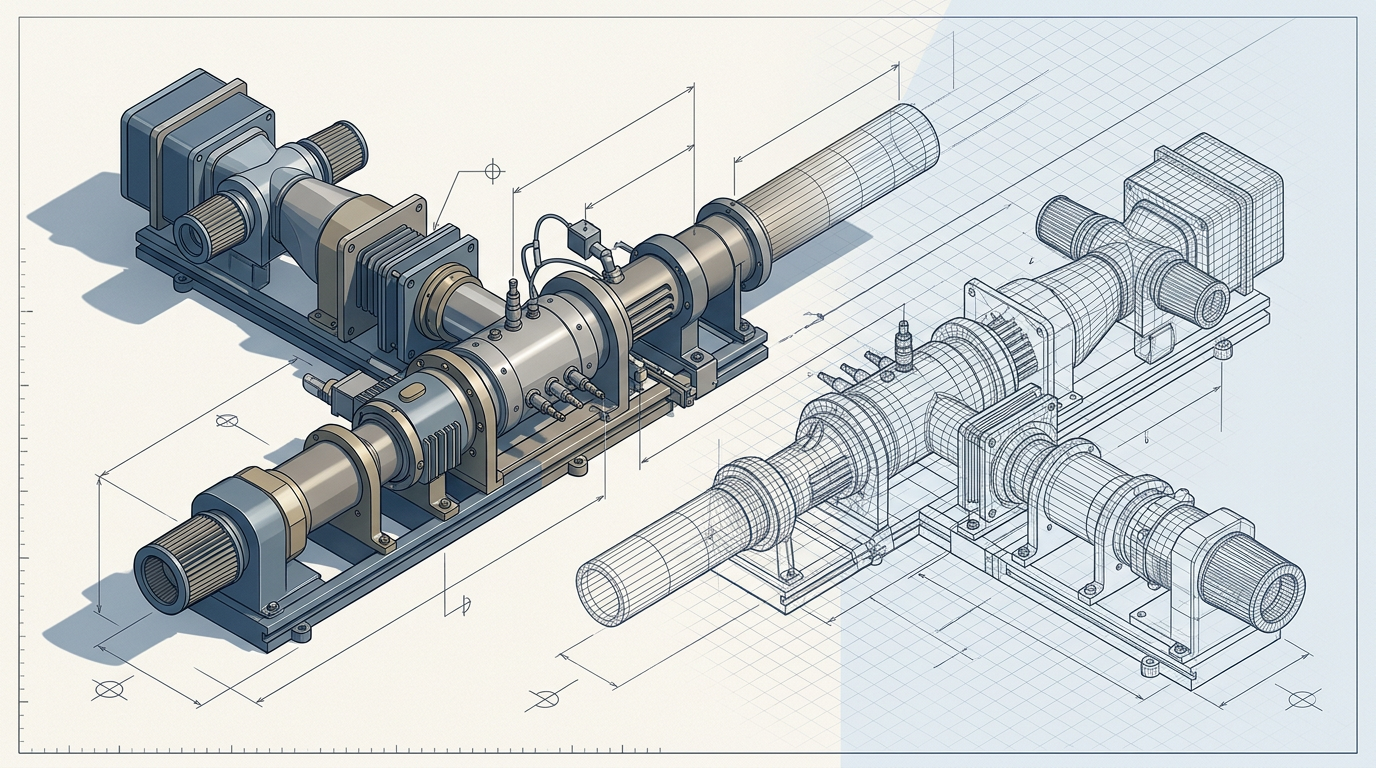
At MIT, artificial intelligence has become so deeply embedded in the work of physical engineering departments that its presence is no longer a deliberate choice but a default condition. Sili Deng, an associate professor of mechanical engineering specializing in combustion kinetics, offers a case study in how that transition happens. When the pandemic halted renovations on her laboratory in 2019, Deng turned to machine learning as a stopgap — a way to continue research without access to physical experimental infrastructure. The workaround proved more durable than the problem it was meant to solve. What emerged was a sophisticated "digital twin," a virtual replica of combustion systems capable of predicting and controlling fuel behavior in real time.
The pattern is not unique to Deng. Zachary Cordero, an associate professor of aeronautics and astronautics who works on aerospace materials, began incorporating AI into his research after a cross-departmental introduction rather than any crisis of access. Across MIT's engineering school, the trajectory is similar: researchers trained in disciplines far removed from computer science are finding that machine learning has become indispensable to their core work.
From workaround to infrastructure
The concept of a digital twin — a computational model that mirrors a physical system closely enough to simulate its behavior under varying conditions — is not new. Industries such as aerospace manufacturing and oil and gas exploration have used versions of the idea for decades, typically relying on physics-based simulations governed by known equations. What has changed is the role of machine learning in making those models faster, more adaptive, and capable of handling systems where the governing physics is too complex or too poorly understood for traditional simulation alone.
In combustion science, the challenge is acute. Chemical kinetics involves thousands of possible reaction pathways, and the interaction between turbulence and chemistry in a real combustion device defies clean analytical solutions. A machine-learning-augmented digital twin can be trained on experimental data and high-fidelity simulations to approximate these dynamics at speeds that allow real-time prediction and control — something a purely physics-based model cannot easily deliver. Deng's pivot from bench experimentation to computational modeling reflects a broader recognition that certain classes of engineering problems are better approached through data-driven methods, not because the physics is unimportant but because the physics is too rich to solve by hand.
Cordero's work in aerospace materials occupies a parallel space. Designing novel materials and structures for extreme environments — high temperatures, high stresses, rapid thermal cycling — involves navigating vast design spaces where intuition and trial-and-error experimentation are slow and expensive. Machine learning offers a way to screen candidate materials and geometries computationally before committing to physical fabrication, compressing timelines that once stretched across years.
The dissolving boundary between disciplines
What makes the MIT case instructive is not that individual researchers are using AI — that is now commonplace across research universities — but the manner in which adoption is occurring. It is not being driven top-down by institutional mandate or by the recruitment of AI specialists into engineering departments. It is emerging organically, through necessity, collaboration, and proximity. A mechanical engineer loses access to a lab and discovers that a neural network can partially substitute for a wind tunnel. An aerospace materials scientist meets a colleague working on optimization algorithms and realizes the tool fits a problem already on the bench.
This pattern carries implications beyond any single university. If AI is becoming a foundational layer for physical engineering — as essential, in the words of one framing, as the lathe or the wind tunnel — then the training pipeline for engineers will need to adjust. Fluency in machine learning may become a prerequisite for work in fields that have historically required little computational sophistication beyond finite element analysis or computational fluid dynamics.
The tension, however, is real. Digital twins and data-driven models are only as reliable as the data and assumptions that underpin them. In safety-critical domains like combustion systems and aerospace structures, the question of when to trust a model's prediction — and when to insist on physical validation — remains unresolved. The efficiency gains from AI-augmented engineering are substantial, but so is the risk of compounding errors in systems where failure carries physical consequences.
MIT's experience suggests that the integration of AI into traditional engineering is no longer a question of whether but of how — and under what epistemic standards. The algorithm may have earned its place alongside the wind tunnel, but the terms of that coexistence are still being negotiated.
With reporting from MIT Technology Review.
Source · MIT Technology Review