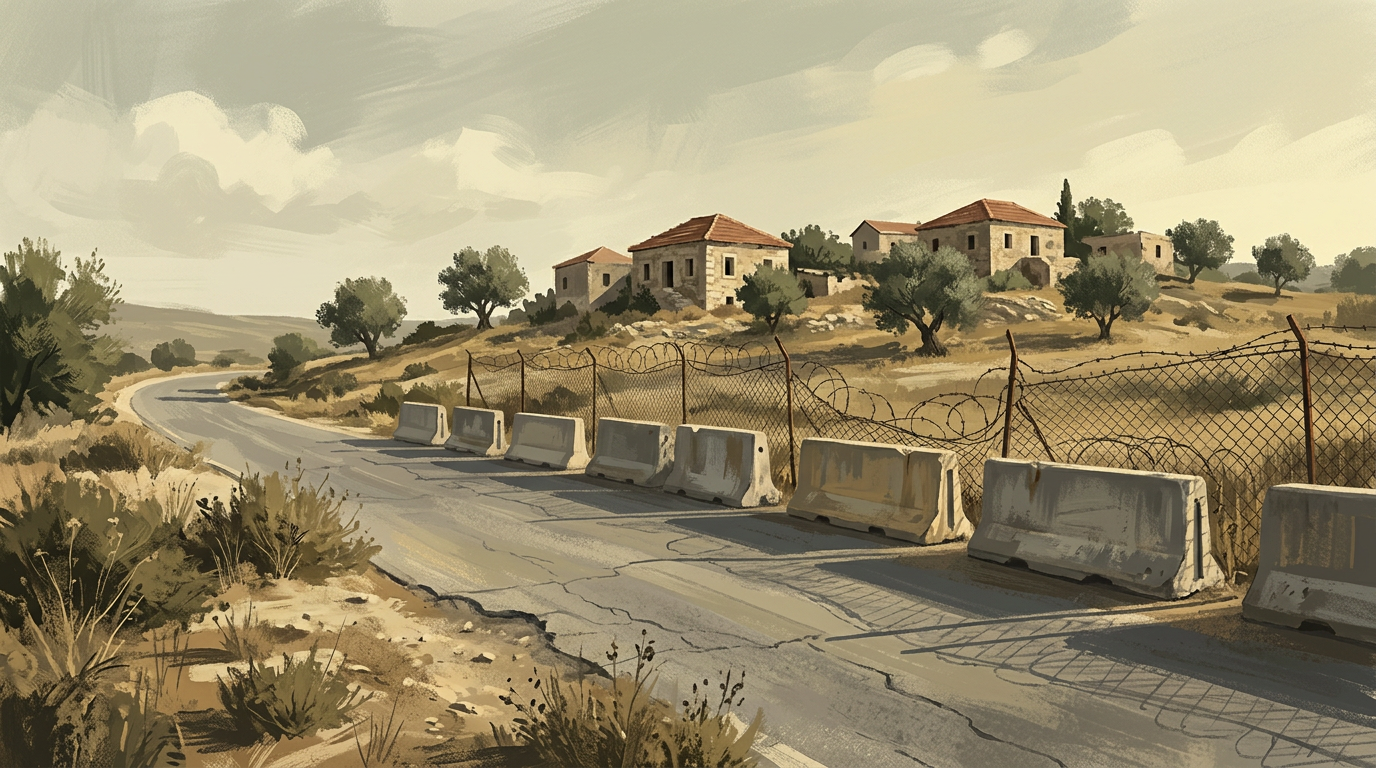
Israel has established a unilateral security perimeter in southern Lebanon, designated as a "yellow line," that prevents hundreds of displaced Lebanese residents from returning to their homes and land. The measure, reported by Dagens Nyheter, effectively creates a buffer zone along the border — one imposed not through diplomatic agreement or international mandate, but through military presence and operational fiat.
The move echoes tactics employed in the Gaza Strip, where Israel has similarly carved out exclusion corridors that restrict civilian movement and reshape the lived geography of conflict zones. In southern Lebanon, the result is a de facto no-go area whose boundaries are dictated by security imperatives rather than negotiated terms, leaving affected communities in a state of indefinite displacement.
A familiar template applied to new terrain
Buffer zones are not new to the Israeli-Lebanese border. After the 1982 invasion, Israel maintained a self-declared "security zone" in southern Lebanon for nearly two decades, withdrawing only in 2000 under sustained pressure from Hezbollah and shifting domestic opinion. United Nations Interim Force in Lebanon (UNIFIL) has patrolled the border area since 1978, and UN Security Council Resolution 1701, adopted after the 2006 war, called for the area between the Litani River and the Blue Line to be free of armed personnel other than the Lebanese army and UNIFIL.
The establishment of a new "yellow line" sits uncomfortably against that framework. Where Resolution 1701 envisioned a multilateral arrangement with Lebanese sovereignty at its center, the current perimeter is a unilateral imposition. It bypasses both the Lebanese state and the UN presence, creating what amounts to a parallel territorial reality on the ground. The precedent from Gaza is instructive: exclusion zones there began as ostensibly temporary security measures and gradually hardened into permanent features of the landscape, reshaping urban planning, agricultural access, and daily life for generations.
For southern Lebanon's displaced residents, the parallel is not abstract. Families who fled escalating violence now find themselves unable to return to homes that may sit just beyond the line. The uncertainty is compounded by the absence of any formal legal status for the zone — it is neither recognized by international law nor codified in a bilateral agreement, which means there is no clear mechanism for contesting it, no timeline for review, and no defined conditions under which it might be lifted.
The cost of ambiguity
The strategic logic behind buffer zones is straightforward: create distance between military threats and civilian or strategic assets. But the humanitarian and political costs of such measures tend to compound over time. In the occupied West Bank, restricted areas around settlements and military installations have progressively fragmented Palestinian territory. In Gaza, the buffer zone along the border fence consumed a significant portion of arable land, undermining food security in an already constrained economy.
Southern Lebanon's agricultural communities face analogous risks. The tobacco fields, olive groves, and small-scale farming that sustain border villages depend on access to land that may now fall within or adjacent to the exclusion perimeter. Prolonged denial of access does not merely delay return — it erodes the economic foundations that make return viable.
At the diplomatic level, the "yellow line" introduces a complicating variable into an already fragile regional picture. Lebanon's government, weakened by years of political paralysis and economic crisis, has limited leverage to contest the measure. UNIFIL's mandate, meanwhile, was designed for a different configuration of forces and may not easily adapt to a reality in which one party has unilaterally redrawn the operational map.
The tension, then, is between two forces that show no sign of reconciling: Israel's security calculus, which treats buffer zones as non-negotiable operational necessities, and the rights of displaced civilians, for whom the line represents dispossession without recourse. Whether the "yellow line" hardens into permanence or becomes a point of diplomatic friction depends on actors — the Lebanese state, the UN, regional powers — whose capacity and willingness to push back remain uncertain at best.
Com reportagem de Dagens Nyheter.
Source · Dagens Nyheter