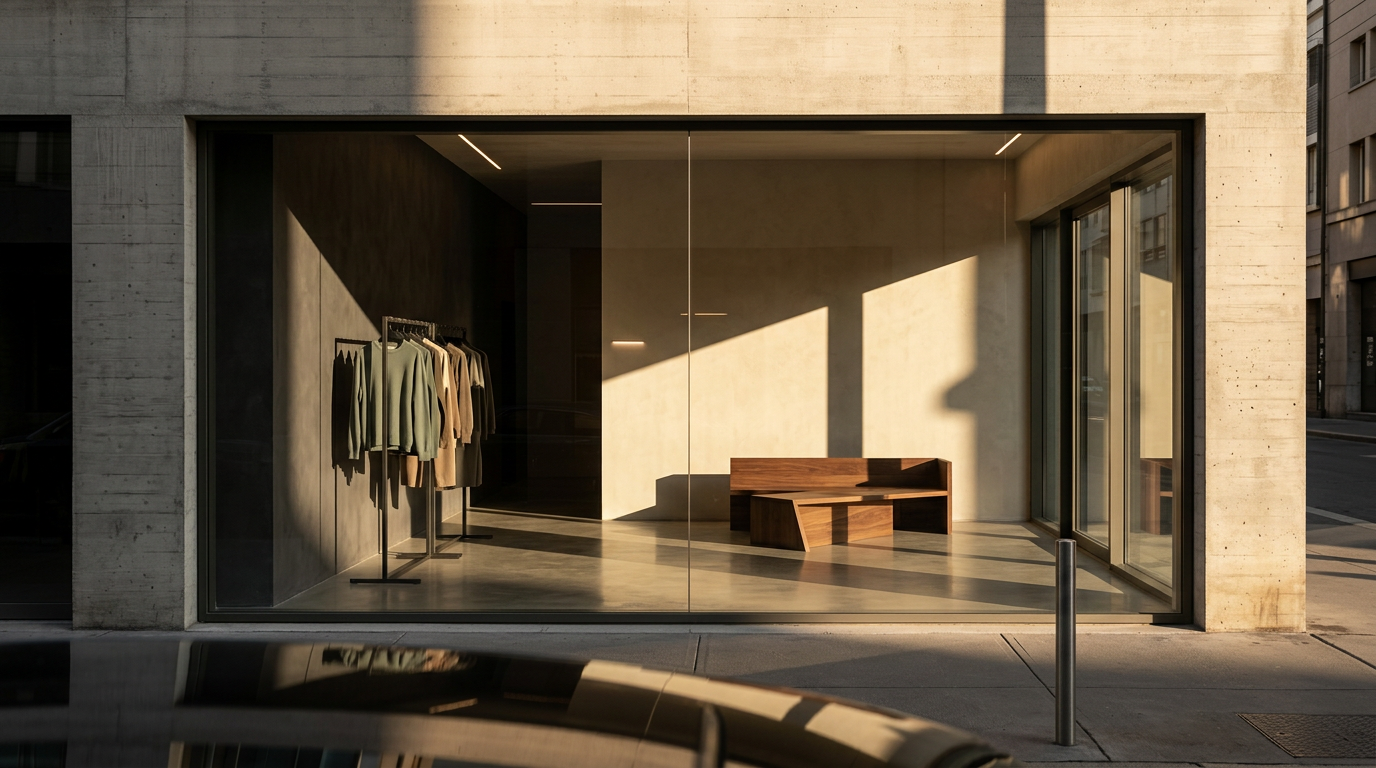
Seoul continues to solidify its position as a primary engine of contemporary design, a shift exemplified by the arrival of Protocol-Index on the global retail stage. Founded by Augustine Oh and Jude Lee — the latter previously serving as creative director for Project G/R — the studio operates at the precarious intersection of high fashion and spatial intervention. Their work is less a pursuit of seasonal trends than a rigorous interrogation of form and volume. This week, the brand's latest offerings debuted on HBX, the Hong Kong-based multi-brand platform, with a price range spanning $115 to $530 USD.
Expansion and Reduction as Design Grammar
Protocol-Index's methodology centers on the dual concepts of expansion and reduction. By deconstructing conventional silhouettes, the studio attempts to bridge the gap between progressive philosophy and traditional craftsmanship. The result is a visual language that treats the human body as a site for architectural exploration, moving beyond simple garment construction into the realm of speculative design.
The approach places Protocol-Index within a broader lineage of designers who have treated clothing as a spatial problem rather than a decorative one. The tradition runs deep in East Asian fashion: Rei Kawakubo's Comme des Garçons and Issey Miyake's pleating experiments both treated fabric as a medium for rethinking the relationship between body and surrounding space. More recently, a generation of Seoul-based labels has pushed this logic further, drawing on the city's rapid architectural transformation and its design schools' emphasis on interdisciplinary thinking. Protocol-Index's distinction lies in making the tension between addition and subtraction — between volume and restraint — the explicit conceptual framework, rather than an incidental byproduct of experimentation.
Jude Lee's background at Project G/R, a label known for its own genre-blurring tendencies, provides a useful reference point. The move from creative direction at an established project to co-founding a studio with a more overtly theoretical posture suggests a deliberate escalation of ambition — an attempt to build a design language from first principles rather than iterate within existing brand codes.
Seoul's Design Infrastructure Meets Global Retail
The collection's debut on HBX is significant less for the individual pieces than for what the distribution channel signals. HBX has increasingly functioned as a curatorial gateway, introducing international audiences to labels that might otherwise remain confined to domestic or niche circuits. For a studio like Protocol-Index, whose work leans conceptual, the platform offers access to a consumer base already conditioned to engage with design-forward product — buyers who treat fashion purchases as cultural participation rather than pure utility.
Seoul's emergence as a design capital is no longer a novel observation, but the mechanisms through which its studios reach global consumers continue to evolve. Government-backed initiatives such as Seoul Fashion Week have provided institutional scaffolding, while platforms like HBX and SSENSE have offered commercial pathways that bypass the traditional Paris-Milan-New York gatekeeping structure. The question for labels operating at Protocol-Index's level of conceptual ambition is whether global retail platforms can convey the intellectual context that gives the work its meaning, or whether the garments inevitably flatten into aesthetic objects once separated from the studio's spatial and philosophical framework.
The price range — $115 to $530 USD — positions the collection in a middle register: accessible enough to attract a broader audience, yet sufficiently elevated to signal design seriousness. It is a calibration that many emerging conceptual labels struggle to execute. Price too low and the work reads as streetwear with pretensions; price too high and the audience narrows to collectors and institutional buyers.
Protocol-Index now faces the tension that confronts every studio attempting to scale experimental work: the market rewards legibility, but the studio's identity depends on resisting easy categorization. Whether the dual logic of expansion and reduction can sustain itself across successive seasons and widening distribution — or whether commercial gravity pulls the work toward safer territory — remains the central question worth tracking.
With reporting from Hypebeast.
Source · Hypebeast