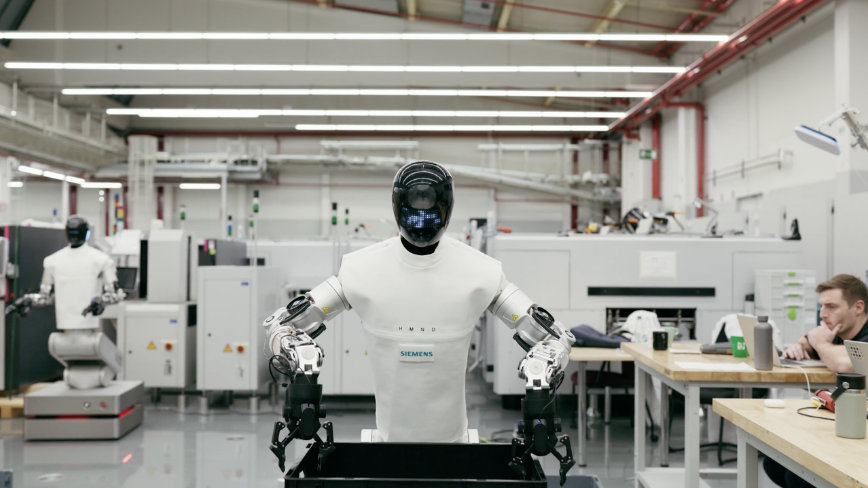
In the industrial landscape of Erlangen, Germany, the abstract promise of general-purpose robotics is beginning to take a physical, wheeled form. During a recent pilot at a Siemens electronics plant, the HMND 01 Alpha — a humanoid robot developed by the UK-based startup Humanoid in collaboration with Siemens and Nvidia — successfully completed a continuous eight-hour shift. Unlike the choreographed demonstrations often seen in laboratory settings, this was a live logistics operation, marking a transition from speculative engineering to measurable industrial utility.
The robot's performance metrics suggest a nearing parity with human-paced logistics. Tasked with autonomous tote-handling, the Alpha maintained a rate of 60 moves per hour with a pick-and-place success rate exceeding 90 percent. The robot's design — humanoid in its upper torso but mobile on a wheeled base — allows it to navigate the tight constraints of a functioning factory floor while maintaining the dexterity required for sorting and moving components.
From demonstration to duration
The significance of the Erlangen trial lies less in the robot's individual capabilities than in the framing of the test itself: a full shift, in a real facility, under standard operating conditions. The humanoid robotics sector has spent years cycling through impressive but brief demonstrations — a robot folding laundry, another stacking boxes for a few minutes under controlled lighting. The gap between a compelling demo reel and sustained, reliable performance in an unstructured environment has historically been where most prototypes stall.
An eight-hour shift imposes a different set of demands. Consistency over time, thermal management, error recovery without human intervention, and coexistence with human workers all become non-negotiable requirements. That the HMND 01 Alpha was evaluated against these criteria rather than a curated highlight reel represents a shift in how the industry is beginning to benchmark progress. The choice of a wheeled base rather than bipedal locomotion is itself a pragmatic concession — legs remain an unsolved engineering challenge at scale, while wheels offer reliability and speed on the flat, predictable surfaces of a factory floor. The trade-off sacrifices versatility in rough terrain for dependability where it matters most in an industrial context.
Siemens, for its part, brings more than a test site. The company has invested heavily in digital twin technology and factory automation software over the past decade, building an infrastructure layer that can orchestrate physical and digital operations in parallel. Integrating a humanoid robot into that ecosystem is a logical extension of a strategy that has long treated the factory as a software problem as much as a hardware one.
The infrastructure beneath the robot
Beyond the hardware, the deployment highlights the critical role of AI infrastructure in modern manufacturing. Powered by Nvidia's technology and integrated directly into Siemens' operational systems, the Alpha functions less as an isolated tool and more as a dynamic agent within a broader digital ecosystem. Nvidia's accelerated computing platforms have become a common thread across robotics ventures — providing the simulation environments where robots train before deployment and the inference engines that drive real-time decision-making on the floor.
This three-party structure — a startup supplying the physical platform, a semiconductor company providing the computational backbone, and an industrial incumbent offering the operational environment and integration layer — may prove to be a recurring template. No single entity currently possesses the full stack required to deploy humanoid robots at scale. The capital requirements for hardware development, the expertise needed for AI training, and the domain knowledge embedded in decades of factory operations each sit in different hands.
The broader question the Erlangen pilot raises is not whether humanoid robots can work a shift, but whether the economics and reliability curves will bend fast enough to justify deployment beyond pilot programs. A 90 percent pick-and-place success rate is notable for a first integration, but industrial logistics typically demands error rates well below one percent before automation displaces manual processes at scale. The distance between a successful pilot and a procurement decision remains considerable.
As these machines transition from experimental novelties toward potential full-time factory staff, the barrier between digital planning and physical execution continues to dissolve. Whether that dissolution accelerates into widespread adoption or plateaus at the pilot stage depends on variables that a single eight-hour shift, however promising, cannot yet resolve: cost per unit, maintenance burden, regulatory frameworks for human-robot cohabitation, and the willingness of labor markets to absorb the disruption. The trial in Erlangen opens the conversation. It does not settle it.
With reporting from The Next Web.
Source · The Next Web