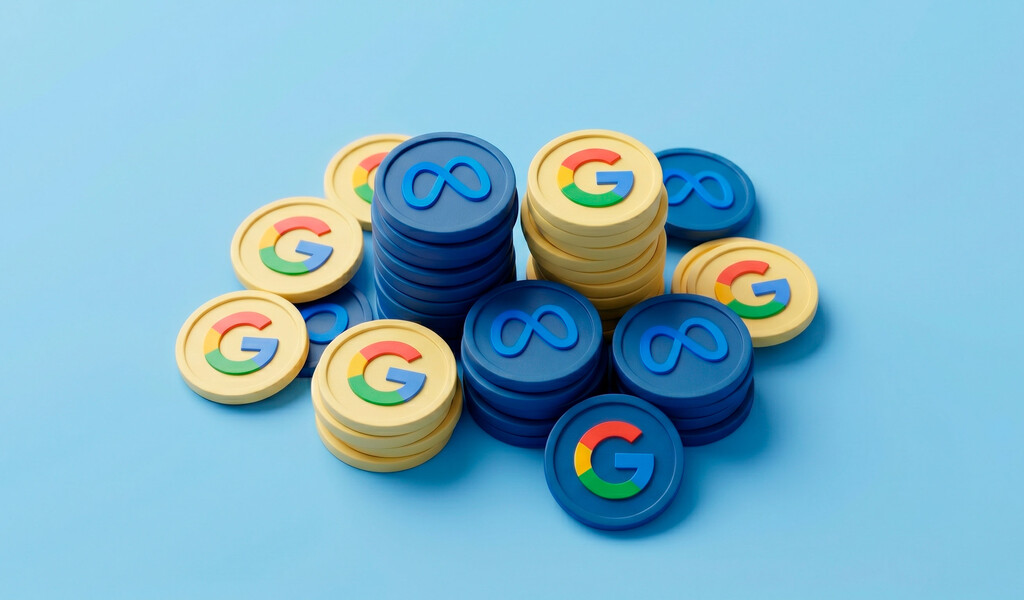
For decades, Google's dominance in digital advertising was treated less as a competitive position and more as a structural feature of the internet itself. Search intent — the moment a user actively looks for something — was the most valuable signal in advertising, and Google owned it almost entirely. That era now appears to be closing. According to projections from Emarketer, Meta is set to surpass Google in global advertising revenue for the first time in 2026, with an estimated $243.46 billion against Google's $239.54 billion.
The margin is narrow, but the symbolic weight is not. If the projection holds, it marks the end of an unbroken reign that began when Google first monetized search at scale in the early 2000s. The shift does not reflect a collapse on Google's part so much as a structural reordering of where advertising dollars flow — and why.
From Search Intent to Continuous Attention
Google's advertising model was built on a specific premise: capture the user at the moment of intent. Someone searches for running shoes, and an ad for running shoes appears. The model was efficient, measurable, and for years unmatched in return on investment. But the internet has changed beneath it. Users increasingly spend time inside closed ecosystems — scrolling feeds, watching short-form video, messaging — rather than querying a search bar.
Meta recognized this shift earlier than most and invested accordingly. Instagram Reels, Facebook's algorithmic feed, and WhatsApp's expanding commercial features have created a surface of continuous engagement where advertising is woven into the content experience rather than appended to a query. The company's aggressive deployment of artificial intelligence to optimize ad targeting — matching ads to users based on behavioral patterns rather than explicit search terms — has sharpened this advantage. Advertisers report that Meta's AI-driven tools have improved conversion efficiency, making it possible to reach high-intent audiences without waiting for them to express intent through search.
This is a meaningful conceptual inversion. Google's model assumes the user comes to the platform with a need. Meta's model assumes the platform can identify the need before the user articulates it. Both work, but the latter scales with time spent, and Meta commands more of it across its family of apps.
Google's Compounding Pressures
The projected loss of the top position arrives at a moment when Google faces pressure on multiple fronts. Regulatory scrutiny in the United States and the European Union has targeted the company's advertising infrastructure, with antitrust proceedings questioning whether Google's control over ad-serving technology constitutes an unfair advantage. These cases have not yet produced structural remedies, but they create uncertainty that can slow strategic decisions and unsettle advertiser confidence.
Simultaneously, the rise of generative AI poses an existential question for Google's core product. As AI-powered assistants provide direct answers rather than lists of links, the traditional search results page — where most of Google's ad inventory lives — risks losing relevance. Google has moved to integrate generative AI into search, but the transition is delicate: every AI-generated answer that satisfies a query without a click is a potential ad impression that never materializes.
Meta faces its own challenges, including ongoing privacy regulation and the long-term uncertainty of social media engagement trends. But its current trajectory benefits from a simpler alignment: the more time users spend inside its apps, the more inventory it has to sell, and its AI systems grow more precise with each interaction.
The gap between the two companies, if Emarketer's numbers prove accurate, would be less than two percent of revenue — close enough that a single quarter of stronger-than-expected search demand could reverse the ranking. What matters more than the precise dollar figure is the direction of the trend. The advertising market is migrating from intent-based models toward attention-based ones, and Meta is better positioned for that world than Google is today. Whether Google can reinvent its model fast enough to reclaim the lead — or whether the search paradigm itself is in secular decline — remains the central question for the industry's next chapter.
With reporting from Xataka.
Source · Xataka