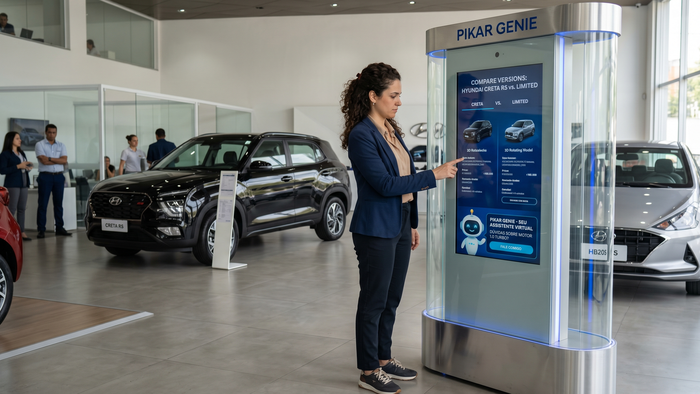
The traditional car dealership experience is defined, in most markets, by a specific kind of friction: the practiced negotiation between a buyer and a salesperson whose compensation depends on the outcome. Epikar, a South Korean technology firm, is betting that a growing share of consumers would prefer to skip that dynamic entirely. Its Pikar Genie, an AI-powered kiosk currently being tested in South Korea and the United States, is designed to digitize the discovery phase of car buying — allowing customers to compare specifications, check inventory, and resolve technical queries without the pressure of a commission-driven pitch.
The concept is not entirely new. Automakers have spent the better part of a decade experimenting with digital retail tools, from online configurators to virtual showrooms accelerated by the pandemic. What distinguishes Epikar's approach is its physical placement inside the dealership itself, occupying the space where a salesperson would traditionally stand. The kiosk does not eliminate the showroom; it restructures who — or what — the customer interacts with once inside.
A leaner showroom floor
The efficiency implications are already visible in early deployments. At a Renault dealership in Seoul, the integration of Pikar Genie has allowed the showroom to operate with just three sales staff — half the headcount typically required for a facility of its size. The AI handles the data-heavy work of feature comparisons, trim-level breakdowns, and inventory queries, while human employees are reserved for the final, legally complex stages of closing the deal and signing documentation.
This division of labor follows a pattern familiar from other sectors where AI has been introduced not as a wholesale replacement for human workers, but as a tool that absorbs the repetitive, information-intensive tasks and concentrates human effort on higher-judgment interactions. Banking saw a similar shift with the introduction of ATMs and, later, digital onboarding — branch staff shrank, but the branches themselves persisted, repositioned around advisory services rather than transactions. The dealership model Epikar envisions appears to follow the same logic: fewer people on the floor, each handling a narrower and more consequential slice of the customer journey.
For dealership operators, the arithmetic is straightforward. Labor is among the largest variable costs in automotive retail, and sales staff turnover in the industry has historically been high. A kiosk that can field routine questions around the clock, without training cycles or commission structures, represents a compelling cost proposition — provided it does not erode the conversion rates that experienced salespeople deliver.
The trust gap
Whether this model can translate globally remains an open question. Industry consultants like Fleming Ford note that the American market, in particular, still views the showroom as a space for building trust. For many buyers, a vehicle remains the second-largest purchase of a lifetime, and the consultative role of a human agent provides a psychological safety net that an AI kiosk has yet to replicate. The concern is not that customers lack access to information — most arrive at a dealership having already researched models online — but that the final commitment benefits from a human presence capable of reading hesitation, answering unscripted questions, and offering reassurance in ways that a scripted interface cannot.
Cultural expectations compound the challenge. South Korea's consumer technology adoption rates are among the highest in the world, and the country's retail environment has long been receptive to kiosk-based and unmanned service models, from convenience stores to fast-food chains. The United States, by contrast, carries a deeper tradition of relationship-driven sales in high-value categories, and regulatory frameworks around vehicle sales vary significantly by state — some still mandate human involvement at specific stages of the transaction.
There is also the question of what happens to brand differentiation. Dealerships have traditionally served as extensions of the automaker's identity, with salespeople trained to articulate a brand's value proposition in ways that go beyond specification sheets. If the discovery phase is handed to a platform-agnostic AI kiosk, the showroom risks becoming a commodity space where the differentiator is price and availability rather than narrative and experience.
The dealership of the near future may not be fully autonomous. The more likely trajectory is a leaner, hybrid environment where the salesperson is no longer a persuader but a facilitator — present for the moments that require judgment, absent from the ones that do not. The tension worth watching is whether that reconfiguration strengthens the buying experience or simply strips it down to a transaction.
With reporting from Canaltech.
Source · Canaltech