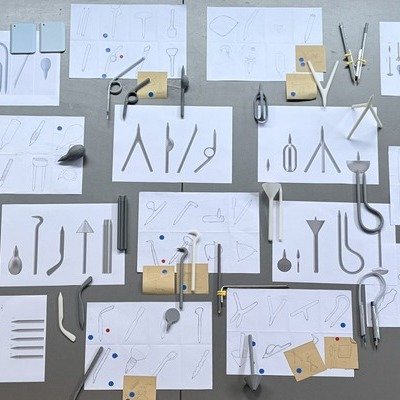
In an era dominated by the frictionless input of glass screens and mechanical keyboards, the tactile feedback of a pencil remains a stubborn, essential link between the human mind and the page. For the National Hangeul Museum in Seoul, the South Korean industrial design firm BKID has revisited this fundamental relationship through "Write, Draw, Think," a research project that deconstructs the physical act of inscription.
The project presents sixteen distinct prototypes, each a study in how form dictates gesture. By analyzing the micro-movements and habits associated with graphite and paper, BKID has produced a series of tools that challenge the standard cylindrical or hexagonal pencil. These objects are not merely aesthetic exercises; they are explorations of the pencil as a medium that translates cognitive effort into physical trace, embedding specific sensory experiences into the grip and movement of the hand.
Form as Research Method
The approach BKID has taken belongs to a tradition in industrial design known as form studies — iterative physical explorations where shape, weight, and material are treated as variables in a controlled investigation. Rather than converging on a single optimized product, form studies generate a range of possibilities, each isolating a different aspect of the user's interaction with an object. In this case, the object under scrutiny is among the oldest and most universal tools in human history: the writing instrument.
What distinguishes this project from a typical product development exercise is its institutional context. The National Hangeul Museum exists to preserve and interpret Hangeul, the Korean writing system created in the fifteenth century under King Sejong. Hangeul is widely regarded among linguists and designers for its systematic, almost modular construction — each character is composed of geometric elements that map to phonetic values. The script's structure invites a particular set of hand movements: deliberate strokes, angular transitions, and a rhythm distinct from the cursive flow of Latin or Arabic scripts. By situating the research within this specific writing system, BKID ties the ergonomics of the instrument to the biomechanics of a particular script, rather than treating handwriting as a universal, undifferentiated act.
This specificity matters. The dominant pencil form — a slender cylinder or hexagonal prism — emerged from centuries of European writing conventions and manufacturing constraints, not from any deep study of how different scripts demand different grips, pressures, or wrist rotations. BKID's sixteen prototypes implicitly question whether a tool optimized for one writing tradition serves all others equally well.
The Instrument as Cognitive Interface
The project also arrives at a moment when the relationship between handwriting and cognition is receiving renewed attention. A growing body of research in neuroscience and education has drawn connections between the physical act of writing by hand and processes such as memory retention, conceptual thinking, and creative ideation. The argument is not nostalgic — it does not claim that analog tools are inherently superior — but it does suggest that the sensory feedback loop between hand, tool, and surface activates neural pathways that typing on a keyboard does not replicate in the same way.
BKID's prototypes engage this territory from the design side. By altering the form of the instrument, each prototype changes the writer's grip, the pressure applied to the page, and the range of motion available to the fingers and wrist. In doing so, the project treats the pencil not as a commodity but as an interface — a mediating layer between intention and expression that carries its own set of affordances and constraints.
The broader implication extends beyond writing instruments. Industrial design has long grappled with the tension between standardization and specificity: mass-produced objects serve the widest possible audience, but in doing so they embed particular assumptions about the human body and its movements. BKID's form studies for the Hangeul Museum surface those assumptions by making them visible and variable. Whether any of the sixteen prototypes could or should become a manufactured product is almost beside the point. Their value lies in the questions they pose about the tools already in widespread use — and about what those tools quietly foreclose.
The instruments people use to record their thoughts are never neutral. They carry the residue of the cultures, scripts, and manufacturing traditions that produced them. BKID's project makes that residue tangible, and in doing so asks a question worth sitting with: what would writing instruments look like if they were designed from the hand outward, rather than from the factory inward?
With reporting from Core77.
Source · Core77