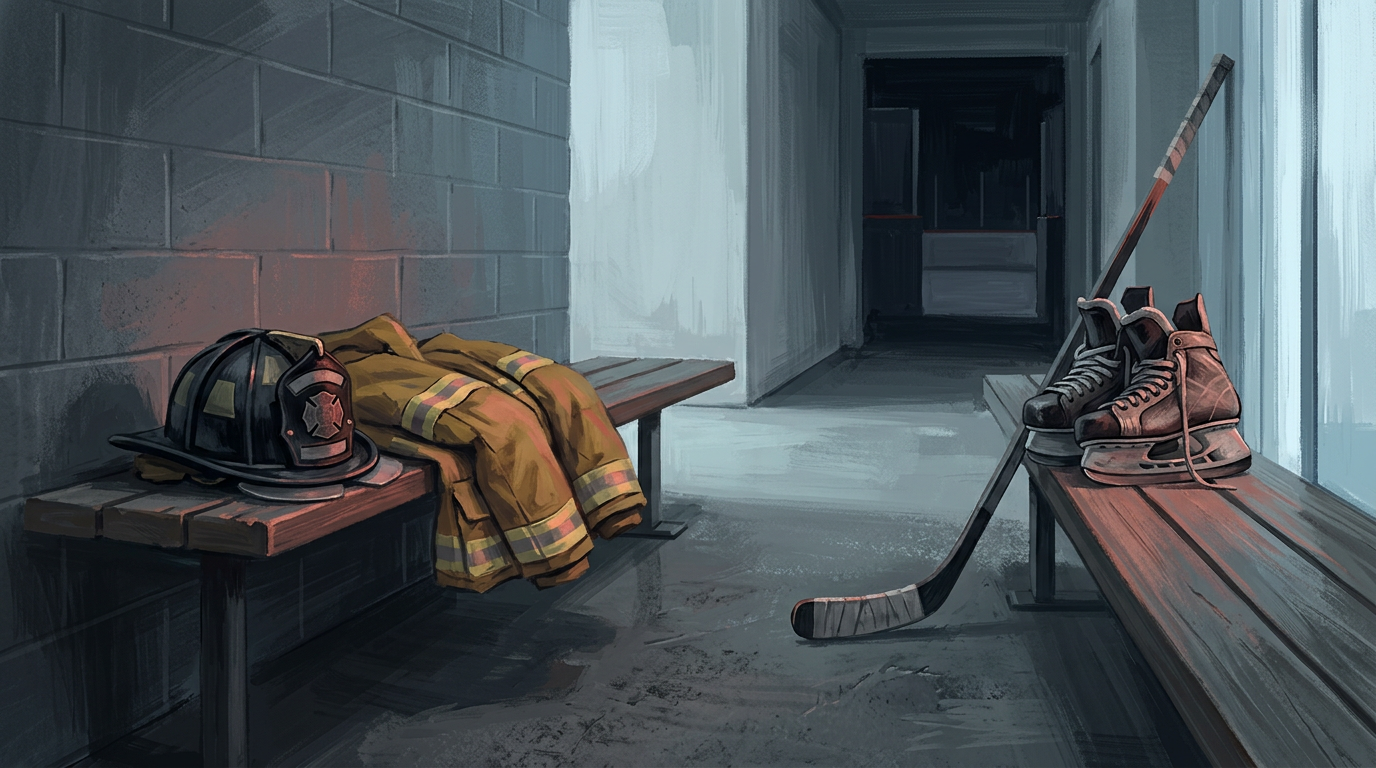
Last summer, Martin Lundberg's daily routine was defined by the weight of heavy gear and the sound of sirens rather than the scrape of skates on ice. The veteran forward, long a fixture in Skellefteå AIK's lineup, had returned to his hometown uncertain whether his professional hockey career had reached its natural conclusion. He spent those months not in a high-performance training camp but as a trainee firefighter, navigating a world of public service where the stakes are visceral and the rewards bear no resemblance to the glare of an arena.
That period of vocational transition turned out to be a quiet preamble to an unexpected comeback. Lundberg is now back on the ice with Skellefteå, positioned to secure his sixth Swedish Championship gold medal — SM-guld, as it is known in the Swedish Hockey League (SHL). If he succeeds, he will stand alone as the most decorated player in the modern era of the league, a distinction that carries particular weight in a country where hockey occupies a central place in the national sporting identity.
From firehouse to ice: the anatomy of a late-career return
Late-career comebacks in professional hockey are not uncommon, but they tend to follow a familiar script: a player retires, misses the competition, and negotiates a return within months. Lundberg's path diverges from that template. His detour into firefighter training was not a placeholder or a publicity exercise. It was, by available accounts, a genuine exploration of a second vocation — a step taken by someone who appeared to have made peace with the possibility that his playing days were over.
The return, then, carries a different texture. Athletes who step away from elite sport and then come back often speak of a shift in perspective: the game feels less like an obligation and more like a choice. Whether that psychological reset has contributed to Lundberg's effectiveness this season is impossible to quantify, but the narrative arc is difficult to ignore. A player who spent a summer learning to operate under an entirely different kind of pressure is now performing at a level sufficient to contend for the highest prize in Swedish club hockey.
Skellefteå AIK itself provides a fitting stage. The club, based in a northern Swedish city with a population that would barely fill a mid-sized arena in Stockholm, has punched above its weight for more than a decade, building a culture of sustained competitiveness in the SHL. Lundberg has been central to several of those championship campaigns, and his continued presence links the current squad to the club's most successful period.
A record in context
Five SM-guld medals already place Lundberg in rare company. Swedish hockey history is populated by players who achieved extraordinary things at the international level — names that became synonymous with NHL excellence — but domestic championship records belong to a different category. They reward longevity, loyalty, and the willingness to remain in a league that many of Sweden's most talented players leave for North America in their early twenties.
A sixth title would not merely add a line to a résumé. It would underscore a particular model of athletic career — one built on commitment to a single club and a single league, rather than on the pursuit of the largest contract or the most visible stage. In an era when player movement across leagues and continents is the norm, that kind of continuity stands out.
Meanwhile, a new generation is already absorbing the rhythms of the sport. Lundberg's six-year-old son has begun playing street hockey, imagining himself as the players he watches on the rink. For the elder Lundberg, the proximity of a potential record is balanced by this domestic continuity — a reminder that even as one career approaches its zenith, the cycle of the game begins anew elsewhere.
The question now is straightforward but unresolved: can Skellefteå deliver one more title, and can Lundberg's body and form hold through the most demanding stretch of the season? The forces at play — age against experience, a small-market club against larger rivals, a man who nearly walked away against the pull of history — make the outcome genuinely uncertain. That uncertainty, more than any record, is what makes the final act worth watching.
With reporting from Dagens Nyheter.
Source · Dagens Nyheter