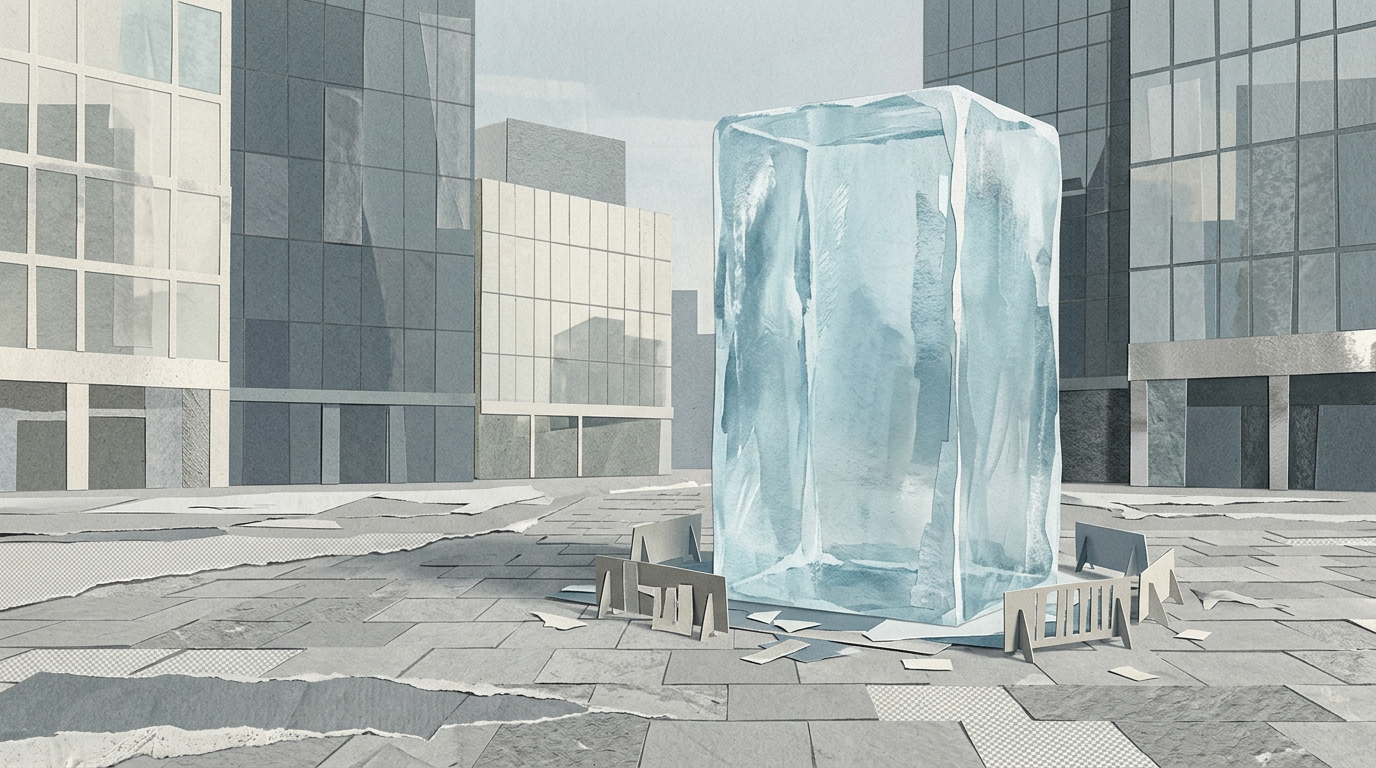
Drake has long mastered the art of the civic spectacle, turning his hometown of Toronto into a recurring stage for his brand's evolution. His latest maneuver — a 25-foot block of ice positioned in the city's center — doubles as public art, marketing event, and a statement about how major album rollouts now function. The installation served as a physical monolith that required the literal labor of the digital class to unlock its secrets, collapsing the distance between street-level spectacle and platform-native content creation.
The reveal was orchestrated through the streamer Kishka, who chipped away at the ice to find a blue waterproof bag marked "freeze the world." Inside was a book of concept art and the official release date for Drake's ninth studio album, ICEMAN: May 15. The stunt concluded with a reported $100,000 cash gift to the streamer — a gesture that underscores the increasingly professionalized relationship between major artists and the creator economy. The moment was, by design, built to be clipped, shared, and replayed across every platform simultaneously.
The Album Rollout as Physical Infrastructure
The music industry's promotional grammar has shifted several times over the past decade. Beyoncé's unannounced visual album in 2013 rewired expectations around surprise drops. Kanye West staged listening events at stadiums. Travis Scott turned Astroworld into a theme park. Each cycle raises the threshold for what qualifies as a culturally significant launch. Drake's ice installation fits squarely within this escalation, but it adds a layer that reflects a newer dynamic: the delegation of the reveal itself to a creator rather than a traditional media outlet or the artist's own channels.
By routing the announcement through a streamer rather than a press exclusive or a social media post, the ICEMAN rollout acknowledges where attention actually lives. The creator economy has matured from a parallel media ecosystem into the primary distribution layer for cultural moments. A streamer chipping away at a block of ice in real time generates the kind of unscripted, participatory content that no 30-second trailer can replicate. The reported cash gift further cements the transactional clarity of the arrangement — this is not a favor or a coincidence, but a paid activation treated with the same seriousness as a billboard campaign or a late-night television appearance.
Drake's Position After the Collaborative Pivot
ICEMAN marks Drake's first solo full-length project since 2023, following a period defined by collaborative R&B work and a high-profile lyrical feud that dominated public discourse. The pivot back to a solo album cycle carries strategic weight. Solo projects remain the primary vehicle through which artists assert creative authorship and narrative control — particularly after stretches where the public conversation has been shaped by external conflicts or joint ventures.
While the tracklist remains guarded, promotional teasers suggest a project that leans into Drake's long-established role as a global curator, with rumored appearances from Central Cee and Yeat. If those collaborations materialize, they would signal a continued interest in bridging geographic and stylistic lanes — a pattern Drake has followed since the Views era, when he began incorporating UK grime and Afrobeats influences into his production palette.
The broader question the ICEMAN rollout raises is whether the album cycle itself can still function as a dominant cultural event in a landscape increasingly fragmented by singles, short-form video, and algorithmic playlists. Drake's bet appears to be that it can — but only if the rollout is engineered to be as memorable as the music. The ice installation, the streamer partnership, the concept art book: each element treats the announcement not as a prelude to the album but as content in its own right. Whether that gravitational pull holds through release day, or whether the spectacle overshadows the work it promotes, is the tension at the center of every modern album campaign operating at this scale.
With reporting from Hypebeast.
Source · Hypebeast